

The John Locke Junior Prize is the division of the John Locke Essay Competition for younger students — candidates who are 14 or younger and will not turn 15 before 30 June of the competition year. Run by the John Locke Institute in Oxford, it asks Juniors to answer the same demanding questions as senior entrants, in a roughly 2,000-word analytical essay. Entry is free, and a strong Junior submission is one of the most credible early academic signals a 13- or 14-year-old can build.
What the Junior Prize actually is (and who can enter)
Most coverage of the John Locke competition — including, frankly, most of what you will find online — is written for the Senior division: 17- and 18-year-olds preparing for Oxford, the LSE, or top US universities. The Junior Prize is quietly different, and it is routinely overlooked. It exists specifically so that academically ambitious students who are still in middle school or early secondary school can take part on their own terms.
The headline eligibility rule is age, not year group. The Junior Prize is for candidates who are 14 or younger on the submission date and who will not turn 15 before 30 June of the competition year. (The Senior division, by contrast, is open worldwide to candidates 18 or younger who will not turn 19 before 30 June.) Because the precise cut-off dates can shift slightly year to year, confirm your exact eligibility on johnlockeinstitute.com before you start writing.
A few facts that frame how seriously this is taken: in 2025 the competition drew 63,328 entries from more than 100 countries. Essays are judged by academics from Oxford and other leading universities, and shortlisted candidates are invited to an interview and an awards ceremony in Oxford. None of that is diluted for Juniors — the bar is real, which is exactly why a good result carries weight.
| Dimension | Junior Prize | Senior division |
|---|---|---|
| Who it's for | Age 14 or younger (not 15 before 30 June) | Age 18 or younger (not 19 before 30 June) |
| Questions | The same questions as seniors | Set per subject category |
| Essay length | ~2,000 words (excludes notes/bibliography) — confirm officially | ~2,000 words — confirm officially |
| Entry fee | Free | Free |
| Judging | Oxford & other leading academics | Oxford & other leading academics |
| Shortlist reward | Interview + Oxford awards ceremony | Interview + Oxford awards ceremony |
“Same questions” is the part people miss
Here is the detail that changes everything about how a younger student should prepare: Juniors answer the same questions as seniors. There is no separate, gentler Junior question paper. A 13-year-old entering the Junior Prize is reading the identical prompt that a polished 18-year-old will tackle.
The competition spans ten subject categories — Philosophy, Politics, Economics, History, Psychology, Theology, Law, Public Policy, International Relations, and Science & Technology — alongside the Junior Prize itself. A Junior chooses a question from these prompts and writes one analytical argument in response. (The exact questions are released by the Institute each year, so check the current set on the official site rather than working from last year's.)
Two practical implications follow from “same questions”:
- Judges read for argument, not for age. Your essay is assessed as a piece of reasoning. A younger writer is not marked down for being young, but they are also not given an easier target.
- Question choice matters enormously. Some prompts assume background a 14-year-old genuinely has opinions and reading on; others lean on technical machinery (formal economics, case law) that takes years to absorb. Picking a question you can argue well beats picking the one that sounds most impressive.
In coaching younger students at Hanlin, the single biggest lever we see is not vocabulary or sources — it is choosing a question where the student already has a real, defensible point of view, and then disciplining that view into a tight argument.
How a younger student should approach a ~2,000-word essay
Two thousand words is short. That is the trap. It is far too little space to “cover” a big question, so the instinct to summarise everything is fatal. A Junior essay wins by doing one thing precisely: making a single clear claim and defending it against the strongest objection. (Treat the word limit as a hard constraint — the official figure excludes notes and bibliography, but verify the current number on johnlockeinstitute.com.)
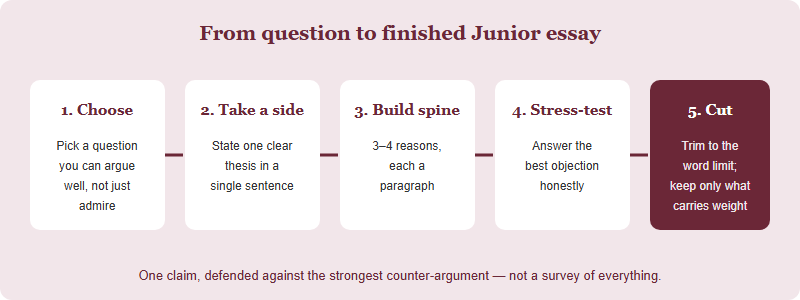
Concretely, here is what tends to separate a strong Junior essay from a competent-but-forgettable one:
- A thesis you could say out loud in one sentence. If you cannot, the essay has no spine yet.
- Reasons, not topics. Each body paragraph should advance a reason the thesis is true, not merely describe an area (“the history of X”).
- One genuine counter-argument. Younger writers often avoid objections for fear of weakening their case. The opposite is true: meeting the best objection head-on is what makes an argument look mature.
- Evidence handled honestly. A couple of well-understood, correctly attributed examples beat a wall of half-digested facts. Never fabricate quotations or sources.
- Plain, precise prose. Big words used loosely read as insecurity. Judges reward clarity.
If you want a structural starting point, our essay-coaching guides walk through how to turn a position into a defensible spine before you write a single body paragraph — a step that saves Juniors enormous amounts of wasted drafting.
Realistic expectations for a 13- or 14-year-old
Let us be honest about odds and outcomes, because false expectations do younger students more harm than good. With tens of thousands of entries worldwide, the proportion who are shortlisted or invited to Oxford is small. No one — no coach, no programme — can promise a prize, and you should be wary of anyone who does.
So what is a realistic reason to enter at 13 or 14? The value is not solely the trophy. It is the discipline of producing a real argument under real constraints, judged by real academics. That is a rare experience for a younger student, and it compounds. Treat a first Junior attempt as a serious rehearsal: a genuine attempt to win, framed honestly as the start of a multi-year arc rather than a one-shot gamble.
| Mindset | Unhelpful (sets up disappointment) | Helpful (builds capability) |
|---|---|---|
| Goal | “We need to win this year” | “We'll write the best argument we can & learn from the result” |
| Question choice | The most impressive-sounding prompt | The one where the student has a real view |
| Length | Cram in everything known | Defend one claim within the limit |
| Sources | Quantity to look learned | A few, understood and honest |
| Outcome framing | Win or it was wasted | A rehearsal that feeds future entries |
How the Junior Prize builds toward the Senior prize
The most strategic way to view the Junior Prize is as the first rung of a ladder. Because the questions are the same and the assessment standard is the same, everything a younger student learns transfers directly — argument construction, handling objections, writing to a tight limit, and the simple confidence of having done it once before.
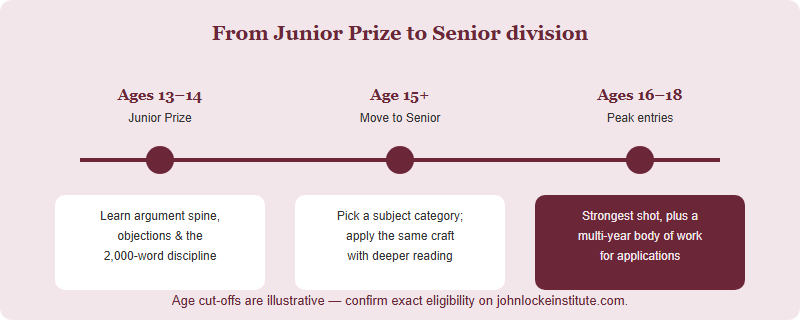
Once a student passes the Junior age window, they move into the Senior division and choose one of the ten subject categories. By then, a former Junior entrant has already internalised the hardest mechanics. They are no longer learning how to argue under pressure; they are deepening what they argue about. Across several years, that can produce a genuine body of written work — useful both for the competition itself and, later, for university applications that reward demonstrated intellectual seriousness.
A sensible long game for a younger student looks like this: enter the Junior Prize once or twice to learn the form; review the feedback honestly; then enter the Senior division in the 16–18 window when reading, subject knowledge, and writing maturity are at their peak. Our coaching track record is built on exactly this kind of patient, multi-year development — and our mentors have guided John Locke winners — rather than treating any single year as make-or-break.
Frequently asked questions
Who is eligible for the John Locke Junior Prize?
Candidates aged 14 or younger who will not turn 15 before 30 June of the competition year. Confirm exact dates on johnlockeinstitute.com.
Do Junior entrants answer easier questions?
No. Juniors answer the same questions as senior entrants. There is no separate, easier Junior question paper.
Is there a fee to enter the Junior Prize?
Entry to the John Locke Essay Competition is free. Always verify current rules and any updates on the official site.
How long should a Junior essay be?
Around 2,000 words of analytical argument, excluding notes and bibliography. Confirm the exact current word limit on johnlockeinstitute.com.
This is an independent essay-coaching guide operated by Hanlin Education for China-based international-school students. It is not affiliated with, endorsed by, or operated by the official John Locke Institute. Eligibility rules, age cut-offs, deadlines, word limits and award details can change — always confirm the current rules on johnlockeinstitute.com before entering. We correct any factual errors within 7 working days.