

The John Locke International Relations essay rewards a tightly argued answer to a contestable question about how states, institutions and power actually behave — not a news round-up. To do well you pick the prompt where you can take a clear, defensible position, anchor it in IR theory and evidence, and reason through the strongest objection. This guide walks through choosing the question, the frameworks that travel, and how to keep the writing analytical.
A quick note before we start: the John Locke Essay Competition is run by the John Locke Institute in Oxford, and International Relations is one of its ten senior subject categories (alongside Philosophy, Politics, Economics, History, Psychology, Theology, Law, Public Policy and Science & Technology), plus a Junior Prize. Of those ten disciplines, IR is the one this site had not yet covered in depth — so this is a from-scratch walkthrough of what the category asks of you and how our mentors coach students through it.
What the International Relations category actually demands
International Relations sits at the intersection of Politics, History, Economics and Philosophy, which is exactly why it is misread so often. Students assume it wants a description of a current crisis. It does not. The IR questions reward conceptual reasoning about recurring patterns: why states cooperate or defect, when institutions constrain power and when they are ignored, whether moral claims have force across borders, and how anarchy (the absence of a world government) shapes behaviour.
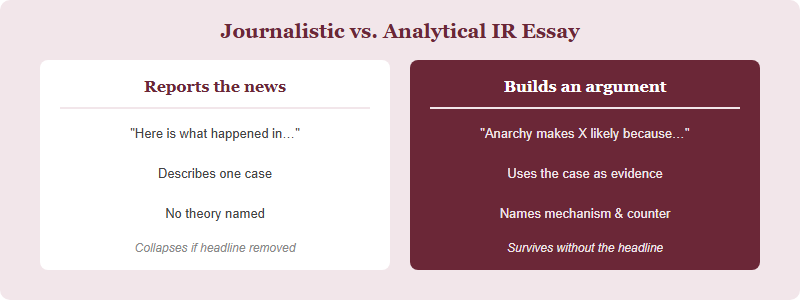
A strong IR essay reads like a structured argument, not a briefing. The marker — an academic from Oxford or another leading university — is looking for an answer to a genuinely contestable question, a position you commit to, and reasoning that survives the obvious counter-argument. The current-affairs example is the servant of the argument, never its subject. If you stripped out the news headline and the essay collapsed, the essay was never analytical to begin with.
Three habits separate a citable IR argument from a journalistic one:
- Define the contested term. Words like "power", "legitimacy", "security" and "intervention" carry different meanings in different theories. State which you are using, early.
- Name the mechanism. Don't say two states cooperated; explain why the incentives lined up — reciprocity, credible commitment, audience costs, institutional lock-in.
- Argue against yourself. The single most valuable paragraph in an IR essay is the one where you take the strongest objection seriously and show why your position still holds.
How to choose among the International Relations questions
Each year the John Locke Institute publishes a short set of questions per category. We deliberately won't reproduce the current IR prompts here — you should read them in full on johnlockeinstitute.com, because the exact wording carries the assignment. What we can teach is the selection logic, which is the same every year.
IR questions tend to fall into recognisable families. Sorting a prompt into its family tells you which evidence and frameworks it will reward, and whether you can actually deliver them in roughly 2,000 words.
| Question family | What it really tests | Pick it if you can… |
|---|---|---|
| Cooperation & conflict | Why states cooperate or defect under anarchy | Reason about incentives, reciprocity, credible commitment |
| Institutions & order | When international law / bodies constrain power | Show both a case where rules held and one where they didn't |
| Ethics across borders | Whether moral duties stop at the state line | Engage a normative argument, not just describe a war |
| Power & structure | How the distribution of power shapes outcomes | Define "power" precisely and track its effects |
| Sovereignty & intervention | Limits of self-determination vs. outside action | Hold two competing principles in tension |
Run any prompt you are drawn to through three filters before committing:
- The position test. Can you state your one-sentence answer before you start researching? If the question only invites "it's complicated", you will drift. Pick the prompt where you have a thesis you can defend.
- The evidence test. Do you already command two or three cases well enough to use them as evidence rather than narrate them? Depth in two cases beats a tour of ten.
- The counter-argument test. Can you name the strongest objection to your view right now? If you can't, you don't understand the question yet — and that is the question most likely to expose you.
Students often pick the question attached to the most dramatic current event. That is usually a trap: the dramatic case is over-written by tens of thousands of other entrants, and drama tempts you toward narration. The quieter, more conceptual prompt is frequently where an original, well-argued essay stands out. (For more on the competition's overall structure and scale, see our John Locke essay resources.)
Frameworks and sources that travel
You do not need to be an undergraduate to use IR theory well — you need to deploy a small number of frameworks accurately and know their limits. Markers reward a student who uses one lens precisely and acknowledges what it misses far more than one who name-drops five.
The major lenses, in the broadest terms:
- Realism — states pursue security and relative power in an anarchic system; institutions matter little when survival is at stake. Strong on great-power rivalry; weak on durable cooperation.
- Liberalism / institutionalism — institutions, trade and democracy can make cooperation rational and self-reinforcing. Strong on why rules persist; weaker when power overrides them.
- Constructivism — interests and identities are socially constructed; norms, ideas and legitimacy shape what states want. Strong on change over time; harder to pin to clean predictions.
- Normative / ethical theory — just war thinking, cosmopolitan vs. communitarian duties, human rights. Essential for the "ethics across borders" family.
On sources: the IR category rewards engagement with serious scholarship, not a wall of news links. A defensible reading stack for a senior essay mixes a few foundational thinkers with rigorous contemporary analysis and primary documents. Use the news to establish facts, then reach for the theory to explain them.
| Source tier | Examples of type (not a reading list to copy) | Role in your essay |
|---|---|---|
| Foundational theory | Canonical IR texts on anarchy, cooperation, just war | Provides the lens & vocabulary |
| Contemporary scholarship | Peer-reviewed journals, university-press books | Up-to-date, rigorous argument to engage or rebut |
| Primary documents | Treaties, UN resolutions, official statements, data | Hard evidence for your claims |
| Quality journalism | Reputable long-form analysis | Establishes facts only — never the backbone |
Whatever you cite, cite it honestly and precisely. The Institute judges on the quality of reasoning, and a misrepresented source — stretching a scholar to say something they didn't — reads as a weakness to an academic who knows the literature. Word-limit, referencing format and bibliography rules are set by the Institute; confirm the exact word count and formatting requirements on johnlockeinstitute.com before you submit.
Building the argument: structure over 2,000 words
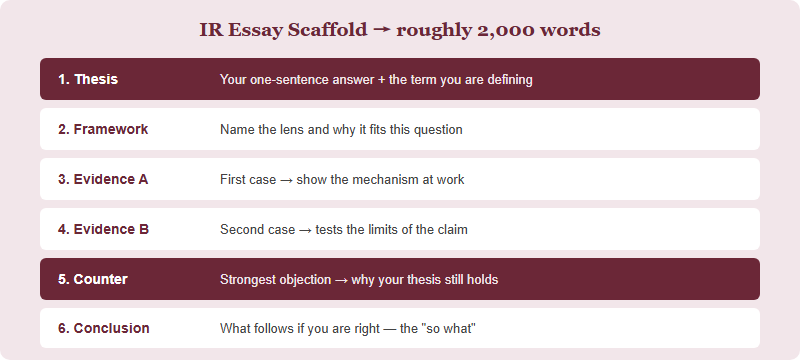
A John Locke essay is an analytical argument of roughly 2,000 words (the precise limit, which excludes notes and bibliography, is set by the Institute — check the official site). Within that budget you cannot afford a paragraph that doesn't move the argument forward. The structure below is a coaching scaffold, not a formula to fill mechanically.
A few executional points our mentors return to again and again with John Locke candidates:
- Open with the thesis, not throat-clearing. The first 150 words should state your position and the contested term. No history of the discipline, no "since the dawn of civilisation".
- Two cases, not ten. One case that confirms your mechanism and one that pressures it is worth more than a survey. The second case shows intellectual honesty.
- Make the counter-argument real. Steel-man it. A strawman you knock down easily signals you haven't met the strongest version of the other side.
- Earn the conclusion. End with the implication of your argument — what we should believe or do if you are right — not a summary of paragraphs the reader just read.
Hanlin's mentors have guided John Locke shortlisted and winning students across several subject categories, and the IR pattern is consistent: the essays that advance are the ones where the writer clearly enjoyed thinking against themselves. We coach the reasoning and the structure — we never write a student's essay, and the Institute's rules on original, individual work must be followed to the letter. If you want a sense of how we work alongside the wider competition, our essay coaching overview is the place to start.
Eligibility, format and what to confirm officially
Two practical facts that shape how you approach the IR essay — both confirmed against the John Locke Institute's published rules, with the live details always to be re-checked on the official site:
- Who can enter. The Senior division is open worldwide to candidates aged 18 or younger on the submission date (you must not turn 19 before 30 June of the competition year). The Junior division is for candidates 14 or younger (not turning 15 before 30 June) — and crucially, Juniors answer the same questions, IR included. Entry is free.
- The scale. In 2025 the competition drew 63,328 entries from more than 100 countries. That volume is the reason a quiet, well-argued IR essay beats a dramatic, narrated one — originality of reasoning is how you separate from the field.
Shortlisted candidates are invited to interview and to an awards ceremony in Oxford, and essays are judged by academics from Oxford and other leading universities. Anything time-sensitive — this year's exact questions, the precise word limit, submission and late-submission deadlines, the interview format, and award details — is set by the Institute and can change between cycles. Always confirm the current rules on johnlockeinstitute.com before you write or submit.
Q: Do I need to already know IR theory to enter the International Relations category?
No. You need to use one or two frameworks accurately and know their limits. Precise use of a single lens beats name-dropping several.
Q: Can I write about a current war or crisis?
Yes, as evidence — but the essay must answer the conceptual question, not report events. Use the case to demonstrate a mechanism, not to narrate.
Q: How long should the International Relations essay be?
It is an analytical argument of roughly 2,000 words; the exact limit excludes notes and bibliography. Confirm the precise figure on johnlockeinstitute.com.
Q: Can Junior candidates attempt International Relations questions?
Yes. Juniors (14 or younger, per the eligibility window) answer the same questions as Seniors, including the IR prompts. Entry is free.
This is an independent essay-coaching guide operated by Hanlin Education for China-based international-school students. It is NOT affiliated with, endorsed by, or operated by the official John Locke Institute. Competition questions, eligibility, word limits, deadlines and award details are set by the Institute and can change between cycles — always confirm the current rules on johnlockeinstitute.com. We correct any errors within 7 working days of notification.