
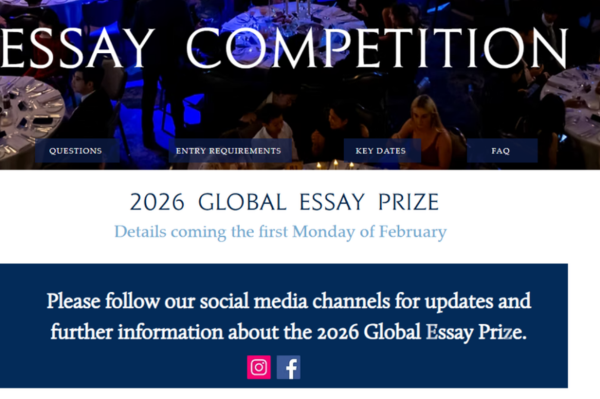
The John Locke Writing Competition has reached a registration milestone of 100,000 participants, marking its transition into a fully scaled event. In response, the organizers have implemented a systematic overhaul of the competition rules. To adapt to this restructured format, participants are advised to adjust their preparation timelines accordingly, focusing on early topic selection and literature review to better align with the new season’s requirements.
Four Core Rule Changes for the 2026 Season
Change 1: Expansion from 7 to 10 Subject Areas
The competition’s long-standing seven classic disciplines—Philosophy, Politics, Economics, History, Law, Theology, and Psychology—remain intact. This year, three new tracks have been added: Public Policy, International Relations, and Science & Technology. While these additions provide more precise focal points for interdisciplinary topics, the grading criteria for these inaugural questions currently lack historical benchmarks for reference.
Change 2: Timeline Shifted Forward by One Month
The registration window has been moved from the traditional April to late May period to February 2 – March 31. Consequently, the submission deadline has been advanced from June 30 to May 31. This shift necessitates a complete revision of preparation schedules, requiring students to begin topic selection and literature review during the winter break.
Change 3: Elimination of the Independent Junior Question Pool
In previous years, students aged 14 and under were provided with a separate set of questions. For the 2026 season, Junior participants can now choose from the full pool of ten subject areas. Although the judging process remains separate from the Senior category, the threshold for critical thinking and analytical depth has been significantly raised.
Change 4: Stricter Academic Integrity Review
The competition has explicitly mandated the use of multiple AI-generated content detection tools. Footnotes remain prohibited, and strict compliance with endnotes and reference formatting is required. Furthermore, the recommender verification process has been moved to the registration stage. Originality checks have transitioned from a post-submission sampling approach to a fully integrated, end-to-end verification system.
New English Test and Online Interview Components
English Test
- Deadline: Must be completed by June 25, 2026.
- Format: 10 questions covering grammar and vocabulary.
- Time Limit: 30 seconds per question, taking approximately 5 minutes in total.
- Access: Log in to the official John Locke website and click “Go to English Test” to begin.
Online Interview (Random & Voluntary Participation)
- Format: Online discussion lasting approximately 15 minutes.
- Content: Centers on the submitted essay, requiring candidates to articulate their writing process, academic perspectives, and engage in scholarly discussion with the judges.
- Academic Defense (25 minutes): Modeled after Oxford University undergraduate interviews. It includes a 10-minute essay presentation followed by a 15-minute Q&A session with the panel. This segment primarily assesses critical thinking, logical coherence, and on-the-spot adaptability.
- Purpose: To verify the originality of the essay and the candidate’s independent research capabilities. Performance may serve as a crucial reference for awarding top-three subject placements, Very High Commendations, and other honors.
Key Timeline for the 2026 Season
- Registration Window: February 2 – March 31
- Submission Deadline: May 31
- Late Submission Options: By June 7 (7-day extension, £25 fee) or by June 21 (21-day extension, £75 fee)
- English Test Deadline: June 25
- Results Announcement: July 7
Get FREE John Locke Preparation Materials
Scan the QR code below to access free practice papers, study guides, and past competition materials. Start preparing today!