
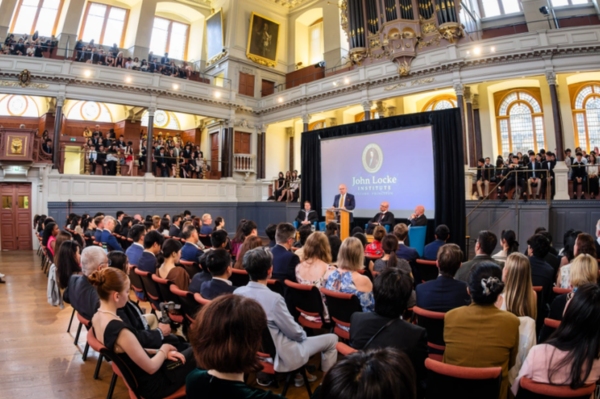
International school students in Shanghai and Beijing applying for Economics, PPE, or Finance programs face a common dilemma: highly homogenized academic backgrounds. While counselors repeatedly emphasize the need for “in-depth extracurricular activities,” few can clearly define what constitutes a truly substantial academic profile. The John Locke Institute Economics Essay Competition is one of the few opportunities that genuinely catches the attention of admissions committees.
For the 2026 season, the Economics prompts have been officially released. The submission window opens on April 1, with a regular deadline of May 31. For students in Shanghai and Beijing planning to apply to Oxford, Cambridge, LSE for Economics/PPE, or Harvard, Princeton, Stanford for Economics/Business, now is the critical time to begin preparation.
What is the John Locke Economics Competition, and Why is it Gaining Attention in Shanghai and Beijing Admissions Circles?
The John Locke Institute is an academic institution headquartered in Oxford, UK, that hosts an annual multidisciplinary essay competition for international high school students aged 14–18 worldwide. Economics is one of the most popular categories. The judging panel comprises scholars from Oxford, Cambridge, Harvard, Princeton, and Stanford. The grading criteria align with university-level academic standards: it disregards flowery language and focuses strictly on logical argumentation and the depth of applied economic analytical frameworks.
The competition is completely free to enter, and all international school students globally are eligible to register. Participants submit a single PDF essay of no more than 2,000 words. This stands in stark contrast to many commercial competitions that charge thousands of dollars in entry fees. While the free entry lowers the barrier to participation, the threshold for winning remains exceptionally high, making the awards highly exclusive.
At schools such as Pinghe, Ulink, and SMIC in Shanghai, and Beijing No.4 High School International Division, Huijia, and Keystone in Beijing, an increasing number of students are including John Locke awards in their university applications. According to 2025 competition data, 76 students won awards across multiple disciplines, with the number of Economics award recipients continuing to grow steadily.
How Valuable are the John Locke Economics Awards, and What Advantages Do They Offer Compared to Other Competitions?
In terms of awards, the John Locke Economics Competition features a Grand Prize ($10,000), First Prize per subject ($5,000), Second Prize ($2,000), and Third Prize ($1,000). Additionally, there are three tiers of commendations: Very High Commendation (approximately top 1% globally), High Commendation (approximately top 3%), and Commendation (approximately top 16.9%).
For applicants in Shanghai and Beijing, the core value of the John Locke Economics Competition extends far beyond the prize money. It sends a powerful signal to admissions officers: your essay demonstrates the ability to apply rigorous economic methodologies to real-world problems. This is something that standardized test scores simply cannot replicate.
When interviewing for Oxford Economics/PPE, interviewers often ask directly: “What analytical framework did you use in this essay?” Having a well-structured, award-winning John Locke essay provides a concrete academic writing example to confidently address this question. For Beijing students applying to top US universities, the John Locke essay serves as the most direct evidence of “intellectual curiosity” for the Common App or personal statement.
What Core Competencies Do the Three 2026 Economics Prompts Assess?
The 2026 Economics category features three prompts, and each participant must choose one to answer.
Prompt 1: Should we be worried about a cashless society? On the surface, this appears to be a policy evaluation question. In reality, it tests the ability to comprehensively analyze the externalities of payment systems, financial exclusion, and monetary policy transmission mechanisms. A strong response must distinguish between “short-term convenience” and “long-term systemic risk,” using economic frameworks to define the conditional boundaries of “worry” versus “no worry,” rather than simply stating a position.
Prompt 2: What would be the impact if personalized pricing were widely adopted? This is a classic application of price discrimination theory. It requires distinguishing between first-degree, second-degree, and third-degree price discrimination, analyzing the transfer of consumer surplus, the increase in producer surplus, and the role of information asymmetry. High-scoring essays typically extend the discussion to the long-term impact of dynamic pricing on market competition structures, as well as the trade-off between privacy rights and economic efficiency.
Prompt 3: Did Jeff Bezos get rich by exploiting customers, employees, both, or neither? This prompt assesses the ability to distinguish between monopoly rents and value creation. Students must apply theories such as market power, monopsony, and two-sided platform markets to analyze how much of Amazon’s wealth accumulation stems from productive innovation, how much from competitive price suppression, and how much from unequal bargaining power in the labor market.
The common grading standard across all three prompts is: avoid static “good/bad” judgments and demonstrate dynamic perspectives and mechanism analysis. A frequent mistake among students in Shanghai and Beijing during preparation is writing economics essays that read like policy commentary, lacking precise descriptions of incentive structures and transmission pathways.
Recommended Preparation Timeline for Shanghai and Beijing Students
The 2026 competition schedule is as follows: the submission window officially opens on April 1, with a regular deadline of May 31 and a late deadline of June 21. It is highly recommended to allocate at least 6–8 weeks for preparation.
For students in Shanghai and Beijing, we recommend the following phased approach. Phase 1 (2–3 weeks): Systematically study the core economic theories related to your chosen prompt, establish an analytical framework, and review relevant academic literature and policy reports. Do not rush to write; first ensure you know exactly which “analytical toolkit” to apply when you see the prompt. Phase 2 (2 weeks): Construct your essay outline and draft a complete version. Focus heavily on the rigor of your argumentative chain, ensuring every conclusion is supported by economic mechanisms rather than intuition. Phase 3 (1–2 weeks): Polish the academic writing format, including proper citation standards, accurate terminology usage, logical paragraph transitions, and strict adherence to the 2,000-word limit.
Experience from 2025 award-winning students indicates that those who undergo systematic framework training typically revise their drafts 3–4 times from the initial version to final submission. This structured approach significantly increases the probability of earning a Very High Commendation compared to unguided self-study.
For students in Shanghai and Beijing aiming for top-tier universities in Economics, the John Locke Economics Competition is one of the most strategic writing competitions to prioritize for the 2026 application cycle. With the regular deadline of May 31 approximately two months away, starting your preparation now represents the ideal window of opportunity.
Get FREE John Locke Preparation Materials
Scan the QR code below to access free practice papers, study guides, and past competition materials. Start preparing today!