
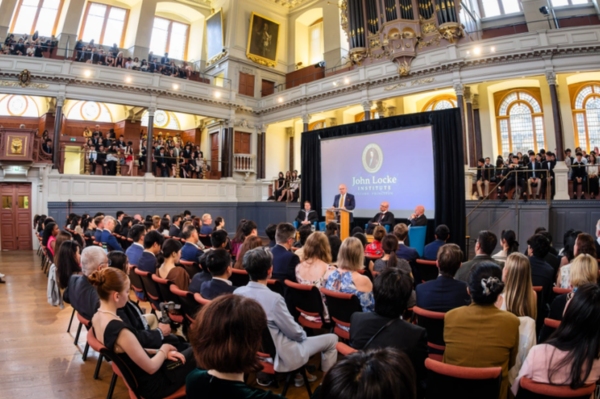
Looking back at the 2025 season of the globally renowned John Locke Essay Competition, widely regarded as the pinnacle of humanities and social science academic contests, global participation surpassed 60,000, marking unprecedented competitive intensity. Official social media channels have announced that the 2026 season has already attracted 100,237 registered participants.
2021-2025 Participation Statistics
The John Locke Essay Competition is universally recognized as the premier academic credential in the humanities and social sciences, closely monitored by admissions officers at Ivy League and G5 universities. Achieving a Distinction in this competition can significantly enhance undergraduate application success rates in both the United States and the United Kingdom. Past participants have secured admissions to world-class institutions including Princeton, Harvard, Yale, Stanford, University of Chicago, UC Berkeley, Oxford, and Cambridge.
Source: John Locke Official Website
2026 John Locke Competition Rule Changes
01 Three New Independent Categories Added
Building upon the original seven classic disciplines of Philosophy, Politics, Economics, History, Law, Theology, and Psychology, this year’s competition introduces three cutting-edge fields: International Relations, Public Policy, and Science & Technology, forming a comprehensive ten-discipline matrix.
02 Updated Question Release Format
The competition introduces an interactive question release model. The official committee will conduct global voting via social media, allowing participants to collectively determine the order in which prompts are revealed. From a pool of 30 candidate questions, 10 will be released in batches, while the remaining prompts will be officially unveiled on February 1.
03 Strengthened Academic Integrity Review
- Implementation of multiple AI probability detection models.
- Strict prohibition of footnotes, standardized citation formats, and enhanced referee verification processes.
Competition Timeline
- Submission Period: Opens April 1, 2026. Final deadline: May 31, 2026.
- Late Submission: Extended to June 7 (7-day extension, £25 fee) or June 21 (21-day extension, £75 fee).
Results & Follow-up
- Shortlist Notification: July 7, 2026.
- Academic Conference: October 2–4, 2026.
- Awards Dinner: October 3, 2026.
Official Question Analysis & Preparation Strategies
2026 John Locke Official Full Question Analysis & Prep Guide:
Part 1. Economics
Q1. Should we fear a cashless society?
Q2. Technology now allows personalised pricing. If this came to be widely used, what effects should we expect?
Q3. Did Jeff Bezos get rich at the expense of his customers, his employees, neither or both?
Preparation Strategy: Avoid purely theoretical deductions and embrace real-world economics. For Q2, do not merely discuss consumer surplus; instead, delve into information asymmetry in the big data era. Q3 requires students to find a logical balance between economies of scale and labor rights.
Part 2. History
Q1. “The arc of the moral universe is long, but it bends toward justice.” Is it? Does it?
Q2. What might the world look like if the Library of Alexandria didn’t burn down?
Q3. Does Che deserve his iconic T-shirt?
Preparation Strategy: Beware of mere storytelling; focus on historiography. Q2 is a classic counterfactual reasoning exercise examining how the dissemination of knowledge drives civilization. Q3 explores the symbolization and commodification of historical figures.
Part 3. International Relations (New Category)
Q1. Does foreign aid help or hurt poor people?
Q2. Is the US economy harmed by cheap imports from China?
Q3. Should a coalition of countries (or of billionaires) run an experiment with a libertarian microstate?
Preparation Strategy: Shift to a great power competition perspective. Q1 requires exploring the aid trap and institutional building. Q2 necessitates a structured analysis of interest distribution using the Stolper-Samuelson theorem. Q3 examines challenges to the fundamental nature of national sovereignty.
Part 4. Law
Q1. If legislators and judges all accepted the philosophical theory of determinism, what would be the effect on criminal sentencing?
Q2. To what extent should criminal sentencing take into account the effect on the perpetrator’s family?
Q3. Is trial by jury obsolete?
Preparation Strategy: Elevate thinking from rule-based logic to jurisprudence. Q1 questions the foundation of law: free will. Q3 requires argumentation integrating AI in the judiciary, expert decision-making, and the dynamics of civic participation.
Part 5. Philosophy
Q1. Is it ever wrong to do the right thing for the wrong reasons?
Q2. What consolations does philosophy offer?
Q3. Why is incest wrong?
Preparation Strategy: Pursue extreme logical coherence. Q1 examines the conflict between virtue ethics and consequentialism. Q3 requires students to move beyond visceral disgust and use rational frameworks (such as social contract theory or evolutionary psychology) to reconstruct moral taboos.
Part 6. Politics
Q1. Is the right to self-determination absolute?
Q2. Did the pandemic normalise authoritarianism?
Q3. Is democracy in crisis?
Preparation Strategy: Capture the fractures in contemporary institutions. Q2 requires analyzing the administrative inertia of emergency powers. Q3 demands deep reflection on how information echo chambers impact representative democracy.
Part 7. Psychology
Q1. Why do we care what happens to our body after death?
Q2. Is mental illness over-diagnosed now, or just better recognised?
Q3. Surveys show a widening gender ideological gap in recent years. Why?
Preparation Strategy: Focus on the interaction between individual psychology and social structures. Q3 requires a socio-psychological analysis combining social media algorithms with trends in value polarization.
Part 8. Public Policy (New Category)
Q1. What discount rate should be applied to long-run environmental policies? Why?
Q2. Which unintended consequence was most devastating and why did we fail to predict it?
Q3. Should vaccination be mandatory in a public health emergency?
Preparation Strategy: Adopt a policymaker’s perspective. Q1 tests intergenerational justice: what is the present value of the environment 100 years from now? Q2 assesses deep understanding of complex social systems.
Part 9. Science & Technology (New Category)
Q1. What discount rate should be applied to long-run environmental policies? Why?
Q2. Which unintended consequence was most devastating and why did we fail to predict it?
Q3. Should vaccination be mandatory in a public health emergency?
Preparation Strategy: Explore human agency and technological boundaries. Q3 superficially tests etiquette but fundamentally examines anthropomorphic ethics: will our attitudes toward AI inversely shape our own personalities?
Part 10. Theology
Q1. Is religious experience better explained by neuroscience or by theology?
Q2. Research shows a strong inverse correlation between religiosity and per-capita spending on education. Does one cause the other?
Q3. If you achieve enlightenment, how will you know?
Preparation Strategy: Facilitate a dialogue between empirical science and a priori belief. Q1 examines whether physical reductionism can explain the spiritual world. Q2 is a rigorous social science statistical analysis question.
Get FREE John Locke Preparation Materials
Scan the QR code below to access free practice papers, study guides, and past competition materials. Start preparing today!