
The John Locke Essay Competition is not the only serious essay competition open to international-school students — and the smartest candidates rarely enter only one. John Locke offers the broadest subject range and the largest scale; economics-focused contests like the LSESU Essay Competition and HIEEC, the HIR Academic Writing Contest in global affairs, and the NYT student writing contests each reward different lengths, styles and calendars. Here is how they compare, and how to sequence two or three into a coherent portfolio.
Why think in portfolios, not single entries
An academic essay competition is a training cycle: you read deeply, build an argument, compress it to a word limit, and submit it to independent judges. Each cycle makes the next one better — the skills compound. Entering two or three well-chosen competitions across a school year therefore costs far less than double or triple the effort of one, because the reading base and argumentative discipline carry over. What does not transfer automatically is format: a 2,000-word philosophical argument, a 1,500-word economics essay and an 800-word analytical piece are genuinely different crafts.
The portfolio logic also manages risk honestly. Every serious competition has a low win rate — John Locke alone drew 63,328 essays from 100+ countries in 2025, and entries have grown since. Spreading well-prepared entries across complementary competitions raises the chance that at least one piece of your best work gets recognised, without any single result carrying your whole year. What a portfolio does not do is guarantee anything: no competition result, singly or in combination, assures admission anywhere.
The comparison: five competitions side by side
Details below reflect recent cycles; every competition adjusts rules year to year, so confirm current requirements on each organiser’s official site before planning around them.
| Competition | Subjects | Typical length | Entry cost | Typical deadline window | Distinctive feature |
|---|---|---|---|---|---|
| John Locke Essay Competition (John Locke Institute, Oxford) | 10 categories: Philosophy, Politics, Economics, History, Psychology, Theology, Law, Public Policy, IR, Sci&Tech + Junior | ~2,000 words | Free to enter (confirm current terms) | Around end of June | Broadest subject range; shortlisted candidates involved in interview/awards phase at Oxford; random interviews added in 2026 |
| LSESU Economics Society Essay Competition | Economics only | ~1,500 words | Free | Around 1 September | Questions set around LSE faculty research themes; direct submission, no registration step |
| HIEEC (Harvard Undergraduate Economics Association) | Economics only | 1,500 words (strict) | Entry fee applies (approx. $20–30 recent cycles) | Around early January | Four set prompts; top essays reviewed at faculty level; run by a Harvard student society, not Harvard University |
| HIR Academic Writing Contest (Harvard International Review) | International affairs / global issues | 800–1,200 words | Fee-based (confirm current) | Three cycles per year | Shorter analytical format; finalists defend their essay orally on a “Defense Day” |
| NYT Learning Network contests | Rotating: editorial, review, STEM writing, narrative, open letter, etc. | Very short (often 450–600 words) | Free | Multiple contests across the school year | Journalistic rather than academic register; huge entry volumes; strong for younger students building fluency |
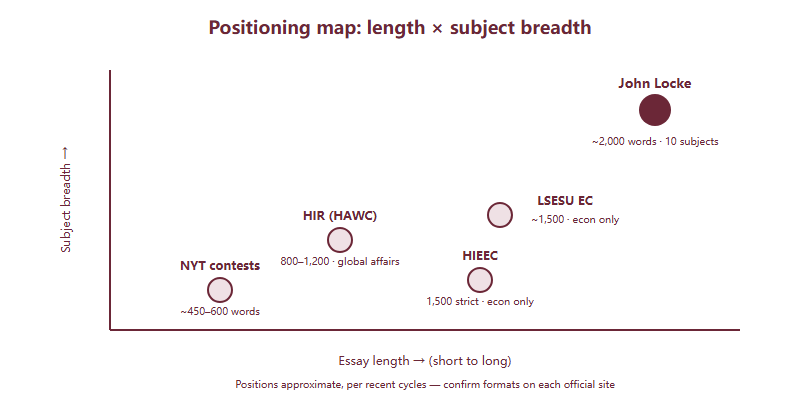
Three structural contrasts stand out. Breadth: John Locke is the only one covering ten academic disciplines — a history or theology student has no equivalent alternative at this scale. Length: John Locke’s ~2,000 words is the longest format here, which rewards sustained argument; if the word limit is your struggle, our guide to how a winning 2,000-word argument is built shows how the space is actually used. Verification: John Locke has moved visibly toward authorship verification, adding random interviews in the 2026 cycle — write only what you can defend in conversation.
Which competition fits which student
- Philosophy, history, law, psychology or theology students: John Locke is effectively the flagship option — the economics-only and current-affairs contests don’t cover your discipline. Go deep on one John Locke category rather than wide.
- Economics students: you have the richest portfolio menu. A John Locke Economics (or Public Policy) essay, an LSESU entry, and possibly HIEEC form a natural ladder — three different word limits, three different judge audiences, one shared reading base.
- Geopolitics and Model UN students: pair a John Locke International Relations essay with the HIR contest’s shorter analytical format. The long essay trains depth; the 800–1,200-word format trains compression. Start with our IR category guide for the John Locke side.
- Younger students (14 and under): the John Locke Junior Prize plus one or two NYT contests is a sensible first-year portfolio: the Junior Prize introduces academic argument, while NYT contests build fluency in short, punchy prose without fees.
Sequencing a school year without burning out
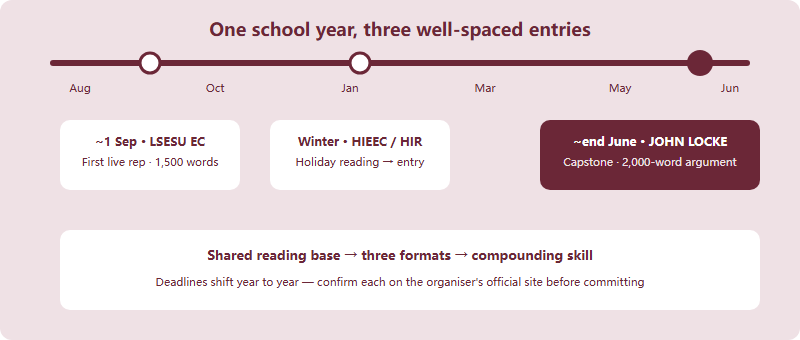
The calendars mesh better than they first appear. A workable sequence for an ambitious Year 11/Grade 10–11 student:
- Summer–autumn: foundation reading in your discipline; if economics, submit LSESU around its early-September deadline as the first live rep of the year.
- Winter: a January-deadline entry (HIEEC for economists; an HIR cycle for IR students) turns holiday reading into a submission.
- Spring–early summer: the John Locke essay as the year’s capstone — longest format, deepest argument, built on everything the earlier entries taught you.
The rule we enforce with our own students: never let a second competition dilute the first. If the calendar forces a choice, prioritise the entry where your reading is deepest. In the 2026 cycle, Hanlin-supported students earned 86 John Locke shortlist places and 76 global awards (per Hanlin records, de-identified); the consistent pattern behind those results was depth in one well-chosen question, not volume of entries.
An honest word on admissions value
Essay competitions are evidence of intellectual initiative — they show a student reading and arguing beyond the syllabus, which admissions readers in the UK and US can weigh alongside everything else. That is real, and it is also the ceiling of the claim: no award, from John Locke or anywhere else, guarantees an offer, and a competition entered purely as a credential tends to produce exactly the kind of generic essay that wins nothing. The portfolio approach works because each entry is a genuine cycle of reading and thinking; the recognitions, when they come, are a by-product of that work rather than its purpose.
FAQs
Is John Locke harder than the other essay competitions?
It is the longest format with the broadest field — 63,328 entries in 2025 — but “harder” depends on fit. Economics-only contests can be equally demanding within their niche.
Can I adapt one essay for several competitions?
Reading and ideas transfer; finished essays usually don’t. Word limits, prompts and originality rules differ, and most organisers require work written for their specific questions. Check each rulebook.
How many competitions should I enter in one year?
Two or three well-spaced entries is the practical ceiling for most students. Depth in one question beats volume — never let a second entry dilute your strongest one.
Do these competitions guarantee admissions advantages?
No. Awards signal initiative and academic writing ability, which admissions readers may value, but no competition result guarantees any admissions outcome.
This is an independent guide operated by Hanlin Education for China-based international-school students. We are not affiliated with, endorsed by, or sponsored by the John Locke Institute, nor by any other competition organiser mentioned. Rules, fees, word limits and deadlines change between cycles; confirm current details on johnlockeinstitute.com and each organiser’s official site. Factual errors reported to us are corrected within 7 working days.