

Yes, you can draw on Mencius, Zhuangzi or a case from Chinese history in a John Locke essay, and for a China-based student it can be a genuine advantage. The advantage appears only when the reference does work your argument would otherwise lack: a rival model, an internal critic, a sharper version of the problem, or evidence most entrants have never studied. Used as cultural colour, it costs words and earns nothing.
Students who read classical texts at school often ask whether that background is an asset or a distraction in an English-language essay competition. It can be either. The difference lies not in the source but in the job it is given, and that is something you can test before you draft.
What the Rules Say, and What They Leave Open
Per the Institute, only essays written in English are considered, in American or Commonwealth English used consistently, and entrants should give sources for factual claims and acknowledge the authors they rely on. The Institute’s competition page does not address sources in other languages. Nothing forbids a Confucian text or a Chinese policy case, and nothing gives such material special credit. It is judged against the same stated criteria as everything else: knowledge and understanding of the relevant material, the competent use of evidence, quality of argumentation, originality, structure, writing style and persuasive force. Rules can change between cycles, so confirm them on johnlockeinstitute.com.
Three of those criteria cut both ways. Originality can rise, because the Institute describes a field of tens of thousands of essays from more than 150 countries, and the same handful of Western examples recurs across it. Knowledge and understanding can fall if a term goes unexplained or a passage is quoted from memory. Persuasive force depends on whether a reader who has never opened the text can see why it matters to your answer.
The integrity rules add a practical test. Each contestant must name an academic referee familiar with their written work, and per the Institute some candidates are invited to an online interview. If your argument leans on a passage of classical Chinese, you should be able to explain the passage, the translation you used and why it supports your claim, without notes.
Four Jobs a Chinese Source Can Do
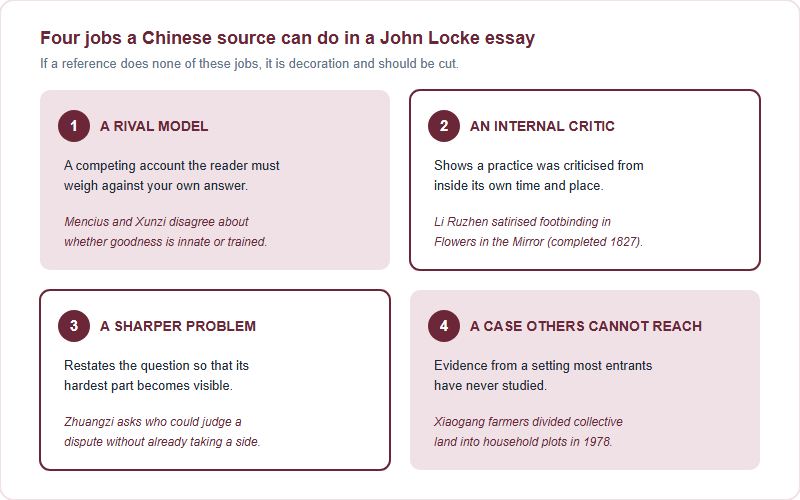
A rival model gives the reader a competing account to weigh against yours. Mencius argued that anyone who suddenly saw a child about to fall into a well would feel alarm and compassion, and read that reaction as evidence of innate moral “sprouts”; Xunzi replied that goodness is produced by deliberate effort and training. For an essay on moral education, punishment or human nature, that dispute is a ready-made pair of opposing positions with centuries of commentary behind it. The well story can be summarised in two sentences, which makes it practical for younger writers too — our Junior Prize guide covers how that route differs.
An internal critic shows that a practice was criticised from inside its own time and place, which matters whenever a question turns on whether we can fairly judge the past. A sharper problem restates the question so its hardest part becomes visible. A case others cannot reach supplies evidence from a setting most entrants never studied: the 1978 agreement in which farmers in Xiaogang village divided collective land into household plots is a standard reference point in accounts of China’s rural reforms, and a natural test for claims about incentives and ownership.
Three Past Questions, Three Chinese Resources
The Institute’s website publishes a selection of past essays. Three questions shown there illustrate how the jobs work in practice. The table is our illustration of how a resource could be used, not a model answer, and none of these questions will necessarily be set again.
| Past question | Chinese resource | Job | What it lets you argue | Objection you then owe |
|---|---|---|---|---|
| History: “Should we judge those from the past by the standards of today? How will historians in the future judge us?” | Li Ruzhen’s novel Flowers in the Mirror (completed 1827) satirises footbinding by subjecting a male character to it | Internal critic | “They could not have known better” fails where contemporaries plainly did know better | One satirist is not a society: show the criticism was more than isolated |
| Theology: “If you cannot persuade your intelligent, sympathetic friends to embrace your religious belief system, do you have enough reason to believe what you believe?” | Zhuangzi’s “Discussion on Making All Things Equal” asks who could judge a dispute without already agreeing with one side | Sharper problem | Failing to persuade may show there is no neutral judge, not that the belief lacks reasons | The same scepticism can be turned on your own position |
| Law: “Should ‘innocent until proven guilty’ apply not only to courts of law, but also to public censure?” | Analects 2.3 contrasts governing by punishments with guiding by virtue and ritual, so that people develop a sense of shame | Rival model | Social shame can be a legitimate means of correction, so the real question is what standards it needs | Online “human flesh search” campaigns show shaming with no standard of proof at all |
Notice that each resource creates an objection as well as an argument. That is a feature, not a flaw. The Institute states that essays which ignore or fail to address the strongest objections are unlikely to succeed, and a resource that brings its own complication hands you an honest objection to answer rather than a straw one. The broader architecture of claim, objection and reply is laid out in our breakdown of how a winning John Locke essay is built.
Five Ways a Chinese Reference Goes Wrong, and the Test That Catches Them
- The tourist brochure. Presenting a tradition as ancient or exotic without using it. Age is not an argument.
- The “China too” parallel. “Confucius said something similar.” A parallel that changes nothing in your reasoning is decoration, however learned it sounds.
- The essentialist generalisation. “Chinese culture believes…” No tradition speaks with one voice: Mencius and Xunzi disagreed about human nature, and the Mohists attacked Confucian partiality. Name the thinker, not the civilisation.
- The unglossed term. Pinyin left unexplained, or explained with a paragraph of background. One plain sentence per term is the budget.
- The position statement. Using the essay to express national pride or national criticism. On the current politics of any country, an essay needs scholarly evidence and a claim a reader could test, not a stance.
The essentialist and position-statement risks are highest in International Relations, where it is tempting to treat any country as a single actor holding a single view; the level-of-analysis discipline in our International Relations guide is the corrective. In every category, run the four checks below on each reference before it stays in the draft.
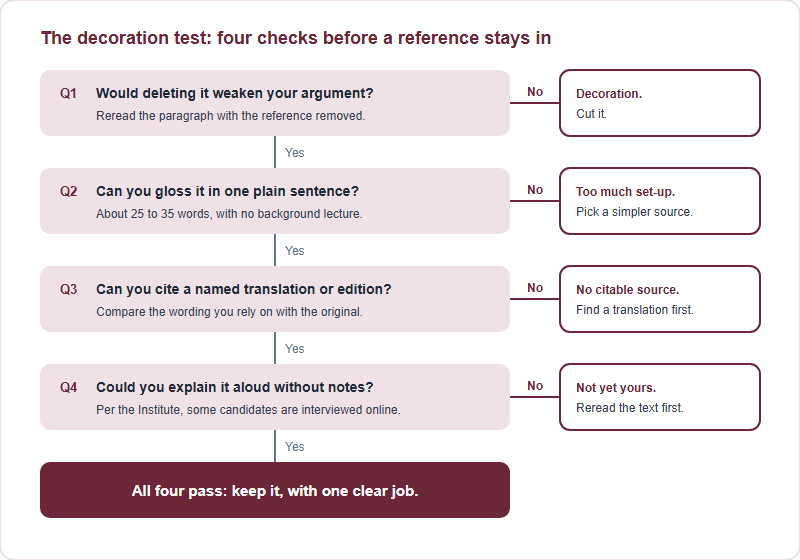
Sourcing is the check students skip. Where a published English translation exists, cite it by translator and edition — widely used examples include D.C. Lau’s Mencius, Burton Watson’s Zhuangzi, Edward Slingerland’s Analects and Eric Hutton’s Xunzi — and compare the wording you rely on with the original. If you use Chinese-language scholarship, give its original title with an English translation in your bibliography. That is ordinary academic practice rather than an Institute rule, so confirm current referencing expectations on johnlockeinstitute.com.
Then count the cost. A term and its one-sentence gloss take roughly 25 to 35 words. Per the Institute’s rules, footnotes are not allowed but endnotes and a bibliography are, and neither counts towards the word limit, while in-text citation styles such as APA are counted — so naming the translation in an endnote costs you nothing. A reference that needs more than about 80 words of set-up before it does any work is usually the wrong reference.
What It Adds to an Application
An essay is one document in a file, and an admissions reader checks it against the rest: the transcript, the activity list, the personal statement, a teacher’s reference. A John Locke essay that draws on Chinese thought is most convincing when the same interest appears elsewhere in that file — a Chinese literature course, a school reading group, an Extended Essay on a related text — because the pieces corroborate one another and the whole profile becomes more believable. A Chinese angle bolted on for novelty does the opposite. It becomes the one element nothing else in the file supports.
For context, Hanlin’s de-identified 2026 John Locke record is 86 shortlisted essays and 76 global awards — our own figures, not an official statistic, and not a claim that any particular technique produced them. What we coach towards is simple to state and hard to do: use the resources you genuinely know, and make each one earn its place in the argument.
Questions Students Ask
Can I cite Chinese-language sources in a John Locke essay?
The essay must be in English, and the rules page does not address other-language sources. Cite a named translation where one exists.
Will markers understand references to Mencius or Zhuangzi?
Write for an intelligent non-specialist: gloss each term in one plain sentence and show what it does for your answer.
Does a Chinese example make an essay more original?
Only if it does argumentative work. An unexplained reference reads as decoration, and originality is judged in the argument.
How many Chinese references should one essay use?
Usually one or two, each with a clear job. More than that tends to turn an argument into a survey of traditions.
This is an independent guide operated by Hanlin Education for China-based international-school students. We are not affiliated with, endorsed by, or sponsored by the John Locke Institute. Rules, dates, word limits and eligibility change between cycles — confirm current details on johnlockeinstitute.com before you rely on anything here. Errors reported to our editorial desk are corrected within 7 working days.