
A thought experiment earns marks in a John Locke essay when it isolates the one feature your thesis depends on, tells the reader what verdict it is meant to produce, and survives the obvious objection that an invented case proves nothing. An analogy earns marks when you have audited its differences before the marker does. Used any other way, both devices spend scarce words on vividness and hand the reader a ready-made counter-argument.
The stakes follow from the Institute’s stated criteria: knowledge and understanding of the relevant material, the competent use of evidence, quality of argumentation, originality, structure, writing style and persuasive force. Its rules add a warning worth taking literally — essays which ignore or fail to address the strongest objections and counter-arguments are unlikely to be successful. An invented case invites the reply that it is artificial; a comparison invites the reply that it is disanalogous. Use either without pre-empting that reply and you have drafted the marker’s objection for them.
Two practical pressures sharpen the risk. Space: per the Institute’s published rules, the essay body is capped at 2,000 words, with diagrams, tables of data, endnotes and bibliography excluded, and a case costs 60 to 120 words before any analysis. Crowding: the Institute describes tens of thousands of submissions from more than 150 countries, so the famous cases appear in many essays besides yours. With 2026 entries closed, practise the technique now, and confirm current rules on johnlockeinstitute.com.
Three Jobs a Thought Experiment Can Do, and One It Cannot
Decide which job you need before choosing a case, and expect the marker’s question that comes with it.
| Job | Classic case | What it does | Most useful in | The marker’s question |
|---|---|---|---|---|
| Isolate a variable | Robert Nozick’s experience machine (1974) | Separates pleasant experience from real contact with the world | Philosophy, Psychology, Science & Technology | Is experience really the only thing that differs between the two lives? |
| Test a principle by counterexample | Peter Singer’s drowning child (1972) | Asks whether physical distance weakens a duty to rescue | Philosophy, Politics, Public Policy | Does your real-world case differ in more than distance? |
| Make a procedure concrete | John Rawls’s veil of ignorance (1971) | Shows what choosing rules without knowing your own position would involve | Politics, Economics, Law | Why should choices made behind the veil bind people who never stood behind it? |
| Establish an empirical fact | None — thought alone cannot do this job | Can frame the question that evidence must then answer | Psychology, Science & Technology, as a warning | What does the research actually show? |
The last row has a fitting illustration. William Molyneux put a puzzle to John Locke, who discussed it in the second edition of An Essay Concerning Human Understanding (1694): would someone born blind, who could tell a cube from a sphere by touch, recognise them by sight on first seeing them? Locke reasoned that they would not. In 2011, Richard Held and colleagues reported in Nature Neuroscience that newly sighted patients treated through Project Prakash in India could not at first match felt objects to seen ones, though they learned to do so quickly. The lesson is exact: a thought experiment can sharpen an empirical question, but only evidence answers it.
Borrowed or Built: How to Construct a Case
A borrowed case arrives with a literature whose replies you can cite. But restating a famous case adds little, and a marker who has met it many times will not be moved by one more summary. A built case is where originality can live, provided it stays minimal — two versions of a situation that differ in exactly one feature, so any change in the reader’s verdict can be traced to that feature. Often the strongest option is a hybrid: keep a famous structure, change one detail, and make it test your claim rather than the original author’s.
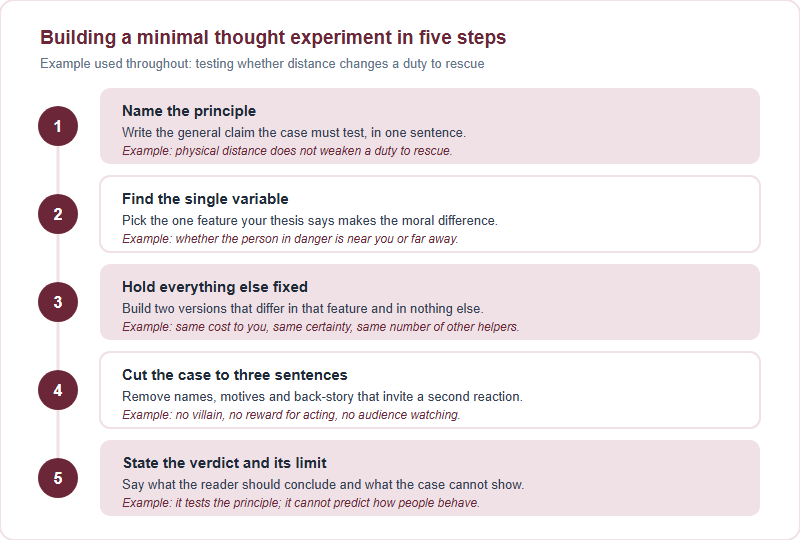
Two failure patterns recur in the drafts we coach. Built cases grow: names, motives and back-story creep in, and each detail hands the reader a second thing to react to — the very confound step three removed. And cases go unexplained: the story appears and the paragraph moves on as if its meaning were obvious. It never is. Give more words to what the case shows than to the case itself.
The Three Objections Every Case Attracts
Because the rules single out the strongest objections, expect one of three replies to every case, and answer it in the paragraph straight after the case rather than at the end of the essay.
- “The case is too artificial to tell us anything.” Show that the verdict holds when irrelevant details change, and name the principle that explains it. A stable judgement backed by a stated principle is far harder to dismiss than a vivid story.
- “Your two versions differ in more than one way.” This confound objection sinks many home-made cases. Check the pair line by line — cost, certainty, who acts, who chooses, how many others could help — and rebuild if anything besides your variable moves.
- “Intuitions are not evidence.” In Philosophy, considered judgements about cases are a normal starting point for testing principles. In Psychology, Economics or Science & Technology, the better reply is usually to concede and add data, as the Molyneux example shows.
The general method of stating an objection at full strength and answering it is set out in our breakdown of how a winning John Locke essay is built. What is specific to thought experiments is that the objection usually attacks the case rather than the thesis, so the reply must repair the case before it can defend the claim.
Analogies: Run a Disanalogy Audit First
An analogy argues that because two things share some features, they probably share another. Its weak joint is always a difference that matters. The classic example comes from the philosophy of religion: William Paley’s watchmaker analogy (1802) reasons from a watch’s evident design to a designer of the world, yet David Hume’s Dialogues Concerning Natural Religion, published in 1779, had already pressed on exactly that joint — how far the world resembles a machine at all.
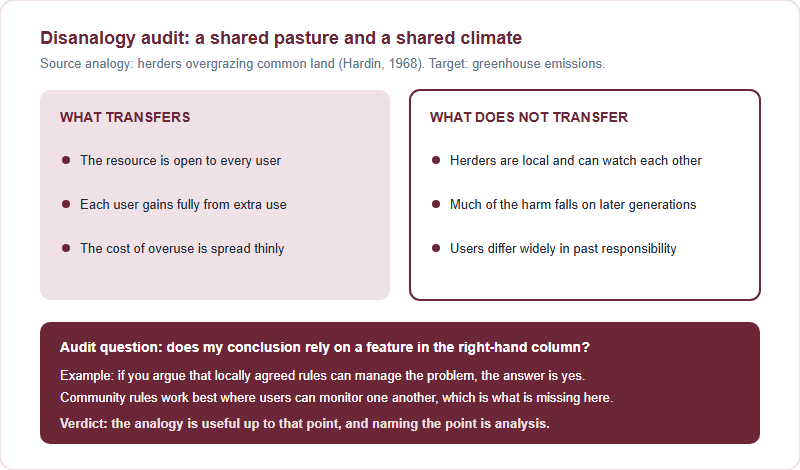
The audit takes five minutes: list what transfers, list what does not, and ask whether your conclusion depends on anything in the second list. Take Garrett Hardin’s “tragedy of the commons” (1968). An essay arguing that locally agreed rules can manage a shared resource can draw on Elinor Ostrom’s Governing the Commons (1990), but the durable community arrangements Ostrom studied typically involved monitoring by the users themselves or by people accountable to them — exactly what goes missing when the users are states and much of the harm falls on later generations. The analogy is useful up to a named point, and naming that point is analysis.
In International Relations, the comparison between individuals in a state of nature and states without a world government, which runs back to Hobbes’s Leviathan (1651), is often borrowed and rarely audited; our International Relations guide covers the level-of-analysis discipline the audit needs.
Three Past Questions, Three Devices
Three questions from the Institute’s published selection of past essays show the devices at work. They illustrate technique, not future questions.
- Economics: “A government funds its own expenditure by taxing its population. Suppose, instead, it relied solely on money newly created by the central bank? What would be the advantages and/or disadvantages?” The question is itself a thought experiment. First specify the world — what is held fixed, and what “solely” rules out. Only then can episodes of heavy money creation, such as Weimar Germany in 1923 or Zimbabwe in the late 2000s, discipline the idealisation instead of replacing it.
- Psychology: “Are beliefs voluntary?” A built case does most of the work: try, right now, to believe something you are certain is false. Bernard Williams developed an argument along these lines in his essay “Deciding to Believe”. The standard reply is indirect control — Blaise Pascal advised the doubter to act as though he already believed — so separate direct from indirect voluntariness before you answer.
- Law: “Should the law ever prevent people from freely making self-harming decisions?” The question continues by asking what should be forbidden and on which principles. John Stuart Mill’s On Liberty (1859) supplies a case: someone about to cross a bridge known to be unsafe, with no time to warn them, may be turned back without real infringement of their liberty, since they do not want to fall. It isolates ignorance from choice. Ulysses, bound to the mast so he could hear the Sirens safely, offers an analogy for self-binding — and the audit flags a difference at once: Ulysses chose his constraint, whereas a law imposes one.
Younger writers should adjust the dose, not the method. Under the Institute’s 2026 rules, entrants under 15 on 31 May were judged separately against their age peers (confirm the current rule on johnlockeinstitute.com), and for them one clean built case usually does more than a famous borrowed one; our Junior Prize guide covers what else changes on that route.
In our own coaching, every case a student proposes meets two questions: what, in one sentence, is it meant to show, and what can it not show? Cases whose writers can answer both usually survive revision. For context, Hanlin’s de-identified 2026 John Locke record is 86 shortlisted essays and 76 global awards — our own figures, not an official statistic, and not a claim that any single technique produced them.
Questions Students Ask
Are thought experiments allowed in a John Locke essay?
Yes. Nothing in the published rules forbids them. They are judged like any argument, on reasoning, originality and persuasive force.
Should I use the trolley problem?
Only in a version you have altered to test your own claim. Restating the standard case adds little on its own.
How many words should a thought experiment take?
Usually 60 to 120 words for the case itself, with more space given to what it shows than to the story.
Do thought experiments work outside Philosophy?
Yes, in Law, Politics, Economics and Psychology too, but pair them with evidence whenever the claim is empirical.
This is an independent guide operated by Hanlin Education for China-based international-school students. We are not affiliated with, endorsed by, or sponsored by the John Locke Institute. Rules, dates, word limits and eligibility change between cycles — confirm current details on johnlockeinstitute.com before you rely on anything here. Errors reported to our editorial desk are corrected within 7 working days.