

If you are invited to interview, practise explaining the reasoning behind your essay in your own words.
Many shortlisted candidates prepare by re-reading their submission until they can quote it. This is a mistake. A useful rehearsal goal is the ability to reconstruct your argument from a small set of anchors—your claim, your evidence, and the best objection you considered. This article teaches you to build that map and to practise with it. It draws on the official competition page and on Hanlin Courses‘ July 2, 2026 briefing, “The 2026 John Locke Essay Interview: Process and Practice Questions,” which reported questions asked of 2026 participants. The advice here is coaching guidance, not official instruction. If you are invited to interview, follow the instructions you receive.
Why Practise With a Map Alongside Your Essay
According to the Hanlin briefing, 2026 participants were asked: why they chose their question, what their main argument was, how the essay was organised, what key concepts meant, what other examples they might use, and how they would elaborate or revise. These questions test whether you still command your own reasoning. Memorised prose cracks under follow-up. A claim-source-objection map lets you reassemble answers in real time.
The diagram below shows how the three anchors interact in a typical interview exchange.
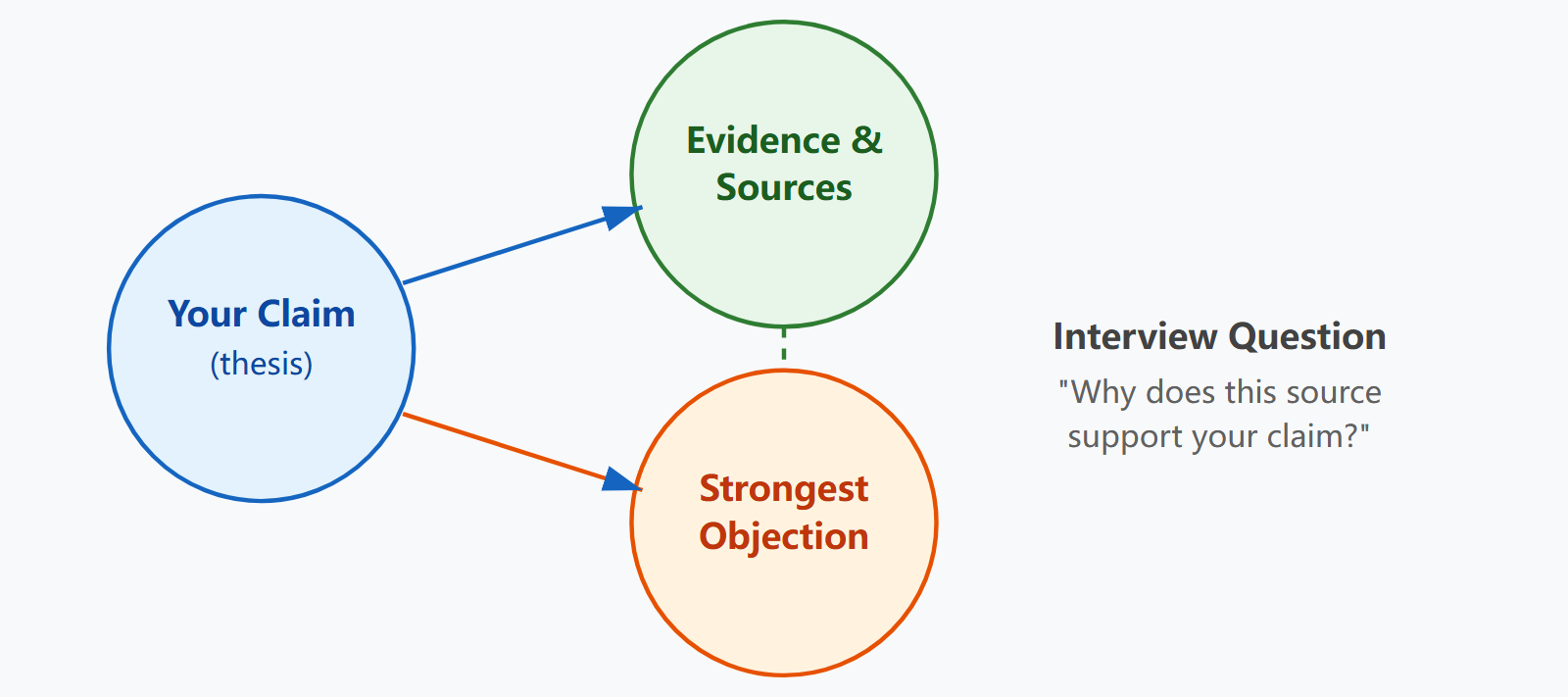
Use the objection anchor to reconsider the scope of your claim. A strong interview answer often revises the claim’s scope rather than pretending the objection fails.
Building Your Three-Anchor Map
Before practising, reduce your essay to the following. Write no more than five sentences per anchor.
| Anchor | What to Record | Why It Matters in Interview |
|---|---|---|
| Claim | Your thesis in one sentence; the scope qualifier (e.g., “in democratic regimes,” “for most cases”) | Examiners often ask you to restate your argument in new words. A scoped claim survives rephrasing. |
| Evidence | Two or three sources; the specific page or passage; what it actually says, not what you wish it said | You may be asked why a source supports your precise claim rather than a broader one. |
| Objection | The strongest counterargument you considered; whether you addressed it in the essay or would now | Showing you understand the objection’s force signals intellectual honesty. |
The Hanlin briefing recommended preparing motivation, thesis, structure, two to three sourced examples, objections, and improvements. This table compresses that advice into a portable format.
Annotated Practice Question Bank
These are practice prompts for rehearsal, not leaked or guaranteed official questions. Use them to test whether your three-anchor map is robust.
Prompt 1: Motivation and Scope
Question: “Why did you choose this question over others in your category?”
Why practise this: Many candidates answer with generic interest. A strong answer connects personal or academic motivation to the specific intellectual gap the essay addresses.
Map entry: One sentence linking the topic to a puzzle you genuinely want solved. Example: “I chose the question on paternalism because I noticed defenders of soft paternalism rarely specify when cognitive bias justifies intervention versus mere information provision.”
Prompt 2: Thesis Precision
Question: “What is your main argument in one sentence?”
Why practise this: If you cannot state it briefly, you do not yet control it.
Map entry: “My claim is that [X] because [Y], but only under [Z conditions].” The qualifier is load-bearing.
Prompt 3: Source Fidelity
Question: “You cite Rawls on the original position. Why does that passage support your claim rather than a much broader egalitarian conclusion?”
Why practise this: This prompt checks whether you can explain the role of a source rather than merely quote it.
Map entry: The specific paragraph; your paraphrase; the narrower conclusion you draw from it.
Prompt 4: Conceptual Clarity
Question: “You use the term ‘autonomy’ in several places. What do you mean by it here?”
Why practise this: Ambiguous terms collapse under pressure. You need a working definition you can defend.
Map entry: Your stipulated definition; one alternative you considered and rejected; why your choice matters for the argument.
Prompt 5: Objection and Revision
Question: “What is the strongest objection to your view, and how would you revise your essay in light of it?”
Why practise this: This separates candidates who considered objections from those who appended a perfunctory paragraph.
Map entry: The objection; whether your current essay addresses it; what you would add or qualify.
A Fictional Language Example: How to Structure a Three-Part Response
The following is entirely fictional, invented for language and argument rehearsal, and not a ready-made competition essay. It demonstrates how to use the claim-evidence-limitation structure in spoken form. No actual data or real institution is involved.
Fictional claim: “Extending our school library’s opening hours would improve access for pupils whose buses leave late, but only if staffing and security costs can be met without diverting funds from existing programmes.”
Three-part response:
Claim: I argue that later library hours would help a specific group—pupils whose buses depart after the current closing time—by giving them a supervised place to study, but I restrict this to cases where the school does not need to cut other services to pay for it.
Reason and evidence: I use a hypothetical access log showing unmet late-afternoon demand: if records showed consistent attempts to enter the library after 4:30 p.m., that would support the access claim for this group. I do not claim this would raise exam grades or cause better outcomes; the logs would only show demand, not effects.
Limitation: The strongest objection is that my argument assumes unmet demand justifies expansion without proving causation. The logs might reflect preference for the library over other spaces, not a genuine barrier. If I revised the essay, I would add a section on alternative spaces and explicitly limit my claim to access rather than educational outcomes.
This structure is useful for rehearsing how to keep claims narrow and to separate evidence from overreach. Practise varying the wording without losing the architecture.
When to Say “I Do Not Know”
Two responses are better than bluffing. First, if asked about a source you no longer remember well: “I do not recall that passage in detail. What I can say is that my argument depends on [X], and I would need to re-examine whether [source] supports it at that level of specificity.” Second, if asked whether your claim extends to a case you did not address: “My claim, as I defended it, only establishes [X]. I have not argued for [broader Y], and I would need additional premises to get there.”
Both responses show control over your own argument’s boundaries. They are preferable to speculative extensions that collapse under follow-up.
Rehearsal Method: Record and Listen Back
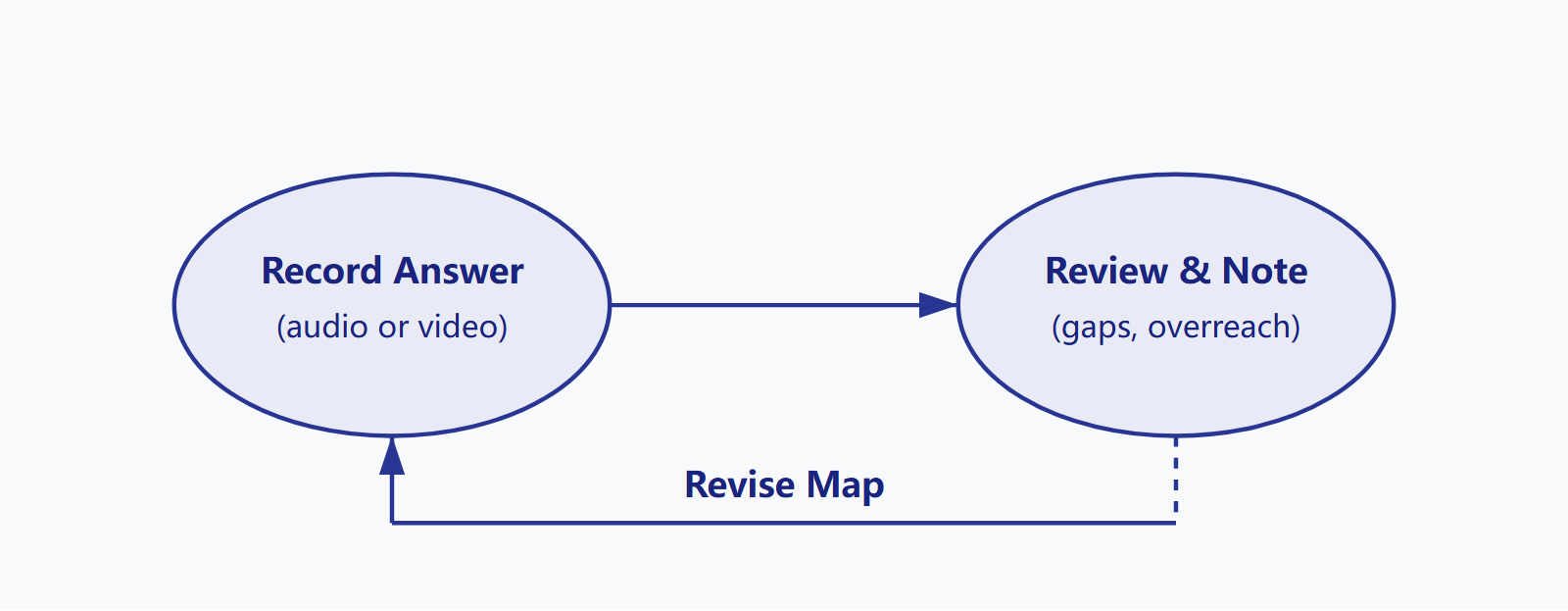
The Hanlin briefing suggested recording rehearsal answers and listening back. This is optional coaching advice, not an official requirement. If you try it, listen for: filler words that mask uncertainty, claims broader than your essay defends, and moments where you cite a source without explaining its specific role. Repeated self-review can help you notice gaps that silent reading does not reveal.
Related Preparation
For guidance on citing sources with integrity, see our article on referencing and academic honesty. For research methods, see source research. For prose style, see English prose.
FAQ
Should I memorise my essay for the interview?
No. Memorisation breaks under follow-up questions. Build a claim-source-objection map you can reassemble in real time instead.
Are the practice questions in this article official interview questions?
No. They are coaching prompts based on reported 2026 experiences, not leaked or guaranteed official questions. Actual interview content varies.
What if I am asked something I did not prepare?
Use the boundary-drawing responses above. Saying “I do not know” or “my claim only establishes X” shows intellectual honesty and control over your argument.
Independence note: This article is independent coaching guidance. It is not affiliated with, endorsed by, or sponsored by the John Locke Institute. For current official rules and instructions, consult the official competition page.