

For the John Locke Institute Essay Competition, the referencing and honesty rules are simple but strict: use endnotes, not footnotes; a clearly titled bibliography is allowed and does not count toward your 2,000 words; in-text citations do count; and every essay “must be entirely the work of a single individual.” Getting these mechanics right protects a strong essay from being sunk on a technicality. Always confirm the current wording on johnlockeinstitute.com.
Footnotes vs. endnotes: the distinction that trips people up
Many students arrive from an IB or A-Level habit of dropping footnotes at the bottom of each page. The John Locke rules are explicit: “Contestants should NOT add footnotes. They may, however, add endnotes and/or a Bibliography that is clearly titled as such.” Endnotes live in a single list at the end of the essay; footnotes sit at the foot of each page. Practically, in a word processor this is one setting — but submitting with page-foot footnotes when the rules ask for endnotes is an avoidable error. Format your references as endnotes, and give your source list a heading like “Bibliography” or “References” so a referee sees immediately that it is not part of your word count.
The referencing choice that changes your word budget
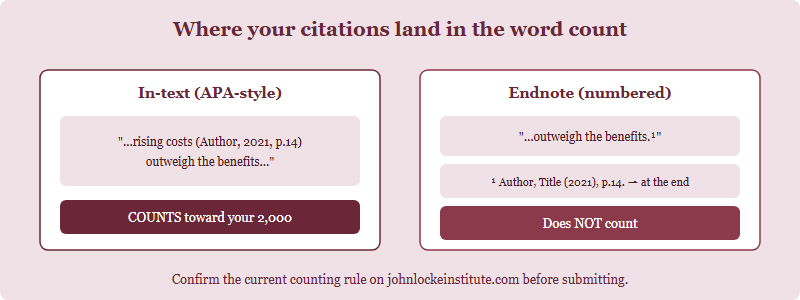
Here is the strategic point most guides miss. The Institute states that if you use an in-text referencing format such as APA, your in-text citations are included in the word limit. Endnotes are not. So your choice of referencing style is also a choice about how many of your 2,000 words go to prose versus to citation markers.
| Referencing approach | Where the citation sits | Counts toward 2,000? | Best when… |
|---|---|---|---|
| In-text (e.g. APA “(Author, 2021, p.14)”) | Inside the sentence | Yes | You cite lightly and value reader transparency |
| Endnote / numbered notes | List at the end | No | You cite heavily and are near the word ceiling |
| Bibliography (titled) | End of essay | No | Always — list what you drew on |
If your draft is citation-heavy and pushing 2,050 words, moving from an in-text style to a numbered endnote style can legitimately bring you under the limit — because you are no longer being charged for every “(Author, year)” inside your prose. Decide this deliberately at the drafting stage, not in a panic at submission. (See our companion piece on writing tight inside the 2,000-word limit.)
“Entirely the work of a single individual”: what academic honesty means here
The Institute is unambiguous: “Each submitted essay must be entirely the work of a single individual,” and “No part of your essay may be written by anyone else.” A referee (typically a teacher or academic) verifies that the essay is the contestant’s original work. The Institute states it uses “various means to identify plagiarism, contract cheating, the use of AI and other forms of fraud.” The consequences of a breach are set by the Institute — do not gamble.
For a China-based student, three honest-work boundaries matter most:
- A tutor or coach may teach, question and give feedback — but may not write your sentences. The line is between developing your thinking and producing your text. Guidance on argument, structure and sources is legitimate; ghost-writing is not.
- Translation is not a loophole. Drafting in Chinese and having someone else render it into polished English is a grey zone at best. The essay must be your own work in the language of submission.
- Every borrowed idea needs attribution. Using a source’s argument without citing it is plagiarism even if you paraphrase. When in doubt, cite.
Using AI without wrecking your originality score
This is the question every family asks in 2026. Per the Institute’s stated position, contestants are welcome to make use of large language models and related tools — but it warns that “an overreliance on LLMs etc will most likely mean that your writing will be very similar to thousands of other essays.” That warning is really about the scoring criteria: essays are judged partly on originality, and generic AI prose is the opposite of original.
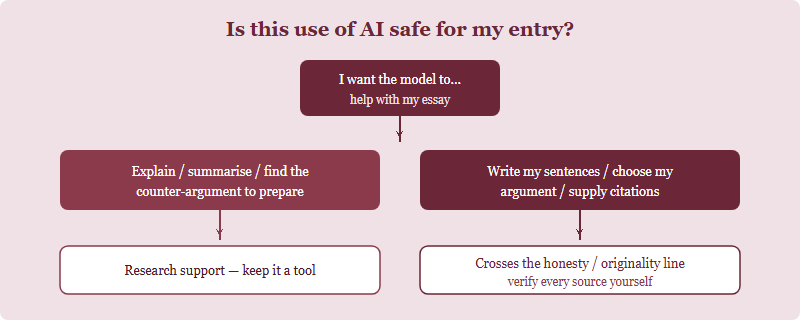
Treat AI the way you would treat a search engine or a study partner — a tool for research and stress-testing, not a source of your argument or your sentences:
| Reasonable research support | Where it becomes a problem |
|---|---|
| Summarising background so you can read the primary source faster | Pasting AI text into your essay as your own writing |
| Asking “what is the strongest objection to my thesis?” to prepare a rebuttal | Letting the model decide your argument for you |
| Checking whether your paragraph’s logic holds | Producing bland, generic prose that reads like everyone else’s |
| Explaining a difficult concept in another way | Fabricated citations — LLMs invent sources; you must verify every reference |
One caution that catches students out: models sometimes generate confident but fake references. If you cannot open the source and confirm the quote yourself, do not cite it — a fabricated citation is worse than no citation, and referees look for exactly this. Always confirm the current AI and authorship policy on the official site, because rules in this area evolve year to year.
Your bibliography is a signal — make it a good one
Because the bibliography does not count toward your word limit, students often treat it as an afterthought. That is a missed opportunity. A referee scoring for knowledge and understanding and competent use of evidence will glance at what you read — and a thoughtful source list quietly reinforces that your argument rests on real engagement, not a skim of the first web results. Two essays with identical prose can read very differently depending on whether the sources are the actual scholarly or primary texts on the question, or a handful of encyclopaedia entries.
| Source type | Signal it sends | Use it for |
|---|---|---|
| Primary texts & original data | You engaged the material directly | The core of your evidence |
| Peer-reviewed articles / scholarly books | You understand the serious debate | Framing and counter-arguments |
| Reputable reference works | Baseline competence | Background only — not your main evidence |
| Unattributed web content / AI output | Weakness or fabrication risk | Avoid citing; verify before use |
You do not need a long list — three to six sources you have genuinely read and used will outperform a padded page of titles you only skimmed. The rule is the same one that governs the whole essay: depth over display. And every entry must be a source you can actually produce and quote from, because the honesty rules mean a fabricated or misrepresented reference is a real risk, not a shortcut.
A pre-submission checklist for the mechanics
Before you upload, run this five-line check (it takes ten minutes and prevents the errors that cost strong essays):
- References are formatted as endnotes, not page-foot footnotes.
- Your source list is titled “Bibliography” / “References” so it clearly sits outside the word count.
- You have re-checked the word count under the correct counting rule for your referencing style (in-text citations included; endnotes and bibliography excluded).
- Every citation points to a source you have personally opened and verified — no AI-invented references.
- The essay is your own work, and any authorship declaration required by the Institute is completed as instructed.
From coaching John Locke entrants, the pattern is consistent: the students who lose avoidable ground are rarely weak thinkers — they are strong writers who treated the rules as an afterthought. The mechanics are the easy marks to protect. Read the official guidance in full, format to it exactly, and let the argument carry the essay.
Frequently asked questions
Footnotes or endnotes for John Locke?
Endnotes. The rules state contestants should not add footnotes but may add endnotes and a clearly titled bibliography. Confirm the current wording on johnlockeinstitute.com.
Do citations count toward the 2,000 words?
In-text citations (e.g. APA) count; endnotes and a titled bibliography do not. Choose your style with this in mind, and verify on the official site.
Can I use AI to help write my John Locke essay?
The Institute permits LLMs for research support but warns overreliance makes writing generic and hurts originality. Your argument and prose must be your own; confirm the current AI policy officially.
Can a tutor help me?
A tutor may teach, question and give feedback, but the essay must be entirely one individual’s own work — no part written by anyone else. Check the official authorship rule before submitting.
Related on this site: how to write tight inside the John Locke 2,000-word limit and our John Locke essay strategy overview.
This is an independent guide operated by Hanlin Education for China-based international-school students. It is not affiliated with, endorsed by, or sponsored by the John Locke Institute. Referencing, academic-honesty, AI and authorship rules are set by the Institute and may change; confirm all current details on johnlockeinstitute.com. Any error will be corrected within 7 working days of notice.