

The John Locke Institute lists “writing style and persuasive force” among its assessment criteria, alongside argumentation and evidence. That means prose is scored, not decorated. For students writing in a second language, most lost marks are not grammar errors — they are register errors: sentences that are correct English but sound like a translated textbook, a school exam answer, or a newspaper column instead of an argued essay.
Why style is a scored criterion, not a finishing touch
The Institute's published criteria are “knowledge and understanding, competent use of evidence, quality of argumentation, originality, structure, writing style and persuasive force.” Read those last two items together and the logic is clear: an argument that a reader cannot follow at speed is not persuasive, and persuasion is the thing being judged.
This matters more at 2,000 words than at 4,000. In a short essay, every sentence either advances the argument or displaces one that would have. Chinese international-school students are usually strong at the parts schools grade — accuracy, vocabulary range, paragraph structure — and weak at the part nobody teaches: sounding like someone who has a position and knows what it costs.
Nothing here is about writing “beautiful” English. It is about removing the specific signals that tell a reader your essay is a school assignment rather than a piece of reasoning. Structure comes first — if the argument itself is not built around a thesis and a real counter-argument, prose fixes will not save it, and our breakdown of how a winning essay is built is the better starting point. This article assumes the structure is sound and the sentences are letting it down.
The three default voices, and the one that scores
Almost every draft we read arrives in one of three registers. None of them is wrong English; all three cost marks.
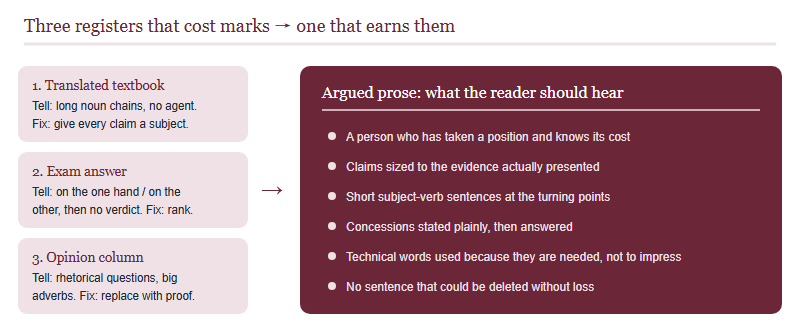
The exam-answer voice is the most damaging because school rewards it. A balanced survey that ends in “therefore both sides have merit” scores well in a coursework rubric and poorly in a competition that asks for argumentation. Balance is a method, not a conclusion.
Calibration: claiming exactly as much as you can prove
The single most common style failure in second-language drafts is mis-calibration — the gap between how strongly a sentence claims and how strongly the evidence supports it. Both directions cost marks. Overclaiming (“this proves conclusively” after one example) reads as naive. Underclaiming (“it may perhaps be somewhat arguable that”) reads as having no position at all.
English gives you a precise ladder for this. Learn it as vocabulary, the way you learned subject terminology.
| Strength | Use when | Language that fits | What a reader infers |
|---|---|---|---|
| Established | Uncontested fact with a citable source | “X is” · “the data show” · “the statute provides” | You can point to the source immediately |
| Argued | Your own conclusion from stated reasons | “I argue that” · “it follows that” · “this is why” | You own the claim and will defend it |
| Probable | Evidence points one way but is incomplete | “the stronger reading is” · “this suggests” | You know what would settle the question |
| Contested | Serious people disagree and you are reporting that | “critics respond that” · “on the rival view” | You have read the other side properly |
| Conceded | The objection lands and you accept a cost | “this is the real cost of my position” | Intellectual honesty — often the highest-value sentence in the essay |
A practical drill: take any three consecutive sentences of your draft, label each with a row from this table, then ask whether the evidence in that paragraph earns the label. Most drafts contain a run of “Argued” language sitting on “Probable” evidence, and a conclusion that jumps to “Established.”
The bottom row deserves particular attention, because it inverts what school teaches. Students are trained to defend a position without visible weakness, so conceding feels like losing marks. In an argumentative essay the opposite holds: a clearly stated concession is evidence that you understand your own position's structure, and it is often the sentence that separates a competent essay from a persuasive one. “My argument cannot account for X, and I accept that this weakens it in cases of type Y” is a strong sentence, not a weak one — provided you then explain why the position survives anyway.
A related vocabulary point. Second-language writers often work on range, reaching for the less common synonym because it looks more academic. In our experience the opposite is rewarded: precision beats range. A technical term used because the argument genuinely needs it — “proportionality,” “externality,” “burden of proof” — earns credit. A thesaurus substitution that replaces “important” with “paramount” earns none, and risks a slight mismatch in meaning that a native reader will notice immediately. Build vocabulary in your subject, not in the abstract.
Six sentence patterns that leak translation
These are the constructions we mark most often in drafts from Chinese international schools. None is ungrammatical; each signals that the sentence was assembled rather than argued. The examples below are written for illustration.
- The agentless noun chain. “The implementation of the policy resulted in the improvement of social welfare conditions.” Nobody does anything. Rewrite with a subject and a verb: “The policy raised welfare because it changed who bore the cost.” In the drafts we edit, this one change alone usually removes a noticeable share of the word count.
- The floating “it is” opener. “It is undeniable that education is important.” If it is undeniable, it does not need saying. Delete the frame and make the real claim.
- The stacked qualifier. “It could perhaps be argued that this may to some extent be relevant.” Four hedges in one sentence signal that you have not decided. Keep one hedge at most.
- The connective that promises nothing. “Moreover,” “furthermore,” “in addition” used to bolt on a point rather than relate it. Replace with a connective that states the logical relation: “because,” “which is why,” “but this only holds if.”
- The unearned intensifier. “Extremely significant,” “absolutely crucial,” “vitally important.” Adverbs cannot do the work of evidence. If the point is crucial, show the consequence of denying it.
- The definition detour. Opening a paragraph by defining a common word from a dictionary. Define a term only where the argument turns on the definition — and then define it in your own words, for your own purposes.
A quick self-test: read your essay aloud and mark every sentence longer than 30 words. In a 2,000-word argumentative essay you should have very few, and each should be doing something a short sentence could not.
Signposting on a 30-word budget
Second-language writers are often taught to signpost heavily — announce the structure, restate it at each transition, summarise at the end. At 2,000 words that habit can consume 250 words on navigation for an essay short enough to hold in the head.
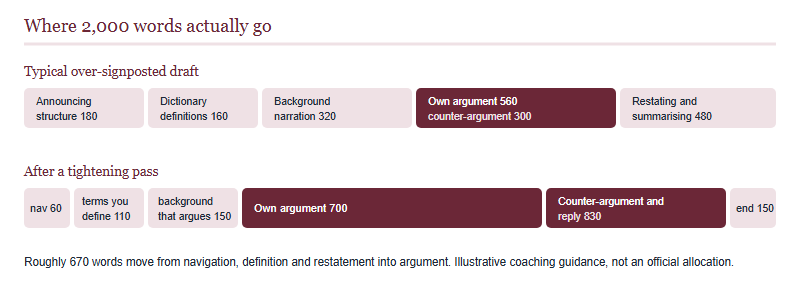
What replaces heavy signposting is a strong first sentence in every paragraph. If a reader can grasp your whole argument by reading only the opening sentence of each paragraph, you do not need navigation language at all. Write those sentences first, read them as a list, and fix the sequence there rather than in transitions.
A 90-minute final pass
Do this once, on a printed copy or a screen you cannot edit, at least three days after finishing the draft. Each stage is a single-purpose read; do not mix them.
- Thesis read (10 min). Underline the sentence that states your position. If you cannot find it in the first 150 words, that is the problem to fix before anything else.
- Topic-sentence read (15 min). Read only the first sentence of each paragraph, in order. Does the argument still make sense? Reorder paragraphs, not sentences.
- Calibration read (20 min). Label claims against the strength table above. Downgrade every claim the paragraph has not earned.
- Pattern hunt (25 min). Search the document for the six leaks: “it is,” “moreover,” “extremely,” “can be argued,” “the implementation of,” and dictionary phrasing. Fix each occurrence individually.
- Read aloud (20 min). Every place you stumble is a place a reader will. Mark, do not fix, then repair all marks in one final sweep.
Two cautions. First, this is your own editing pass. Rules on who may help with an entry, and on declaring authorship, are set by the Institute — confirm them on johnlockeinstitute.com before anyone else touches your file. Second, younger entrants writing in the Junior category work to different questions and expectations, and should not be judged against senior-category prose. The same calibration habits transfer to other subjects too, including the evidence-heavy International Relations category.
One first-party note on how much this matters. Across Hanlin's 2026 cohort, our own de-identified records show 86 students shortlisted and 76 global awards across subjects — our internal figures, not official statistics. In our reading of those drafts, the essays that improved most between first and final version rarely gained new research. They gained commitment: fewer hedges, shorter sentences at the turning points, and a concession stated in plain English rather than buried.
Frequently asked questions
Does non-native English put me at a disadvantage?
Style is assessed, but clarity and commitment matter more than idiom. Precise, plain sentences outperform elaborate ones in a 2,000-word argument.
Should I use first person in a John Locke essay?
A measured “I argue that” is normal in academic prose and helps you own a claim. Avoid personal anecdote unless it is genuine evidence.
Can a teacher proofread my essay?
Rules on outside help and authorship declarations are set by the Institute and change yearly. Confirm current policy on johnlockeinstitute.com.
How long should my sentences be?
There is no rule, but keep sentences over 30 words rare and put your key claims in short ones. Read the draft aloud to test.
This is an independent guide operated by Hanlin Education for China-based international-school students. We are not affiliated with, endorsed by, or sponsored by the John Locke Institute. Assessment criteria, word limits, authorship rules and deadlines are set by the Institute and change between cycles — always confirm current details on johnlockeinstitute.com before acting on anything here. Factual errors reported to our editorial desk are corrected within 7 working days.