

The John Locke Law category does not test legal knowledge. Its questions are normative — they ask what the law ought to do and why — so the essay that scores is a piece of reasoned argument supported by legal examples, not a survey of case citations. You do not need a subscription law database, a common-law background, or an ambition to read Law at university. You need a defensible thesis, one counter-argument you take seriously, and evidence a reader can verify.
What the Law category actually asks
The clearest way to see the character of this category is to read the questions themselves. For the 2026 cycle, the John Locke Institute set three Law questions:
- “If legislators and judges all accepted the philosophical theory of determinism, what would be the effect on criminal sentencing?”
- “To what extent should criminal sentencing take into account the effect on the perpetrator's family?”
- “Is trial by jury obsolete?”
Notice what is missing. None of the three asks you to state the law of any jurisdiction. The first is applied philosophy of mind crossed with penal theory. The second is a question about desert and proportionality — who may legitimately bear the cost of a punishment. The third is a question of institutional design: whether a procedure that survives for historical and democratic reasons still does the job we built it for.
That framing is consistent with how the competition is assessed. The Institute lists its criteria as “knowledge and understanding, competent use of evidence, quality of argumentation, originality, structure, writing style and persuasive force.” Doctrine sits inside “knowledge and understanding” and “evidence” — it is instrumental. What carries the essay is argumentation.
Two logistical points before the method. Essays are capped at 2,000 words, and per the Institute the limit excludes endnotes, bibliography, diagrams and tables — so there is no word-budget excuse for thin referencing. And each cycle's questions are published when that cycle opens; the 2027 Law questions will be a new set, and the dates are on johnlockeinstitute.com rather than in any third-party list, including this one. Entrants aged under 15 write in the Junior category instead, which follows a separate set of rules and questions.
The four moves a Law answer has to make
Almost every Law question in this competition can be answered with the same four-move skeleton. The moves are not paragraphs — a move might take 200 words or 600 — but if one is missing, the essay reads as commentary rather than argument.
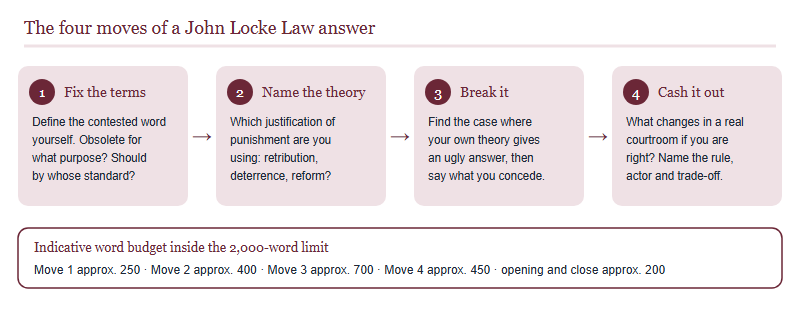
Move 3 deserves emphasis because it is the move students skip. An essay that states a position and then defends it three times is not arguing; it is repeating. The counter-argument has to be the strongest version available, and you have to say plainly what it costs you — which claim you soften, which cases you accept you handle badly. That structural discipline is the same one described in our breakdown of how a winning essay is built around thesis and counter-argument.
Worked example: “Is trial by jury obsolete?”
This question looks like an invitation to list advantages and disadvantages. That is the trap. “Obsolete” is a comparative and purposive word: something is obsolete only relative to a purpose and an available replacement. So the first paragraph of a strong answer establishes what juries are for, and the whole essay then turns on whether that purpose is still served, still needed, or better served otherwise.
Three theses are defensible here. Each carries a different burden of proof, and choosing one you cannot discharge in 2,000 words is the most common self-inflicted wound in this category.
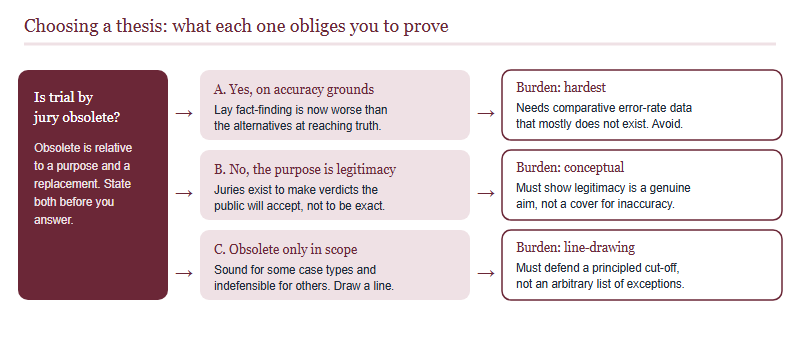
Thesis C is usually the strongest choice for a school-age writer, because a scope argument lets you use the essay's limited length to defend one principled boundary properly rather than survey a whole institution badly. But it only works if the boundary follows from Move 2. If you argue that juries exist for democratic legitimacy, your cut-off should track cases where public acceptance matters most — not cases that happen to be complicated.
The opening is where most of this is won or lost, and at 2,000 words you have roughly 150 of them to establish control. A reliable skeleton runs: one sentence naming the purpose the institution is supposed to serve; one sentence stating the standard by which you will judge whether it still serves it; one sentence giving your answer; one sentence naming the strongest objection you will have to meet. No history, no dictionary, no throat-clearing about how the question has been debated for centuries. A reader who reaches your second paragraph should already know what you think and what would embarrass you.
The corresponding discipline at the end is to avoid summary. A conclusion that restates your three sections has spent 150 words telling a reader something they read ten minutes ago. Spend them instead on the limit of your claim — the cases you have not covered, the further question your argument raises — which reads as command of the material rather than as filler.
Where evidence comes from when you have no case-law database
Students in Chinese international schools rarely have Westlaw or LexisNexis access, and that matters far less than they fear. The evidence a normative Law essay needs is mostly open:
- Official statistics and judiciary reports. Ministry of justice and court-service publications in most jurisdictions release conviction, appeal and case-load data as free PDFs.
- Law commission and parliamentary committee reports. These are written to be read by non-specialists and often summarise the best arguments on both sides — ideal Move 3 material.
- Open-access scholarship. University repositories and open journals carry a great deal of jurisprudence and empirical legal studies.
- Primary legislation. Almost every jurisdiction publishes its statutes online. Quote sparingly and accurately.
One working rule saves more marks than any reading list: an example must be checkable in about a minute. If a reader cannot locate the report, the statute or the statistic quickly, its persuasive value collapses — and endnotes are outside the word limit, so precision costs you nothing. Never cite a source you have not opened yourself, and never take a figure from a summary blog when the primary document is one search away.
Law, Politics, Public Policy or Philosophy: choosing the right home
Several 2026 questions could plausibly have lived in more than one category, and candidates lose time deciding. The distinction that matters is not subject matter but the kind of claim the question wants you to defend.
| Category | Core claim type | Evidence that persuades | Typical failure mode |
|---|---|---|---|
| Law | What a legal rule or procedure ought to be, and why it is justified | Statutes, judicial reasoning, commission reports, penal theory | Describing systems instead of justifying rules |
| Politics | How power should be distributed, legitimated or constrained | Political theory, constitutional design, comparative institutions | Current-affairs commentary with no theoretical spine |
| Public Policy | Whether a specific intervention is worth its costs | Empirical evaluation, incentives, trade-offs, implementation detail | Recommending a policy without pricing the downside |
| Philosophy | Whether a concept or principle survives scrutiny | Argument, thought experiment, careful distinction | Restating famous positions rather than testing them |
| International Relations | How states and institutions should act toward one another | Treaties, institutional behaviour, IR theory | Narrating events instead of arguing a norm — see our International Relations guide |
A practical test: write your thesis as a single sentence, then ask what would make it false. If the answer is “a court decided otherwise,” you are writing doctrine. If it is “that value does not in fact justify the rule,” you are in the Law category properly.
Five patterns we see repeatedly in China-based drafts
These observations come from Hanlin's own coaching records rather than from the Institute. In the 2026 cycle our de-identified internal tally recorded 86 students shortlisted and 76 global awards across all subjects — figures we report as our own, not as official statistics. The recurring problems in Law drafts were consistent:
- Turning a normative question into a comparison of legal systems. A section contrasting civil-law and common-law procedure is only relevant if it does argumentative work; otherwise it burns 400 words.
- Treating a statute as a knock-down argument. Citing what the law says does not answer a question about what the law should say. The citation is a premise, not a conclusion.
- Importing translated textbook definitions. Definitions lifted from a study guide rarely fit the question's pressure points. Define terms yourself, in the terms of your own argument.
- A 600-word runway before the thesis. Background is not free at 2,000 words. Say what you will argue within the first 150 words.
- Picking the hardest-sounding question. The determinism question rewards students who have genuinely read on free will and responsibility. Choosing it as a signal of ambition, without the reading, produces a confident essay about a topic it has not understood.
Frequently asked questions
Do I need to have studied law to enter the Law category?
No. The questions are normative rather than doctrinal. Strong entries argue from legal philosophy and verifiable examples, not case citation.
Do endnotes and the bibliography count toward the 2,000 words?
Per the Institute, endnotes, bibliography, diagrams and tables sit outside the limit. Confirm the current rule on johnlockeinstitute.com.
Can I write about Chinese law?
Yes, if it earns its place as evidence for a normative claim. Describe it accurately and cite a source a reader can verify quickly.
When are the 2027 Law questions published?
The Institute releases each cycle's questions when that cycle opens. Check johnlockeinstitute.com rather than any third-party list.
This is an independent guide operated by Hanlin Education for China-based international-school students. We are not affiliated with, endorsed by, or sponsored by the John Locke Institute. Competition rules, questions, deadlines, eligibility and awards are set by the Institute and change between cycles — always confirm current details on johnlockeinstitute.com before acting on anything here. Factual errors reported to our editorial desk are corrected within 7 working days.