

A winning John Locke essay is not a longer essay or a cleverer-sounding one. It is built around a single, defensible, original thesis; it names and defeats the strongest objection to that thesis; and it uses precise evidence inside roughly 2,000 analytical words. Master those three moves and your structure stops being a container and starts being the argument. This guide maps the anatomy.
Why structure, not topic, separates the shortlist from the rest
The John Locke Essay Competition, run by the John Locke Institute in Oxford, drew 63,328 entries from more than 100 countries in 2025. Entry is free and the prompts are published openly, which means tens of thousands of capable students answer the same question. When a question is shared by a crowd this large, the topic cannot be your edge — almost everyone will reach for the obvious examples and the obvious position. What distinguishes a shortlisted essay is the shape of the reasoning: a thesis a reader has not seen forty times that day, and a line of argument that survives the objection a sharp examiner would immediately raise.
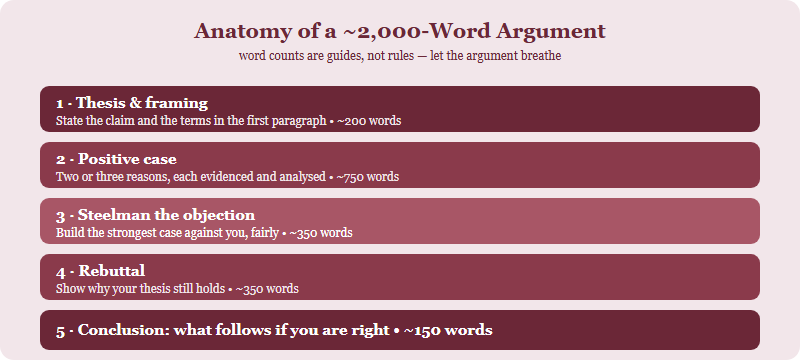
Essays are read by academics from Oxford and other leading universities, and the strongest candidates are invited to interview and an Oxford awards ceremony. Academic readers are trained to test claims, not to be impressed by them. So the question behind every paragraph you write is the one a tutor asks in a supervision: “Is that actually true, and how do you know?” An essay engineered to answer that question — repeatedly, with discipline — reads completely differently from one that merely lists points. Below we take the standard ~2,000-word analytical argument (the exact word limit, which excludes notes and bibliography, is set by the official rules) and break it into parts you can build deliberately.
Move 1: an original thesis you can actually defend
A thesis is not a topic and not a summary of “both sides.” It is a single sentence that takes a side, makes a claim that could be wrong, and that the rest of the essay exists to prove. The fastest diagnostic: can a smart reader disagree with your thesis? If no one could reasonably disagree (“education is important”), it is not a thesis — it is a platitude. If everyone in the room would already agree, you have no work to do and the reader has no reason to keep reading.
Originality at this level rarely means inventing a brand-new idea. More often it means one of three moves: drawing a sharper distinction than the question assumes; narrowing a sweeping prompt to the specific case where your claim genuinely holds; or conceding the popular answer in general but identifying the precise condition under which it fails. Each of these gives a tutor something to chew on. Notice that all three start from intellectual honesty, not contrarianism — picking the opposite of the obvious answer just to look bold usually collapses under the first objection.
| Weak (a topic or a platitude) | Stronger (a defensible thesis) | Why it works |
|---|---|---|
| “This essay discusses whether democracy is the best system.” | “Democracy’s value lies less in producing good decisions than in making bad decisions reversible without violence.” | Takes a contestable position; gives the essay a specific job to do. |
| “Free markets have advantages and disadvantages.” | “Markets allocate efficiently precisely where preferences are revealed by price — and fail in exactly the cases where they are not.” | Draws a sharp distinction the rest of the essay can test. |
| “Punishment is a complex moral issue.” | “Punishment can be justified by deterrence or by desert, but not by both at once without contradiction.” | Narrows the claim to a precise, arguable proposition. |
Your opening paragraph should put the thesis on the table within the first few sentences and define any term doing heavy lifting. Examiners reading their thousandth essay of the season decide quickly whether a writer is in control. A first paragraph that names the claim, defines its terms, and previews the line of argument signals control immediately — and earns you the benefit of the doubt through the harder middle.
Move 2: the counter-argument is where essays are won
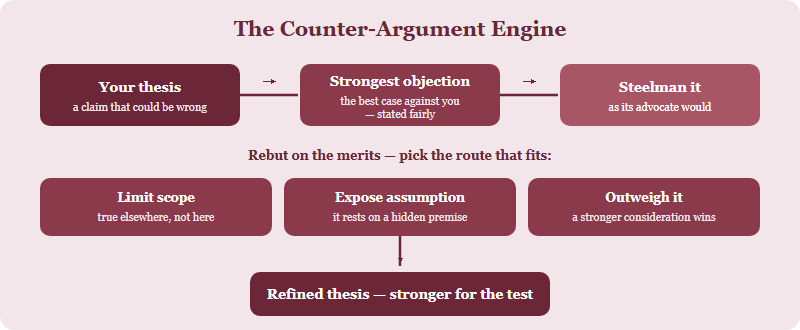
This is the move that most separates shortlisted essays from competent ones, and the one most students skip or fumble. A persuasive argument does not pretend objections do not exist. It seeks out the strongest objection — the “steelman,” the opposite of a strawman — states it as fairly as its best advocate would, and then shows why the thesis survives anyway. Doing this proves three things to an academic reader at once: that you understand the debate, that you are arguing in good faith, and that your position is robust rather than lucky.
Most students get this wrong in one of two ways. They either strawman — knock down a weak version of the objection no serious person holds — which a sharp examiner spots instantly and reads as evasion. Or they concede too much, raising a real objection and then failing to answer it, which quietly hands the argument to the other side. The winning pattern is harder and more honest: make the objection genuinely threatening, then defeat it on the merits.
- Find the real objection. Ask: if a brilliant person disagreed with my thesis, what is the single best reason they would give? Write that, not a convenient substitute.
- State it generously. Use phrasing a proponent would accept — “The strongest case against this view is…” Generosity here is a strength move, not a weakness.
- Rebut precisely. You do not need to destroy the objection. You need to show why, granting its force, your thesis still holds — by limiting its scope, exposing a hidden assumption, or out-weighing it with a stronger consideration.
- Let it refine you. Often the best essays emerge improved from this section: “This forces a qualification — my claim holds for X but not Y,” which is far more credible than pretending nothing dents it.
Move 3: evidence used precisely, not decoratively
Across the ten subject categories — Philosophy, Politics, Economics, History, Psychology, Theology, Law, Public Policy, International Relations, and Science & Technology, plus the Junior Prize — strong essays treat evidence as the load-bearing part of an argument, not as ornament. Weak essays pile up examples and quotations to look learned. Strong essays use fewer pieces of evidence and make each one do a specific job in the chain of reasoning. The test for any sentence of evidence is simple: remove it — does the argument still stand? If yes, it was decoration; cut it and reclaim the words.
Precision also means matching the kind of evidence to the kind of claim. A normative claim (“punishment ought to…”) is not settled by a statistic; it needs a principle and a worked-through implication. An empirical claim (“this policy reduced X”) needs data and a reason to trust the causal story, not a philosopher’s quotation. Mixing these up — answering a values question with numbers, or an empirical question with assertion — is one of the most common ways otherwise-bright essays lose a reader’s confidence.
- Quote sparingly, analyse always. A quotation that is not unpacked is dead weight. The analysis after the quote is where your marks live.
- Prefer one example examined deeply to five name-dropped. Depth demonstrates understanding; breadth often hides its absence.
- Cite honestly and consistently. Reference your sources properly. The official rules govern formatting and the word count’s treatment of notes and bibliography — confirm them on the official site.
- Make every figure earn its place. If a statistic does not move the argument forward, it is taking space a better sentence could use.
Staying analytical inside ~2,000 words
The word limit is not a cruelty; it is a discipline that rewards writers who know what their argument actually is. Roughly 2,000 words is enough to defend one thesis well and nowhere near enough to defend three badly. The single most common self-inflicted wound is the sprawling introduction — three paragraphs of context and throat-clearing that burn 400 words before the thesis appears. Cut it. Open on the claim. Context can be braided into the argument where it is needed, in a clause, not front-loaded as a history lesson.
“Analytical” means every paragraph advances or tests the thesis. A useful editing pass: write the function of each paragraph in the margin — “introduces reason two,” “raises the objection,” “rebuts by limiting scope.” If you cannot name a paragraph’s job, or two paragraphs share one, you have found your cut. This is also where a second reader earns their keep: writers are blind to their own padding, and an experienced mentor can tell within a page whether an essay is arguing or merely describing. The table below catalogues the failure modes we see most often.
| Common failure | What the examiner reads | The fix |
|---|---|---|
| Long contextual intro before the thesis | “This writer is not yet in control.” | Open on the claim; weave context into the argument. |
| Three theses instead of one | “Nothing here is defended properly.” | Choose the most defensible claim; cut the rest. |
| No real counter-argument | “This is advocacy, not analysis.” | Steelman the strongest objection and answer it. |
| Evidence listed, not analysed | “They have read, but have they thought?” | Follow every example with its analytical payoff. |
| Conclusion that only repeats the intro | “The argument went nowhere.” | State what follows if the thesis is right. |
Finally, the conclusion is not a summary — it is the payoff. Having defended your thesis and survived the strongest objection, a winning conclusion answers the “so what”: what changes, what follows, what the reader should now believe or do that they did not before. That forward motion is what leaves an academic reader nodding rather than shrugging.
How coaching fits — honestly
None of the three moves above is a secret, and none can be guaranteed to win a prize against more than sixty thousand entries. What experienced guidance reliably does is shorten the distance between a capable draft and a disciplined one. Our mentors at Hanlin have guided John Locke winners, and the value is rarely in handing over ideas — the best work is unmistakably the student’s own. It is in the questions a good reader asks: Is that your real thesis, or your topic? Is that the strongest objection, or a convenient one? Does this paragraph earn its place? Those questions are exactly what an Oxford-style supervision trains, and they are what this guide is built to help you ask yourself. For our wider library on the competition, see the John Locke coaching home, and pair this with our pieces on choosing a question and managing the timeline. If you want a second reader for a draft, our team works with China-based international-school students on precisely this kind of argument craft.
Frequently asked questions
What is the most important part of a John Locke essay?
A single, original, defensible thesis that the whole essay proves, plus a genuine rebuttal of the strongest objection to it.
How long should a John Locke essay be?
Around 2,000 analytical words. The exact limit and how notes and bibliography are counted are set officially — confirm on johnlockeinstitute.com.
Do I really need a counter-argument?
Yes. Steelmanning and defeating the best objection is what signals robust analysis rather than one-sided advocacy to academic readers.
Can I just copy what past winners did?
No — study what winning essays do structurally (thesis, rebuttal, precise evidence), but never reproduce their text. Your argument must be your own.
This is an independent essay-coaching guide operated by Hanlin Education for China-based international-school students. It is NOT affiliated with, endorsed by, or operated by the official John Locke Institute. Always confirm current rules, dates and word limits on johnlockeinstitute.com. Any error will be corrected within 7 working days.