
You do not need a university library card to research a John Locke essay well. You need three things: a clear idea of what counts as evidence in your subject, a short list of openly available places where that evidence actually lives, and a reading method that gets you to the argument of a paper in fifteen minutes instead of two hours. This guide covers all three.
Why the source base is the quiet differentiator
The organiser lists what judges assess, and two of the seven criteria are about sources: knowledge and understanding of the relevant material, and competent use of evidence. In practice these are where most international-school entries quietly lose ground — not because students are lazy, but because their research stops at whatever is free, fast and in English on the first page of results.
The result is a recognisable kind of essay: fluent, well-structured, correctly cited, and built entirely on secondary commentary. It reads as though the writer has learned about a debate rather than entered it. That essay can be shortlisted. It rarely wins, because originality has nowhere to come from — you cannot make a new point using only the sources that made all the old points.
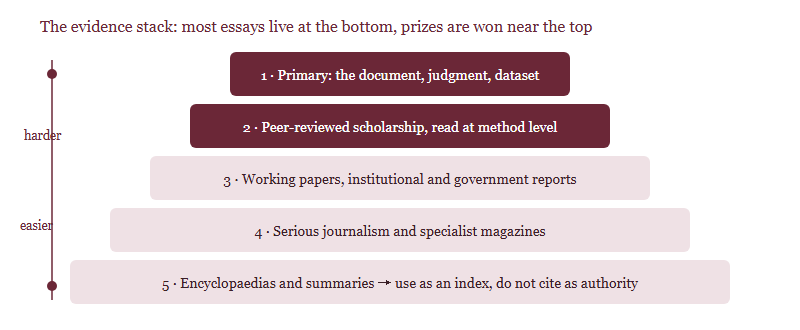
The fix is not “read more”. It is to move one layer down the evidence stack: from commentary about research, to the research itself; from summaries of a treaty, judgment or dataset, to the document or numbers. That single move is available to any student with an internet connection, and most of your competition will not make it.
What counts as evidence in your subject
The ten John Locke categories — Economics, History, International Relations, Law, Philosophy, Politics, Psychology, Public Policy, Science & Technology and Theology — do not all use evidence the same way. A philosophy essay is not weakened by having no dataset; a public policy essay is fatally weakened by it. Work out which family you are in before you start collecting.
| Subject family | What a judge treats as strong evidence | Where it typically lives, openly |
|---|---|---|
| Economics, Public Policy | Empirical estimates, official statistics, evaluated programmes, identified mechanisms | Working-paper repositories, central bank and finance-ministry publications, statistical agencies, multilateral data portals |
| History | Primary documents, contemporary records, and the historiography — how interpretations have changed | National archives and digitised collections, out-of-copyright text libraries, parliamentary and legislative records |
| Law | The judgment or statute itself; then doctrinal commentary | Free case-law databases and official court websites, which publish full judgments |
| International Relations, Politics | Treaty and resolution texts, voting records, speeches in full, and quantitative political-science work | Institutional document archives, national foreign-ministry sites, open political-science preprints |
| Psychology, Science & Technology | Peer-reviewed studies read at method level, including effect sizes, samples and replication history | Open biomedical and preprint repositories, journal open-access sections, registered-report archives |
| Philosophy, Theology | The primary text, read closely; then the best objections to your reading | Open philosophy encyclopaedias for orientation, plus public-domain editions of the primary texts |
The open stack you can reach without a university card
Almost every category of source you need has an openly published route. Names and terms change, so treat this as a map of types rather than a fixed list, and check each site's own access rules:
- Academic search engines. Start with a scholarly search engine rather than a general one, and use its citation-count and “cited by” features to find the papers a field actually argues about.
- Working-paper and preprint repositories. In economics, social science, physical sciences and increasingly medicine, the version of record is often preceded by a freely posted working paper containing the same analysis. This is the single most useful habit for a student without journal subscriptions.
- Open-access directories and journal OA sections. Many journals make a subset of articles permanently free; directories of open-access journals let you search only those.
- Institutional and governmental publications. Statistical agencies, central banks, audit offices, multilateral organisations and regulators publish full methodology alongside their numbers. For policy essays this is tier-1 evidence, not background.
- Primary document archives. Court judgments, legislative debates, treaty texts and declassified papers are routinely published in full by the institutions that produced them.
- Public-domain text libraries. For philosophy, theology and older history, the primary texts themselves are usually free and complete.
- Your own school library. International schools in China often hold database subscriptions that students never use. Ask the librarian what the school licenses — this is the most under-exploited resource in the whole list.
Two cautions. First, if a source cannot be reached or verified, do not cite it — citing something you have not read is a serious integrity problem, and per the organiser some candidates are invited to an online interview, where it would surface immediately. Second, machine translation is fine for orientation but not for close reading of a quoted passage; if your argument rests on the precise wording of a text, you need a published translation you can name.
How to read fast without faking it
You cannot read forty papers properly in a month, and you do not need to. What you need is a triage method that spends five minutes on most sources and two hours on the four or five that matter.
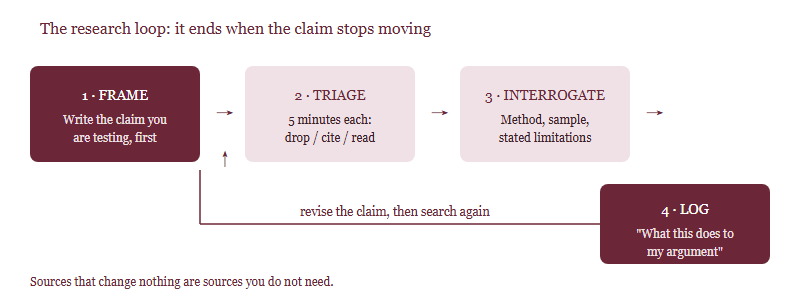
- Frame the question first. Write the claim you are testing at the top of a blank page before you search. Research without a claim expands forever; research against a claim terminates.
- Locate and triage. For each candidate source, read the abstract, then the conclusion, then the first line of each section. Decide in five minutes: discard, cite once for a fact, or read properly.
- Interrogate the keepers. For the four or five that survive, go to the method: what exactly was measured or claimed, on what sample or sources, and what does the author admit their evidence cannot show? The limitations paragraph of a paper is usually the most useful paragraph in it.
- Log and convert. One row per source, and one column that no student ever fills in: what this does to my argument. A source that changes nothing is a source you do not need.
Turning a source into an argument
Collecting is the easy half. The failure that costs marks is the essay where every paragraph ends in a citation but nothing has been argued — evidence stacked as decoration. Three habits fix it:
- Cite for a specific job. Before adding a reference, name what it is doing: establishing a fact, supplying a mechanism, providing a counter-case, or marking a position you reject. If it does none of those, cut it.
- Use a source against itself. The strongest move available to a school-age writer is to take a study or text that is usually read one way and show, from its own content, that it supports a narrower or different conclusion. That is originality with a safety net, because your evidence is already accepted.
- Quote rarely and briefly. Quotation is for wording that matters — a statutory phrase, a defined term, a line whose ambiguity is your point. Everything else should be paraphrased and cited, which also protects your word budget.
That last point matters more than students expect, because per the organiser in-text citations count toward the 2,000-word body limit, while endnotes and the bibliography do not, and footnotes are not permitted. A research strategy that produces thirty parenthetical citations has quietly spent a meaningful slice of your argument on punctuation. Our guide to how a winning essay is built shows where those recovered words are best spent.
The rules that shape how you research
Four official constraints should be in your mind from day one of research, not discovered in the final week. All of them should be re-checked on johnlockeinstitute.com, since details change between cycles:
| Rule (per the organiser) | What it means for your research |
|---|---|
| 2,000-word body limit; diagrams, tables, endnotes and bibliography excluded; in-text citations included | Referencing style is a budget decision. Plan a lean citation habit before you write, not after. |
| Footnotes not permitted; endnotes and/or a bibliography permitted | Discursive asides have nowhere cheap to hide. If a point needs defending, defend it in the body or drop it. |
| Others may point out errors and weaknesses, but no part of the essay may be written by anyone else | Feedback on reasoning is legitimate; delegated drafting is not. Keep your own drafts as evidence of process. |
| AI may be used to develop and stress-test thinking; over-reliance tends to produce less original work, and integrity is checked by various means, including online interviews for some candidates | Never cite a source you have not opened. Assume you may have to discuss any reference in your bibliography unprompted. |
One last piece of planning advice. Research is the part of the process that expands to fill whatever time you give it, so it needs a hard stop — typically when you can state your claim, name your two best sources, and name the strongest objection, all without notes. If you are working toward a future cycle and want to see where that stop belongs in the calendar, subject-specific guides such as our International Relations walkthrough show what a realistic evidence base looks like in one category; younger entrants should read the Junior Prize guide first, since the expectations differ.
FAQ
Can I write a competitive essay without journal subscriptions?
Yes. Working papers, open-access articles, official statistics and primary documents cover most needs. Ask your school librarian what is already licensed.
How many sources should a 2,000-word essay use?
There is no official number. In practice, four or five sources read properly beat twenty skimmed — depth shows, and in-text citations cost words.
Is it acceptable to cite Wikipedia?
Treat encyclopaedias as an index for finding real sources, not as authority. Cite the underlying document, judgment, dataset or study instead.
Can I use AI to find and summarise sources?
Per the organiser, AI may be used to develop and stress-test thinking, but over-reliance weakens originality — and never cite anything you have not read yourself.
This is an independent guide operated by Hanlin Education for China-based international-school students. We are not affiliated with, endorsed by, or sponsored by the John Locke Institute. Rules on word limits, referencing, AI use and integrity checks change between cycles — confirm current details on johnlockeinstitute.com. Any factual error reported to us is corrected within 7 working days.