

Your first page has four jobs: name the term the question is fighting over, state a claim a reasonable person could deny, show that you already know the strongest objection to it, and promise a method. Do those in roughly 250 words and a marker reads on expecting an argument. Miss them and everything good later has to fight uphill.
This is not a point about hooks or elegant sentences. It is about what a reader can infer. Somebody assessing a very large pile of essays forms a working hypothesis about each one early — is this an argument or a report? — and then reads to confirm or overturn it. You cannot control how fast they read. You can control how much of your case is legible before they decide.
The Four Jobs of a First Page
Most students think the introduction exists to introduce the topic. At this level it exists to establish that there is something to argue about and that you know what it is. The four jobs, in order:
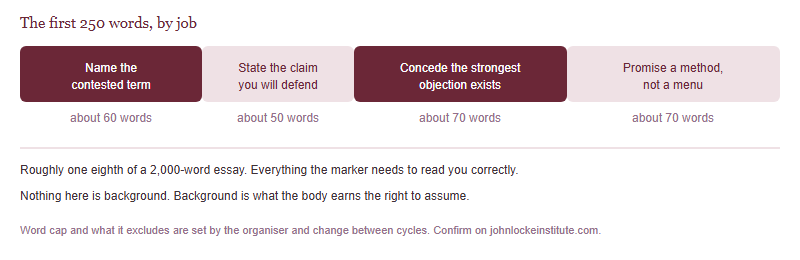
- Name the contested term. Every John Locke question turns on a word doing disputed work — justified, obligation, responsible, knowledge, harm, legitimate. Say which sense you are using and flag that other senses exist. This single move separates an essay that will stay coherent from one that will drift.
- State a claim someone could deny. Not a topic (“this essay examines…”), not a hedge (“there are arguments on both sides”), but a position. If a well-read reader could not disagree with your sentence, it is not a thesis.
- Show you know the best objection. One clause is enough: “even granting that X is the strongest case against this…”. It tells the marker that the counter-argument later in the essay will be real rather than a straw figure set up to be knocked over.
- Promise a method, not a menu. “I argue this in three steps, the last of which does the real work” beats “first I will discuss A, then B, then C.” A menu describes the essay. A method tells the reader what kind of reasoning is coming.
Notice what is absent: background, history of the debate, definitions of uncontested words, and any sentence beginning “Since the dawn of”. None of those are wrong in principle. They are simply unaffordable when the whole essay is capped at 2,000 words.
Four Openings That Lose the Reader
Nearly every weak first page we see in coaching is one of four recognisable shapes. Each is a habit imported from school writing, which is why strong students produce them so reliably.
| Opening type | Typical first sentence | What it signals | The fix |
|---|---|---|---|
| The funnel | “Throughout human history, societies have grappled with questions of justice.” | The writer has not yet decided what they think | Delete every sentence before the first one a reader could dispute. Usually that is sentence four. |
| The dictionary | “The Oxford English Dictionary defines liberty as…” | Definition treated as settled fact rather than as the contested move it is | Give the definition you will use, and say what it rules out and why that is defensible |
| The quotation | An epigraph from a famous thinker, then a paragraph unpacking it | Borrowed authority standing in for the writer’s own claim | Keep the quotation only if you go on to argue that it is wrong, or incomplete |
| The news hook | “Recent events in [country] have brought this issue to the fore.” | Topicality mistaken for relevance; often the first sign of a commentary essay | Move the example to the body as a test of your claim; open on the claim itself |
The funnel deserves special attention because it is the one taught most explicitly in school. The instinct to move from general to specific serves a reader who does not yet know the topic. Your marker knows the topic — they set the question. Broad context is therefore not orientation; it is delay.
A 250-Word Anatomy You Can Fill In
The proportions below are a starting template rather than a formula. What matters is that all four jobs are done before the reader reaches page two, and that no words are spent on anything else.
One mechanical point that specifically affects openings. The organiser caps essays at 2,000 words excluding diagrams, tables of data, endnotes, bibliography and the authorship declaration — but in-text citation formats such as APA are counted. A first page that establishes its credentials with five parenthetical author-and-year citations can therefore lose a meaningful slice of its budget before making a single claim. Openings need almost no citation: you are stating a position, not yet proving it. Where you do cite early, an endnote costs you nothing against the cap. The full referencing question is covered separately on this site; confirm the current rules on johnlockeinstitute.com.
The Handoff: What Paragraph Three Must Do
A strong opening can still be wasted. The commonest way is a handoff failure: the introduction promises an argument and paragraph three delivers a summary of the literature. The reader’s working hypothesis flips back, and the essay never recovers it.
The rule is that your first body paragraph should be the least skippable one. Do not open the body with context, biography of a thinker, or scene-setting. Open it with the load-bearing move of your argument — the step that, if a reader rejected it, would bring the whole thesis down. Everything else in the essay is support for that step or defence of it against objection.
There is a related failure that costs more marks than it should, and it is almost invisible to the writer. A student finishes the introduction, feels the argument is now established, and spends paragraphs three and four justifying the framing rather than using it. Signs of this are easy to spot in your own draft: several sentences beginning “It is important to note that”, a paragraph explaining why the topic matters, or a defence of your definition running past its usefulness. Definitions are worth defending once, briefly, in the opening. Re-defending them in the body means the argument has not started; it means you are still negotiating the terms on which it might.
The cleanest correction is mechanical. Write the load-bearing paragraph first, before the introduction exists, and only then write an opening that sets it up. Openings drafted last are almost always tighter, because by that point you know exactly what has to be promised. Openings drafted first tend to promise whatever the writer hoped the essay would become.
A quick diagnostic: cover your introduction and read from paragraph three. If a stranger could not tell within four sentences what you are claiming, the handoff has failed. The wider architecture — how the thesis, counter-argument and reply fit together across the whole piece — is set out in our breakdown of how a winning John Locke essay is built, and is worth reading alongside this.
Five Tests for Your Own Opening
Run these on your draft before anyone else reads it. Each takes under a minute, and each has a specific diagnosis attached rather than a vague sense that something is off.
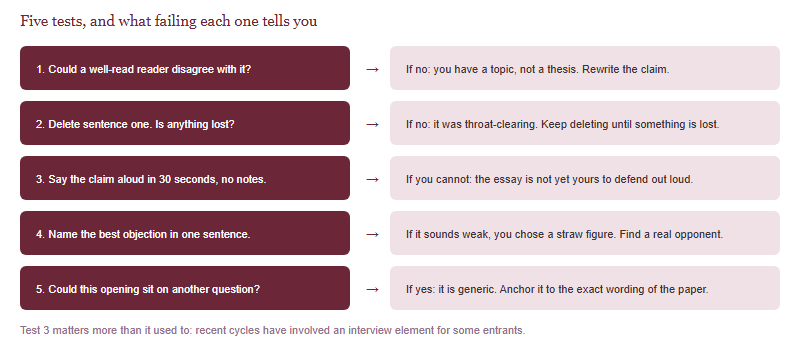
Test five is worth dwelling on because it catches a specific and expensive error. Students often draft an opening from their general interest in a subject and only later attach it to the paper they have chosen. The result reads as competent and unanchored. Since you select from a published list rather than writing your own title, the exact wording of the question is your most useful raw material: the verbs in it tell you what kind of answer counts, and an opening that quietly re-words the question into an easier one is answering something nobody asked.
Test three has become more consequential than it was. With verification of authorship now including a referee and, in recent cycles, an interview element for some entrants, an opening you cannot deliver aloud in your own words is a warning sign rather than a stylistic preference. Confirm the current position on johnlockeinstitute.com. In practice this cuts the same way as good writing advice anyway: a claim you can say plainly is usually a claim you understand.
Two final notes on scope. Younger writers entering the under-15 route face the same four jobs on a shorter runway, and the compression makes the opening matter more, not less — our Junior Prize guide covers what changes. And openings look different across categories: an opening in the International Relations category usually has to establish a level of analysis before it can state a claim, where a philosophy opening can go almost straight to the claim. Across our own de-identified 2026 cohort — 86 shortlisted, 76 global awards — the single most common note our coaches wrote on second drafts was not about evidence or structure. It was: your argument starts on page two.
Questions Students Ask
How long should a John Locke introduction be?
Around 200 to 250 words of a 2,000-word cap. Much longer usually means you are still clearing your throat.
Should I open with a quotation?
Rarely. A quotation spends words on someone else’s authority before you have made any claim of your own.
Do in-text citations count toward the word limit?
Per the organiser, in-text styles such as APA count; endnotes and bibliography do not. Confirm on johnlockeinstitute.com.
Should I state my conclusion in the introduction?
Yes. Withholding the answer is a school habit. A marker should know what you defend by the end of page one.
This is an independent guide operated by Hanlin Education for China-based international-school students. We are not affiliated with, endorsed by, or sponsored by the John Locke Institute. Rules, dates, word limits and eligibility change between cycles — confirm current details on johnlockeinstitute.com before you rely on anything here. Errors reported to our editorial desk are corrected within 7 working days.