
A parent can do a great deal for a John Locke entry without touching a sentence of it: protect the calendar, own the registration deadline, be the person the argument gets explained to, and hold the standard when a draft is merely finished rather than good. What a parent cannot do is supply the thesis, rewrite the prose, or commission the work. This guide draws the line and explains why it has become sharper.
We write this because the question comes up in almost every family conversation we have, and it is usually asked backwards. Parents ask “how much am I allowed to help?” when the more useful question is “which kinds of help actually raise the essay, and which kinds quietly destroy its value?” Those turn out to be almost the same list.
Why the Authorship Line Got Sharper
It is easy to assume authorship is governed by a declaration and by trust alone. That is not the whole picture. The organiser states that it uses various means to identify plagiarism, contract cheating, the use of AI and other forms of fraud, and it requires an academic referee — a teacher who knows the student’s work — to verify that the essay is genuinely the entrant’s own. Recent cycles have also introduced an interview element for some entrants, as we have covered elsewhere on this site. Every one of those checks is a check on the same thing: is the person whose name is on this essay the person who thought it?
On AI specifically, the organiser’s published position is permissive but pointed: contestants may use such tools, while stating that such tools should be used for research support and as a thought partner, not as a substitute for the human author, and warning that an AI-produced essay will generally be inferior and markedly less original. Read that carefully and it is less a rule than a description of what happens. In a field this size, the fastest route to invisibility is a competent, characterless essay. That is exactly what heavy adult editing produces too.
The practical consequence for a parent is simple. Help that leaves the student able to explain, defend and extend every claim in the essay is safe and useful. Help that leaves a document the student could not reconstruct out loud is a liability, whether it came from a parent, a tutor or a language model. Confirm the current verification, interview and AI rules on johnlockeinstitute.com before the cycle opens — the organiser has changed them between years.
Three Lanes: Safe, Grey, Over the Line
The table below is our own working framework from coaching conversations, not organiser guidance. The test running through it is the one above: after this help, can the student still account for the essay as theirs?
| Parent action | Lane | Why |
|---|---|---|
| Reading the published question list together and talking about which interests them | Safe | Choosing is the student’s; discussion is how choices get tested |
| Asking “why would someone disagree with that?” and then staying quiet | Safe | The single highest-value thing a non-specialist adult can do |
| Managing registration dates, the referee request, file naming and submission logistics | Safe | Administrative, not intellectual; see the calendar trap below |
| Listening to the argument read aloud and saying where you got lost | Safe | You are reporting your experience as a reader, not supplying content |
| Paying for teaching, feedback or subject coaching | Grey | Normal, but the boundary must hold: coaches teach and question; they do not write |
| Pointing at a paragraph and saying “this is unclear” | Grey | Fine once. Doing it line by line until the prose is yours is not |
| Correcting grammar throughout the draft | Grey | For a second-language writer this quickly becomes co-authorship of the voice |
| Suggesting the thesis, or which side to argue | Over the line | The thesis is the thing being assessed |
| Rewriting sentences, paragraphs or the conclusion | Over the line | Produces text the student cannot defend in an interview |
| Finding and summarising the sources so the student can cite them | Over the line | Reading is where the argument is actually formed |
| Commissioning any part of the essay from anyone | Over the line | Contract cheating; the organiser states it screens for exactly this |
The Four Jobs Only a Parent Can Do
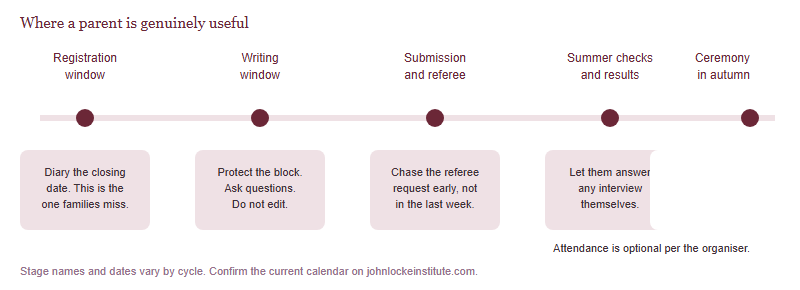
1. Own the calendar trap. This is the most concrete favour you can do, and it is invisible to most families until it costs them the year. In the 2026 cycle the competition ran as two separate stages: a registration window that opened in early February and closed at the end of March, and a submission window that ran from 1 April to 31 May. That means a student can be working diligently on an essay in April, entirely on schedule in their own mind, and already be ineligible because nobody registered in March. Late submission existed but carried a fee — a modest sum for a seven-day extension and a larger one for twenty-one days. Registration, not writing, is the deadline a parent should have in a calendar with two reminders. Dates and fees change annually; confirm the current cycle’s on johnlockeinstitute.com.
2. Protect four uninterrupted hours a week. A 2,000-word argumentative essay is not built in twenty-minute gaps between tutoring sessions. The scarce resource in an international-school student’s year is not ability; it is a continuous block long enough to hold a difficult idea in mind. Defending that block against everything else on the family schedule is a parent’s job in a way that no coach can do.
3. Be the intelligent non-specialist. Ask your child to explain the argument in two minutes, without notes, in whichever language is easier for them. If it takes six minutes and arrives nowhere, the essay has a structural problem that no amount of polishing will fix. You do not need to know the subject to run this test. You only need to notice whether you were persuaded.
4. Hold the standard without setting the content. “Is this the version you want a stranger to judge?” is a legitimate parental question. “I think you should argue the opposite” is not. The difference matters more than it sounds: the first raises effort, the second transfers ownership.
When the Answer Is No: the September Conversation
By early autumn most families know their outcome, and the majority of them are having a version of the same conversation. It is worth preparing for, because the reflex response makes things worse.
Two things are true at once and both should be said. The first is that not being shortlisted in a field of this size carries very little information about a specific student. The organiser has reported entry numbers in the tens of thousands in recent cycles, from students in many countries; a strong essay can miss for reasons that have nothing to do with its quality, including the density of the particular category that year. The second is that a near miss usually does have a diagnosable cause, and it is nearly always the same one: the essay described a subject rather than defending a claim. That is fixable, and it is fixable in a way that improves school essays, personal statements and interviews at the same time.
What does not help is treating the result as a verdict on the child, or immediately buying more tutoring. What does help is asking them to re-read their own essay in September and mark every sentence that a reasonable person could dispute. Most students find far fewer than they expected. That discovery is worth more than the prize would have been. For a younger student who entered the under-15 route, the same exercise applies with a shorter runway — our Junior Prize guide sets out what changes at that age.
What a Result Actually Does Inside an Application
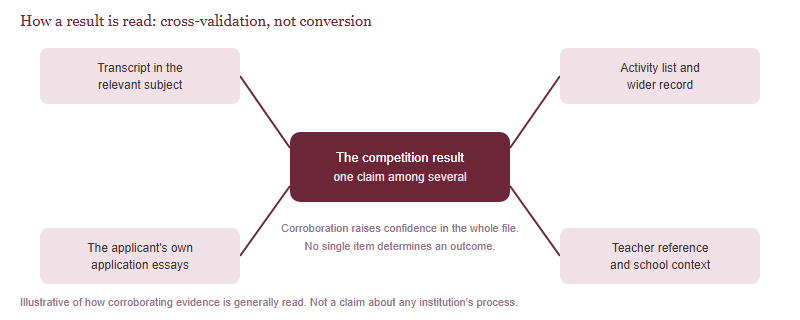
Parents reasonably want to know what this is worth. The honest answer is that a John Locke result works by corroboration, not by conversion. An admissions reader does not treat an award as a standalone credential to be exchanged for a place. They read it against everything else in the file: the transcript in the relevant subject, the activity list, the applicant’s own essays, and the teacher reference. When those four things point the same way — a student who says they are serious about political philosophy, whose grades in that area are strong, whose reading shows up in their writing, and whose teacher describes the same person — the whole file becomes more believable. That is the mechanism. A result that contradicts the rest of the file does much less work.
Two cautions on value. First, we do not publish, and would not believe, a figure for how much a competition result raises anyone’s chances; nobody can isolate that variable, and any provider quoting one is guessing. Second, on prizes specifically: in the 2026 cycle the organiser listed category prizes at US$5,000, US$2,000 and US$1,000 for first, second and third, with a grand prize described as a US$10,000 scholarship toward attending its summer schools. A scholarship toward a programme is a real benefit, but it is not a cash transfer, and families should read the current terms rather than the headline number. Confirm all prize details on johnlockeinstitute.com.
Our own de-identified records for the 2026 cycle show 86 students shortlisted and 76 global awards across the cohort we worked with. We publish that because it is ours to publish and it is checkable internally; we cannot and do not translate it into any claim about where those students were admitted. If you want to understand what actually separates an essay that places from one that does not, the mechanics are set out in our breakdown of how a winning essay is built, and the subject-by-subject differences — for instance in the International Relations category — are covered separately.
Questions Parents Ask
Can I read my child’s John Locke essay?
Yes. Reading it and asking questions is fine. Rewriting sentences or supplying the argument is not.
Is paying for a tutor allowed?
Teaching and feedback are normal; writing any part of the essay is not. A referee verifies the work is the student’s own.
What does it cost to enter?
Entry in the regular window is free. Late submission carried a fee in the 2026 cycle. Confirm current fees officially.
Do we have to travel to the ceremony?
Per the organiser, attendance is optional and winners do not need to travel to receive their prizes. Confirm before booking.
This is an independent guide operated by Hanlin Education for China-based international-school students. We are not affiliated with, endorsed by, or sponsored by the John Locke Institute. Rules, dates, fees, eligibility and prizes change between cycles — confirm current details on johnlockeinstitute.com before you rely on anything here. Errors reported to our editorial desk are corrected within 7 working days.