

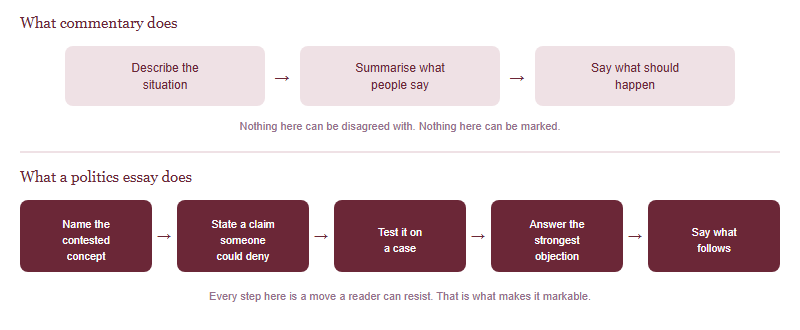
A John Locke Politics essay is not a piece about what is happening in the world. It is an argument about a contested political concept — legitimacy, authority, representation, coercion, consent — tested against cases. The most common failure is a well-informed student writing 2,000 words of intelligent commentary and never once making a claim an intelligent reader could deny.
Politics is the last of the ten John Locke categories we have covered in this subject series, and it is the one where strong general knowledge is most likely to work against you. Students who read widely about elections, wars and legislation arrive with a great deal to say. Saying a great deal is not the task. This guide sets out what the category actually asks for, the four ways politics essays lose their marker, and a skeleton you can build against.
What the Politics Category Is Actually Asking
Every John Locke question is set by the Institute; you choose one from the published list rather than inventing a title, so your first act of judgement is interpretive, not creative. Politics questions tend to be phrased in the vocabulary of normative political theory: whether something is justified, whether an institution has authority, whether a duty binds, whether a form of rule is legitimate. Those words are the instruction. They are asking you to reason about the standards by which political arrangements are judged, not to report on how a particular arrangement is currently going.
This is why an essay can be factually excellent and still score poorly. If your conclusion is a description of the world — “polarisation has increased”, “trust in institutions has declined” — you have written a report. If your conclusion is a normative claim — “a citizen has no standing duty to obey an unjust law where a legal remedy exists” — you have written a politics essay, and a reader can now agree or disagree with you. That disagreement is the point. An argument nobody could reject is not an argument.
Two structural facts shape how much room you have. The organiser caps essays at 2,000 words, excluding diagrams, tables of data, endnotes, bibliography and the authorship declaration; in-text citation styles such as APA count toward that limit, while endnotes do not. And entry is free within the regular window, with registration and submission running as two separate stages of the cycle. Both are worth confirming for the current year on johnlockeinstitute.com, because the calendar and the fee structure for late entry have moved between cycles.
Four Ways a Politics Essay Loses Its Marker
In our own coaching, most weak politics drafts are recognisably one of four types before the end of page one. Each has a specific repair, and the repair is almost never “add more research”.
| Failure type | What it looks like | Why it costs marks | The repair |
|---|---|---|---|
| The op-ed | Confident opinions about a live controversy, written in the register of a newspaper column | Asserts values rather than arguing for them; no premise a reader can attack | Convert each assertion into a claim plus a reason, then ask what the reason assumes |
| The survey | “Hobbes says X, Locke says Y, Rousseau says Z, in conclusion it is complex” | Reports a debate instead of entering it; no thesis of your own | Pick the position you will defend in sentence three, then use the thinkers as pressure on it |
| The manifesto | A programme of reforms the world should adopt | Answers a policy question the paper did not ask; smuggles in the value premise | Argue for the principle; if instruments and trade-offs are your real interest, that is Public Policy |
| The chronicle | A detailed narrative of one country’s recent politics | Case material with no general claim for it to test | State the general claim first; keep only the case detail that could falsify it |
Build on a Concept, Not on a Country — and Use Cases as Tests
The single most useful decision in a politics essay is choosing your unit of analysis. Students default to a country, an election or an institution, because that is what they have read about. Markers reward essays built on a concept, because a concept is the only thing an argument can be about. A country is a place where evidence lives.
Practically, that means your second paragraph should be doing definitional work that the rest of the essay will cash out. Take “legitimacy”. It can mean at least three different things: that a government came to power by an accepted procedure; that it is generally obeyed; or that its commands generate real moral obligations. Those are not shades of one idea — they are three different claims, and an essay that slides between them will contradict itself by page four. Choosing one, saying why you have chosen it, and holding to it is worth more than any amount of additional reading.
A quick test before you commit: write your contested concept, then write the sentence “Someone could reasonably hold that this means ___ instead.” If you cannot fill the blank, the concept is not contested and you have chosen a topic rather than a question. Go back to the paper and pick a term that genuinely divides people.
- Concepts that carry an essay: legitimacy, authority, consent, representation, coercion, toleration, rights, sovereignty, obligation, accountability.
- Words that look like concepts but are not: democracy, populism, freedom, justice — not because they are unimportant, but because they are too large to define and defend inside 2,000 words. Narrow them before you use them.
Evidence: cases as tests, not decoration
Politics essays fail on evidence in a particular way. The material is usually accurate; the problem is that it is doing no work. A case is doing work when it could have come out the other way — when, had the facts been different, your claim would be in trouble. A case is decoration when it is introduced by “for example” and could be swapped for any of six others without changing a word of the argument.
Two moves raise the quality of evidence immediately. The first is to name in advance what the case is testing: “If the procedural account of legitimacy is right, we should expect X; the following case is one where X does not hold.” The second is to include one case that is awkward for you. An essay that only presents friendly evidence tells a marker that the writer has not looked for trouble; an essay that meets a hard case head-on and either accommodates it or explains its limits reads as the work of someone doing philosophy rather than advocacy.
On volume: three or four texts you have genuinely read, and can quote precisely, outperform a bibliography of twenty. This matters more than it used to. The organiser states that it uses various means to identify plagiarism, contract cheating and the use of AI, and requires an academic referee to verify that the work is the entrant’s own; recent cycles have also involved an interview element for some entrants. A source list you cannot discuss out loud is a liability, not an asset. Confirm the current verification and interview rules on johnlockeinstitute.com before you submit.
Where Politics Stops and the Neighbouring Categories Begin
Politics sits between three neighbours, and the boundaries are worth knowing because the same idea scores very differently depending on where you file it.
| Category | Central question | Test of a good answer |
|---|---|---|
| Politics | Is this arrangement of power justified, and on what standard? | The standard is defended, not assumed |
| Philosophy | Is the underlying concept coherent at all? | The analysis survives without political examples |
| Public Policy | Which instrument achieves the goal, at what cost, with what side effects? | Trade-offs are quantified or at least confronted |
| International Relations | How do states and other actors behave under anarchy, and what follows? | The claim holds across more than one dyad or period |
The boundary that catches most students is the Politics / International Relations line. If your argument is about the standard by which authority within a community is judged, you are in Politics. If it is about how actors relate to one another in the absence of a common authority, you are closer to the International Relations category and the kind of thesis it expects. Sovereignty questions can genuinely go either way, which is exactly why the paper you choose should be the one whose framing you can hold for 2,000 words.
A Working Skeleton and Where the Words Go
The allocation below is a starting point, not a rule. What matters is the proportion: the objection section is the largest single block, because in our own coaching the drafts that place are rarely the ones with the most information. They are the ones that took the strongest case against themselves seriously. The general architecture of thesis, counter-argument and reply is covered in more depth in our guide to how a winning John Locke essay is built; what follows is the politics-specific version of it.
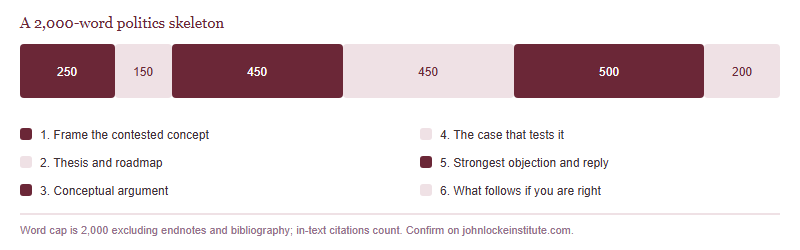
One first-party note on how this plays out at scale. Across the 2026 cycle our own de-identified cohort records show 86 students shortlisted and 76 global awards; the drafts that moved were, with very few exceptions, the ones that got smaller rather than broader between the second and final version. Narrowing is the intervention that works. Adding a fourth thinker is almost never it. Younger writers working toward the same standard should read this alongside our guide to the Junior Prize, where the concept-first discipline matters just as much on a shorter runway.
Questions Students Ask
Is Politics the same as Public Policy at John Locke?
No. Politics asks what is legitimate or justified; Public Policy asks which instrument works, at what cost, and with what side effects.
Can I write about a current government or leader?
Yes, as a test case for a general claim. An essay that only narrates one country and one year reads as commentary, not argument.
Do I have to stay neutral in a Politics essay?
No. Take a side and defend it. What you must avoid is campaigning: asserting a value instead of arguing your way to it.
How many sources does a Politics essay need?
Fewer than students expect. Three or four texts you have genuinely read beat twenty skimmed titles in a bibliography.
This is an independent guide operated by Hanlin Education for China-based international-school students. We are not affiliated with, endorsed by, or sponsored by the John Locke Institute. Rules, dates, word limits, eligibility and prizes change between cycles — confirm current details on johnlockeinstitute.com before you rely on anything here. Errors reported to our editorial desk are corrected within 7 working days.