

A Public Policy essay argues that a particular instrument is better than a named alternative, judged against a stated goal by a stated measure. That sentence contains four commitments — instrument, alternative, goal, measure — and an essay missing any one of them reads as an opinion column with footnotes. This guide walks through the craft: the spine of a policy argument, how to write evidence that disagrees with itself, and where these essays lose marks.
Two constants first. You answer one of the questions the Institute publishes in your chosen category, as written; you do not set your own title. And the published assessment criteria — knowledge and understanding, use of evidence, quality of argumentation, originality, structure, writing style and persuasive force — apply here as everywhere. Word limits, deadlines, age rules and the fee position are the Institute's and change between cycles: confirm the current position on johnlockeinstitute.com.
The One Sentence That Separates Policy From Opinion
Almost every weak Public Policy essay we read shares a single structural feature: it argues that something should happen without ever saying what would count as it having worked. The writer knows what they want. They have not told the reader how anyone could tell whether they got it.
This matters because Public Policy is the category where the argument is fundamentally about consequences under constraint. Politics can argue about who has the right to decide. Philosophy can argue about whether a principle is sound. Public Policy has to argue about what happens when a real government does a specific thing with a limited budget and imperfect information — and that argument is empty unless something is being measured.
The test is blunt. Take your thesis and ask: what observation, in five years, would show me I was wrong? If you cannot answer, you have written a preference, not a policy argument. Judges do not need you to be right about the future. They need to see that your claim was the kind of claim that could have been wrong.
The Five-Part Spine
Every policy argument that works has the same underlying skeleton, whatever the topic. School essays typically begin at step three — here is a policy I like — and stop there. The marks are in steps one, two, four and five.
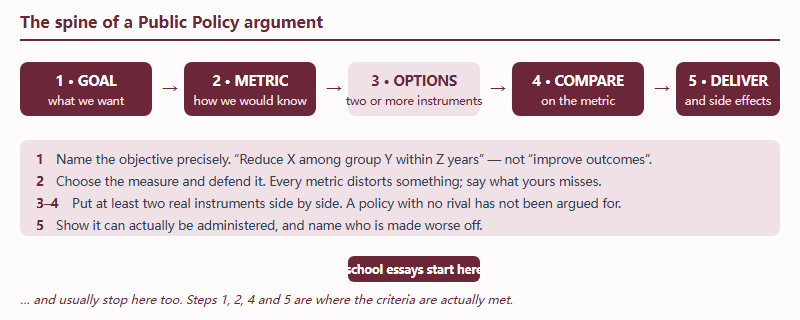
Step two deserves a note, because it is the step most students skip and the one specialists notice immediately. Every metric distorts. Measure school quality by exam results and you get teaching to the test; measure hospital performance by waiting times and you get patients reclassified. An essay that names its metric and admits what the metric misses demonstrates exactly the judgement the category exists to test. That single paragraph is often the strongest in a student's essay, and it costs about eighty words.
A compact worked example makes the spine concrete. Suppose your question invites an argument about reducing youth unemployment. Goal: raise the share of 18- to 24-year-olds in work or training within five years. Metric: that share, measured annually — while admitting it counts a six-week placement the same as a durable job. Options: a wage subsidy paid to employers, set against a publicly funded training entitlement. Comparison: the subsidy moves the metric faster but risks paying firms for hires they would have made anyway; the training route is slower and depends on whether employers actually value the qualification. Delivery: the subsidy needs little more than a payroll system, while the training route needs providers, places and quality control that may not exist. Every element there is illustrative, written by us to show the shape rather than drawn from any published question — but notice how much argument is already available before a single study has been cited.
Comparing Instruments Honestly
Once you have a goal and a measure, the essay becomes a comparison. The trap is the straw alternative — a rival policy introduced only to be knocked over. Judges have read that essay many times. The table below sets out how we ask students to run a comparison so that it survives a specialist reader.
| Dimension | The question to answer | Weak version | Strong version |
|---|---|---|---|
| Effect size | How much does it move the metric? | “Studies show it is effective” | A magnitude, a population, a time horizon, and the study design behind it |
| Cost | What does it consume, and instead of what? | Cost mentioned once, then dropped | Cost held against the alternative use of the same money |
| Incidence | Who gains and who pays? | “Society benefits” | Named groups, including the ones your preferred policy harms |
| Feasibility | Can the administering body actually do this? | Implementation assumed | The capacity, information and enforcement the instrument requires |
| Reversibility | What if it fails? | Not addressed | Whether the policy can be unwound, and at what cost |
| Second-order effects | How do people respond? | Behaviour assumed fixed | Anticipated adaptation, avoidance or substitution by those affected |
Note the last row especially. Policy acts on people who respond to it, which is why so many interventions produce less than they promise: firms restructure, households substitute, the regulated relabel. A student who anticipates the response rather than assuming a static world is doing genuine policy analysis, and it is one of the more reliable routes to an original thesis within a familiar topic.
Writing Evidence That Disagrees With Itself
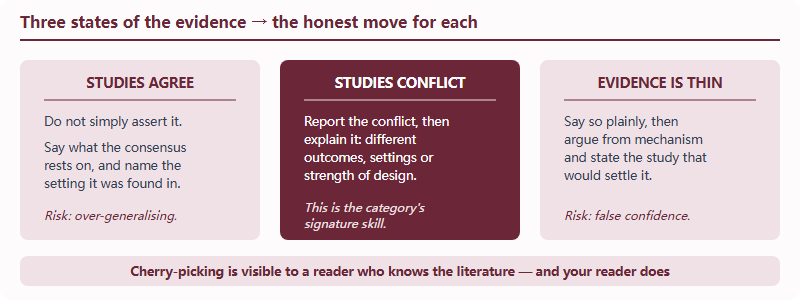
Here is the signature skill of the category, and the one that most distinguishes a strong entry. Real policy evidence is messy. Studies conflict, effects vary by context, and the honest answer is frequently “it depends, and here is what it depends on.” Students fear this, so they cherry-pick, and cherry-picking is visible to anyone who knows the literature.
The professional move is the opposite: report the disagreement, then explain it. Do the studies differ because they measured different outcomes, ran in different institutional settings, or used designs of different strength? Explaining a conflict is a higher-order analytical act than citing a convenient result, and it converts your essay's weakest-looking moment into its most credible one.
The Counterfactual and the Unintended Consequence
Two errors account for a large share of the policy essays that read as capable but not competitive.
The missing counterfactual. A policy was introduced; the outcome improved; the essay concludes the policy worked. But something else may have improved anyway. Any claim that an intervention caused an outcome needs some account of what would have happened without it — a comparison group, a trend before and after, a region that did not adopt it. You do not need econometric machinery to do this well. You need to show the reader you know the question exists, and to say honestly how confident the available comparison lets you be.
The absent loser. Nearly every policy makes someone worse off, and an essay in which the preferred instrument has no victims has not looked hard enough. Naming who bears the cost is not a concession that weakens your case; it is the move that makes the case credible, and it gives you somewhere honest to put your counter-argument. The structural role of that counter-argument is the same across every category, and we set out how to build it in our guide to how a winning John Locke essay is built.
Is Public Policy Your Category?
Choose it if you enjoy the machinery of getting something done — budgets, trade-offs, delivery, evaluation — and if you can tolerate concluding that the evidence is mixed. It rewards students who read evaluation literature rather than commentary, and who are comfortable saying “this instrument is better on this measure, and here is what it costs.”
Look elsewhere if your real interest is who has the right to decide rather than what works, or if your question keeps crossing borders and turning into a story about states, treaties and conflict — that is the terrain our International Relations guide covers. Younger students building toward this category over more than one cycle can practise the same argumentative discipline through the Junior Prize, which draws on the same published question sets. Before committing a season to any category, read that category's current questions yourself — they are published by the Institute on johnlockeinstitute.com, and they change each cycle.
Across the 2026 cycle, students we coached recorded 86 shortlistings and 76 global awards, per our own internal records and reported here de-identified. The pattern we take from the policy entries specifically is narrow: the essays that travelled furthest were the ones that named a measure early and stayed loyal to it. That is an observation about craft, not a promise — no method guarantees a shortlisting, an award, or any admissions outcome, and results vary from student to student.
Frequently Asked Questions
Do I need statistics to write a Public Policy essay?
No. You need to read evidence carefully and say how confident it lets you be. Precision of reasoning matters more than technique.
How many policy options should I compare?
Usually two, occasionally three. Within roughly 2,000 words, more options means less depth on each comparison.
Can I conclude that the evidence is inconclusive?
Yes, if you say what would settle it. An honest unresolved ending beats manufactured certainty a specialist can see through.
Should I write about my own country's policy?
Only if you can source it properly. Familiarity helps; verifiable evidence and a real comparison case matter more.
This is an independent guide operated by Hanlin Education for China-based international-school students. We are not affiliated with, endorsed by, or sponsored by the John Locke Institute. Question sets, word limits, eligibility, deadlines and fees are set by the Institute and change between cycles — confirm current details on johnlockeinstitute.com before acting on anything here. Errors reported to our editorial desk are corrected within 7 working days.