

The moment you pass the Junior age ceiling, you enter the senior competition — and the senior competition does not sort by age. A student who has just turned 15 is read against Year 13 students who have had three more years of reading. That gap is real, but it is narrower than it looks, and it sits in specific places. This guide sets out where you are genuinely behind, where age buys nothing at all, and how to spend the months in between.
Start with the rule, because it is the whole reason this article exists. In the published rules for the 2026 cycle, the Junior Prize was defined by age at the submission deadline — under 15 on that date — and the competition as a whole was open to entrants under 19 on that same date, with no minimum age stated. Everything above the Junior threshold and below the ceiling sits in one pool. Age thresholds, deadlines, fees and any election between brackets are set by the Institute and move between cycles, so confirm the current position on johnlockeinstitute.com before you plan around a date here.
The Cliff Is a Date, Not a School Year
The most common confusion we correct is students assuming their bracket follows their year group. It does not. It follows a birthday measured against a single date on the calendar, which means two students in the same class can be in different brackets, and a student can be Junior-eligible one cycle and senior the next without any change in what school calls them.
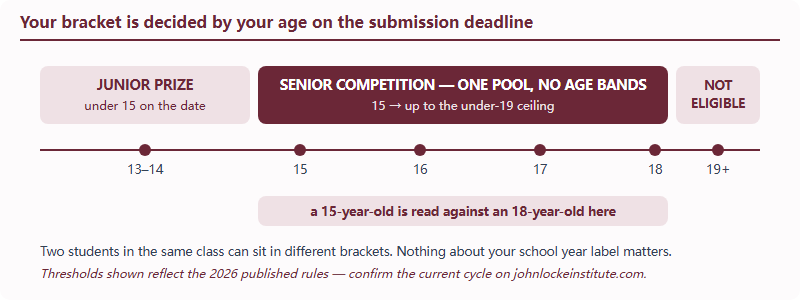
One consequence worth planning around: if you are close to the threshold, the arithmetic of which cycle you enter can decide which bracket you are in, and that is a genuine strategic variable rather than an accident. Students who are still Junior-eligible should read our Junior Prize guide, which covers that side of the line in detail.
Where the Three-Year Gap Actually Sits
It helps enormously to be precise about what an older entrant has that you do not, because the honest list is shorter than the anxious one. Three more years buys reading time, subject vocabulary and some intellectual confidence. It does not buy better judgement about a question, and it does not buy a cleaner argument — we read plenty of Year 13 essays that sprawl.
| What the essay is judged on | Does age help? | Why | What you do about it at 15 or 16 |
|---|---|---|---|
| Breadth of reading | Yes, substantially | Three more years of books is three more years of books; there is no shortcut | Do not compete here. Narrow the question until your reading is deep enough to be sufficient |
| Subject vocabulary | Yes | Older students have met more technical terms and use them without strain | Learn ten terms properly rather than fifty loosely; misused jargon is worse than plain English |
| Named-debate awareness | Yes, moderately | Knowing who disagrees with whom takes exposure | Find one live disagreement in your topic and learn both sides thoroughly |
| Question discipline | No | Answering the question asked is a habit, not an accumulation | Train it deliberately — this is where younger entrants most often beat older ones |
| Argument shape | No | Thesis, objection, response is a structure you can master in weeks | Drill it until it is automatic; it is fully available to you now |
| Concision | No — often the reverse | Older students frequently have more to say and cut less ruthlessly | Treat the word limit as an advantage; a tight 2,000 words reads as control |
| Originality | No | A non-obvious thesis comes from thinking hard about one question, not from seniority | Spend your time here — it is the highest-return use of an extra month |
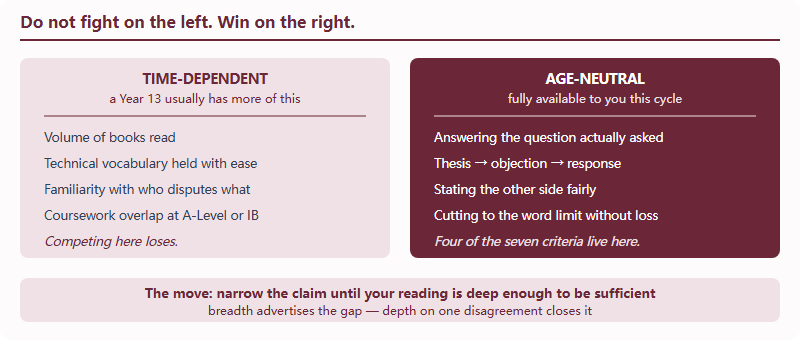
Read the “No” rows again, because they are four of the seven published assessment criteria — argumentation, structure, originality and writing style are all things a 15-year-old can do as well as anyone. The criteria that reward accumulated years are knowledge and understanding, and to a degree the competent use of evidence. That is the shape of the problem, and it tells you exactly how to spend your time.
The Strategy: Narrow Rather Than Broaden
The instinct of a younger entrant facing an older field is to compensate by covering more ground — more thinkers cited, more context supplied, more of the topic surveyed. This is precisely backwards, and it is the single most common way we see capable 15- and 16-year-olds hand away their advantage.
Breadth is where an 18-year-old will beat you, every time. Depth on a deliberately narrow claim is where the gap disappears, because a narrow claim needs a small number of sources handled precisely, and precision is age-neutral. A 15-year-old who has genuinely mastered one disagreement, can state the opposing case fairly, and answers it in clear prose is doing exactly what the criteria ask for. A 15-year-old who name-drops eight thinkers is advertising the gap.
Two Cycles Beat One — If the First Is Taken Seriously
A 15-year-old has something an 18-year-old does not: remaining cycles. Under the published 2026 rules, entry itself was free, which makes a multi-cycle plan practical in a way it would not be if every attempt carried a significant cost. That fee position, like everything else, is the Institute's to set and should be confirmed for the current cycle.
The plan we recommend is deliberately unglamorous. Treat your first senior entry as a real attempt with a real argument, and treat what comes back — whether or not it goes further — as diagnostic information you could not have bought any other way. In our coaching experience, students who enter twice with three years of growth between attempts almost always produce a visibly stronger second essay, not because they learned a technique but because they learned what a competitive argument feels like from the inside.
What ruins this plan is entering unseriously the first time. A rushed entry teaches nothing, because there is no honest signal in the result of an essay you did not really write. If you cannot give the first attempt a genuine effort, wait a cycle.
What Our Own Record Does and Does Not Tell You
Across the 2026 cycle, students we coached recorded 86 shortlistings and 76 global awards in the John Locke competition, per our own internal records and reported here de-identified. We publish that because it is evidence of experience with the format, and for one specific reason relevant to this article: our stronger younger entrants have consistently been the ones who narrowed their questions, not the ones who tried to read like a Year 13.
Read the limits of that figure honestly. It describes students who chose to prepare with support, over one cycle, and it says nothing about what any individual essay will achieve. No coaching, method or checklist can promise a shortlisting, an award, or any university outcome. Results vary, the field changes every year, and the judging is entirely the Institute's.
A Checklist for the Younger Senior Entrant
- Confirm your bracket by date, not year group. Work out your age on the submission deadline for the cycle you intend to enter, using the current published dates.
- Choose a category your reading can already serve, rather than the one that sounds most impressive. Nothing exposes an age gap faster than a category you have not read for.
- Narrow the claim twice. Whatever question you pick, your first framing is almost certainly too broad; the second cut is where the essay becomes writable.
- Master the architecture. Thesis, strongest objection, response, consequence — our guide to how a winning John Locke essay is built sets out the moves in full, and they are entirely learnable at 15.
- Read one live disagreement to the bottom. Four sources handled precisely will outperform fifteen skimmed, at any age.
- Avoid categories that reward accumulated context unless you already have it. If you are drawn to a category like International Relations, be honest about whether you can currently supply the background it assumes.
- Write to the limit deliberately. A controlled 2,000 words is a demonstration of judgement, and judgement is the thing nobody can tell your age from.
The summary is short. You are behind on reading and level on thinking. Build the essay around the second fact.
Frequently Asked Questions
Is there a separate bracket for 15- and 16-year-olds?
No. Above the Junior age ceiling, entrants sit in one senior pool regardless of age. Confirm current brackets on johnlockeinstitute.com.
Which age decides my bracket — now, or at the deadline?
The published rules define brackets by age at the submission deadline, not by school year group or your age when you register.
Is it worth entering at 15 if I probably will not win?
Often yes, if the attempt is genuine. A serious first entry teaches what a competitive argument feels like; a rushed one teaches nothing.
Can I enter in more than one cycle?
Students commonly enter across successive years while under the age ceiling. Rules on repeat entry are the Institute's — check the current cycle.
This is an independent guide operated by Hanlin Education for China-based international-school students. We are not affiliated with, endorsed by, or sponsored by the John Locke Institute. Age thresholds, deadlines, fees and eligibility are set by the Institute and change between cycles — confirm current details on johnlockeinstitute.com before acting on anything here. Errors reported to our editorial desk are corrected within 7 working days.