
Theology at John Locke is not a test of faith and not a survey of world religions. It asks you to argue about claims — about God, revelation, religious authority, suffering, the relationship between faith and reason — with the same discipline any other category demands. You do not need to be religious to enter. You do need to take religious claims seriously enough to state them at full strength before you touch them.
Two structural facts shape everything below. You do not invent a title: the Institute publishes a set of questions in each subject category and you answer one of them as written. And the assessment criteria do not soften for Theology — the published criteria cover knowledge and understanding, use of evidence, quality of argumentation, originality, structure, writing style and persuasive force, whichever category you enter. Word limits, deadlines, age rules and the fee position all move between cycles, so confirm the current position on johnlockeinstitute.com before you plan a season around any detail here.
A Category Many Students Skip — and Why That Is a Bad Reason to Skip It
Across the John Locke cohorts we coach, Theology is one of the least-chosen categories among China-based international-school students. The reason students give is almost always the same: they assume the category is reserved for people who grew up inside a religious tradition, or that a secular student would be writing in bad faith. Both assumptions are wrong, and both are worth dismantling before you decide.
A theology question is a question about the truth, coherence, justification or consequences of religious claims. Answering it well requires accuracy about what a tradition actually holds, and honesty about where you stand. It does not require you to hold the belief. A committed atheist can write an excellent Theology essay; so can a devout student. What neither can do is win by asserting the conclusion they arrived with.
One warning against the opposite error. Some students hear “fewer entrants” and treat the category as an arbitrage opportunity. It is not. Judges are academics, and a thin essay reads thin in any subject. We have never seen a student benefit from entering a category they had not read for. Choose Theology because the questions grip you, not because you have modelled the field size — and note that we make no claim about relative entry numbers or relative odds, because that is not data we hold.
What a Theology Question Is Asking — and the Two Moves That Answer It
Theology questions are not all the same shape, and the commonest source of a misfired essay is answering one shape with the method of another. In our teaching we sort them into four kinds. Recognising which one you are holding tells you what would count as a good answer — and what would count as evidence.
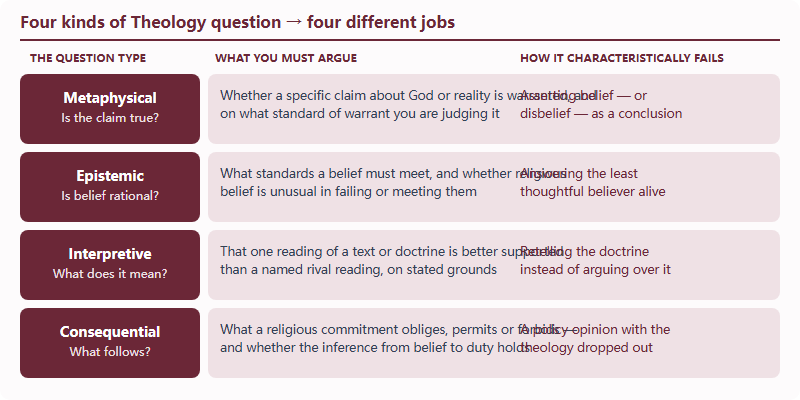
The practical use of this is diagnostic. If you cannot say which row your question sits in, you cannot yet say what a persuasive answer would look like — and you will default to whichever mode you find most comfortable, usually the interpretive one, because it feels like schoolwork. An interpretive answer to a metaphysical question reads as evasion.
Knowing the question type tells you what to argue. Two further moves decide how well you argue it. Beyond the general architecture of a competitive essay — which we set out in detail in our guide to how a winning John Locke essay is built — Theology rewards two moves that are close to signature skills for the category.
The first is the steelman. Every theology question has a position you are inclined against. The single most reliable predictor of a weak Theology essay is that this position appears only in its clumsiest form. If you are arguing that the problem of evil defeats classical theism, you must first present the strongest available theistic response — not the version a bored classmate would give. If you are arguing that religious belief can be rational without evidence in the ordinary sense, you must state the evidentialist objection so well that an evidentialist would nod. Judges read a great many essays that defeat opponents nobody holds.
The second is the internal/external distinction, and it is genuinely under-taught at school level. An internal critique asks whether a position is coherent on its own terms: given what this tradition itself affirms, does the conclusion follow? An external critique asks whether the position is true or warranted by standards the tradition does not accept. Both are legitimate. Mixing them silently is fatal, because an internal argument that suddenly imports an external standard has changed the subject mid-paragraph. Naming which one you are running — explicitly, in a clause — is one of the cheapest ways to look like you know what you are doing, and it is cheap precisely because it is true.
Theology, Philosophy, History or International Relations?
Religion-adjacent ideas can legitimately sit in several categories, and since you answer a published question in one chosen category, the placement decision is really a decision about which question set your reading can serve. The table below is the disambiguation we run with students who arrive saying “I want to write about religion.”
| Category | The question it is really asking | What counts as evidence | The tell that you are in the wrong room |
|---|---|---|---|
| Theology | Is this religious claim true, coherent, justified — or what does it oblige? | Primary texts and creeds; the tradition's own interpreters; the strongest external critics | Your argument would survive unchanged if the religious content were deleted |
| Philosophy | Does this argument work, on general standards of reasoning? | Formal structure of arguments; thought experiments; the analytic literature | You keep needing what a particular tradition specifically affirms in order to proceed |
| History | What happened, why, and how do we know? | Sources with provenance; historiographical debate; context and change over time | You are ranking beliefs as true or false rather than explaining what people did |
| International Relations | How does religion shape the behaviour of states and movements? | State conduct; institutions; conflict and cooperation; IR theory | Your evidence is doctrinal rather than about actors and their incentives |
Building a Reading Base Without a Seminary
The objection we hear most from students in China is access: no theology faculty, no divinity library, a school curriculum that touches religion only through history or a Theory of Knowledge unit. That is a real constraint on breadth, but it is a much smaller constraint on depth than students assume, because a Theology essay is judged on how well you handle a small number of positions rather than on how many you have surveyed.
The stack below is what we ask students to build for a single question. Four layers, in this order, is usually enough — and it beats twenty skimmed sources, because layer three is what stops the essay reading as advocacy.
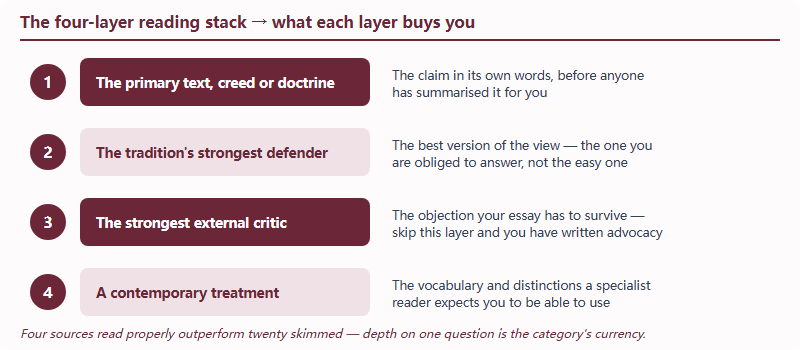
Two practical notes. Read the primary text before the commentary, even briefly, so that your sense of what it says is not entirely borrowed. And when you quote, quote sparingly and interpret every quotation — a Theology essay that stacks scripture or creed without argument has substituted authority for reasoning, which is exactly the move the category is designed to test.
Five Ways Theology Essays Lose Marks
| Failure mode | What it looks like on the page | The fix |
|---|---|---|
| Preaching | The conclusion is present in paragraph one and never at risk; objections appear only to be dismissed | Write the strongest objection first, in full, before you know how you will answer it |
| Debunking | The mirror image — religious belief is treated as obviously confused, so no real position is engaged | Name a specific thinker's specific claim and argue against that, not against “religion” |
| The comparative tour | Four traditions surveyed in 2,000 words; nothing argued about any of them | One tradition, one claim, one argument — the limit forces this choice and you should make it early |
| Category collapse | “Religion says…” — treating a vast, internally contested tradition as one voice | Specify: which tradition, which period, which interpreter — precision here reads as expertise |
| Silent switching | An internal critique that quietly starts using an external standard, or the reverse | State in a clause which critique you are running, and flag it when you deliberately change |
Should You Enter Theology?
Enter it if the published questions in the category make you want to argue rather than explain — if reading one produces an immediate reaction of “that is not quite right, and here is why.” That reaction is the raw material of an original thesis, and it is more useful than any amount of prior religious knowledge.
Be cautious if your interest in religion is mainly historical or sociological, if you cannot name a position you would be arguing against, or if you would need to learn a tradition from scratch in the weeks before a deadline. Depth is the currency here, and depth takes months. Younger students who want to build toward this over more than one cycle should read our guide to the Junior Prize, which uses the same published question sets and is a reasonable place to practise the argumentative habits the senior categories reward.
A closing note on honesty, because Theology tempts students into a particular kind of dishonesty. You are allowed to end unresolved. An essay that argues carefully to the conclusion “this argument does not settle the matter, and here is precisely what it would take to settle it” is a stronger piece of work than one that manufactures certainty it has not earned. Judges have read enough manufactured certainty to recognise it.
Frequently Asked Questions
Do I need to be religious to enter the Theology category?
No. The category asks for argument about religious claims, not religious commitment. Confirm current rules on johnlockeinstitute.com.
Is Theology an easier category to win?
We make no such claim and hold no data on relative entry numbers. The published assessment criteria are the same across all categories.
Can I write about a tradition I was not raised in?
Yes, if you represent it accurately using its own sources and interpreters. Accuracy matters far more than personal background.
How many religions should one essay cover?
Usually one. Within roughly 2,000 words, a comparative survey crowds out the argument that the criteria actually reward.
This is an independent guide operated by Hanlin Education for China-based international-school students. We are not affiliated with, endorsed by, or sponsored by the John Locke Institute. Question sets, word limits, eligibility, deadlines and fees are set by the Institute and change between cycles — confirm current details on johnlockeinstitute.com before acting on anything here. Errors reported to our editorial desk are corrected within 7 working days.