

The best time to start preparing for the 2027 John Locke Essay Competition is now — the summer after the 2026 deadline has passed. Serious candidates do not begin when the questions are released; they spend the preceding months building a reading base and argument skills, so that question release starts a sprint rather than a scramble. Here is a realistic month-by-month roadmap from July to next summer’s submission window.
Why the calendar favours early starters
The John Locke Institute Essay Competition runs on an annual rhythm: new essay questions are published for each cycle, students write an essay of around 2,000 words in one of ten subject categories (or the Junior Prize), and submissions close around the end of June, with late-entry provisions in some years — exact dates for the 2027 cycle should be confirmed on johnlockeinstitute.com when announced. After the deadline, shortlisting, interviews and the awards phase run through late summer.
That rhythm creates a structural asymmetry. The window between question release and the deadline is fixed and the same for everyone. What is not fixed is how prepared you are when that window opens. A student who arrives at question release having already read three serious books in their category, written two practice essays, and internalised the thesis–counter-argument–reply structure will use the writing window to refine ideas. A student starting cold will use it to learn what an academic argument even is. In 2025 the competition drew 63,328 essays from over 100 countries, and the field has kept growing since — the margin between shortlisted and unplaced essays is thin, and preparation is where that margin is built.
From the 2026 cohort we coached — which earned 86 shortlist places and 76 global awards (per Hanlin records, de-identified) — the clearest common factor was lead time: the strongest essays came from students whose reading started months before the questions existed.
Phase 1 · July–September: build the foundation
- July — choose your terrain. Shortlist two subject categories using curriculum fit and reading appetite. If you are 14 or under, decide whether the Junior Prize is your entry point this cycle (confirm age cut-offs on the official site). Read last cycle’s questions in your shortlisted categories — not to answer them, but to calibrate the level of abstraction they operate at.
- August — deep summer reading. This is the single highest-leverage month of the year: no school, no deadline pressure. Target two full books per shortlisted category — one framework text (e.g. an introduction to political philosophy or a core economics text) and one argumentative book by a serious scholar. Take structured notes: for every chapter, write the author’s claim, their best evidence, and one objection.
- September — first practice essay. Pick any question from a previous cycle and write 2,000 words under no time pressure. It will probably be mediocre. That is the point: you now have a concrete artefact showing exactly where your argument skills stand.
Phase 2 · October–December: train the argument muscles
- October — dissect real academic writing. Study how professional scholars structure arguments: where the thesis lands, how counter-arguments are staged, how concessions are made without collapse. Our breakdown of the anatomy of a winning John Locke essay maps this structure onto the competition format specifically.
- November — rewrite, don’t just write. Return to your September essay and rebuild it: sharper thesis, one genuinely strong counter-argument taken seriously, a reply that concedes something real. Rewriting one essay well teaches more than drafting three new ones.
- December — broaden the evidence base. Winter break is your second reading window. Add case studies, empirical papers or primary sources depending on your category’s evidence style. Students in International Relations, for instance, should be accumulating two or three concrete cases they know deeply — see our International Relations essay guide for what depth looks like there.
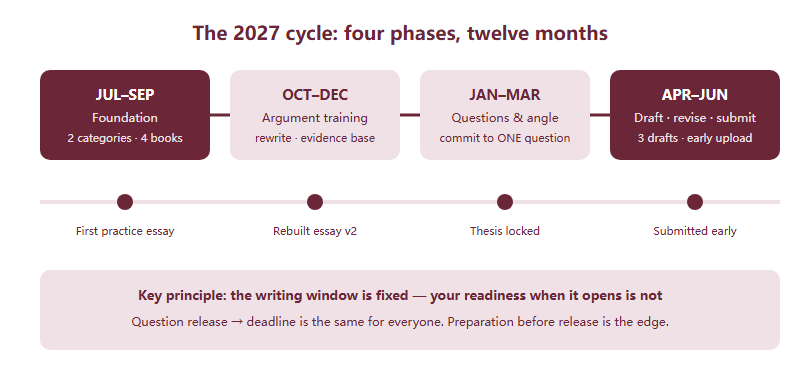
Phase 3 · January–March: questions, angle, commitment
Question release timing has varied across cycles — watch johnlockeinstitute.com and expect the new questions in the first part of the year. Once they are out:
- Weeks 1–2 after release: audit every question in both shortlisted categories. For each, write a two-sentence answer attempt. Most will produce something obvious. You are looking for the one question where your attempted answer surprises you — where your reading gives you an angle most 17-year-olds will not have.
- Commit to one question, then interrogate it. Spend two weeks on question analysis before drafting: what is the question really asking, what would the strongest opposing essay argue, what must you concede? Weak essays answer a nearby, easier question; strong essays answer the actual one.
- March: targeted research. Now reading becomes surgical — you are hunting for the two or three pieces of evidence your specific argument stands on, plus the strongest objection you must answer.
Phase 4 · April–June: draft, cut, verify, submit
Plan for three drafts, not one:
| Month | Draft | Focus | Common failure to avoid |
|---|---|---|---|
| April | Draft 1 | Get the full argument down; ignore elegance | Polishing the introduction for two weeks |
| May | Draft 2 | Restructure: thesis early, counter-argument staged honestly | Adding material instead of cutting |
| early June | Draft 3 | Word-limit discipline, references, factual verification | Citations formatted late and sloppily |
| mid–late June | Submit | Upload well before the deadline window closes | Last-day technical problems |
Two administrative notes belong in this phase, not the final week. First, references and academic-honesty requirements: the Institute takes originality seriously, and recent cycles have added verification steps around identity and authorship — including interview components introduced in 2026 — so write in a way you can defend in conversation. Second, submission logistics: account setup, parental-consent requirements where applicable, and file formatting all follow the official process on johnlockeinstitute.com; do them early.
How much time does this actually take?
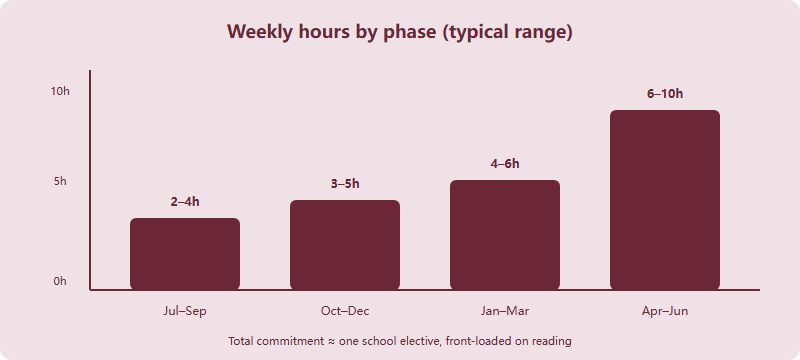
Less than it sounds. Phases 1–2 run at roughly 2–4 hours per week — mostly reading you would benefit from anyway as an IB, A-Level or AP student. Phase 3 rises to around 4–6 hours weekly, and only Phase 4 approaches project intensity, at 6–10 hours in peak drafting weeks. Spread over twelve months, the total is comparable to one school elective — but concentrated compression of the same hours into the final six weeks produces measurably weaker essays, because reading depth cannot be compressed.
FAQs
When are the 2027 John Locke questions released?
Release timing varies by cycle and is announced by the Institute. Watch johnlockeinstitute.com; historically questions appear in the first part of the year, well ahead of the mid-year deadline.
Is starting in July really necessary?
Not strictly — but reading depth is the hardest thing to compress. Students who start after question release compete with candidates who have read for months. Early foundation work is the cheapest edge available.
Can I prepare without knowing my category yet?
Yes. Shortlist two categories, read in both through December, and let the released questions decide. Argument-structure skills transfer across every category.
What if I’m too young for the Senior competition?
The Junior Prize covers younger entrants with its own question set. Check the current age cut-offs on johnlockeinstitute.com, and see our dedicated Junior Prize guide for how expectations differ.
This is an independent guide operated by Hanlin Education for China-based international-school students. We are not affiliated with, endorsed by, or sponsored by the John Locke Institute. Question-release dates, deadlines, eligibility and rules change between cycles; always confirm current details on johnlockeinstitute.com. Factual errors reported to us are corrected within 7 working days.