

Choosing your John Locke subject category matters more than most students realise: the strongest essays almost always come from candidates whose category matches their existing coursework, reading depth and natural style of argument — not from chasing a supposedly “easy” category. This guide compares all ten Senior categories (Philosophy, Politics, Economics, History, Psychology, Theology, Law, Public Policy, International Relations, Science & Technology) so you can make a deliberate choice for the 2027 cycle.
First, the ground rules that shape the decision
The John Locke Institute Essay Competition, run from Oxford, invites school-age students worldwide to submit an essay of roughly 2,000 words answering one of several set questions in their chosen subject category. Entry is free, and the Senior competition is open to students aged 18 or younger, with a separate Junior Prize for younger entrants (age cut-offs and dates should always be confirmed on johnlockeinstitute.com). In 2025 the competition attracted 63,328 essays from students in over 100 countries — so whichever category you pick, you are writing into a genuinely global field.
Two structural facts follow from this. One: you answer one question in one category per essay, so your category choice determines the entire intellectual terrain you will work in for several months. Two: the Institute does not routinely publish per-subject entry counts, so any claim you read online that a particular category is “less competitive” is speculation. Treat it that way.
If you are 14 or under, note that the calculus is different again — the Junior Prize has its own question set and expectations, and this guide focuses on the Senior categories.
The ten categories at a glance
Here is a working map of what each category actually rewards. The question wording changes every year, but the intellectual habits each subject demands are stable.
| Category | What strong essays tend to do | Best-fit student profile |
|---|---|---|
| Philosophy | Define terms precisely, run thought experiments, anticipate objections | Enjoys abstract argument; reads primary texts (Mill, Locke, Parfit) |
| Politics | Combine political theory with real institutional examples | Follows current affairs and reads theory, not just news |
| Economics | Apply models correctly, then question the model’s assumptions | IB/A-Level/AP Economics students comfortable with trade-offs |
| History | Weigh sources, argue causation, resist hindsight bias | Strong essay writers used to historiographical debate |
| Psychology | Cite empirical studies carefully, separate evidence from folk claims | Students who can read and evaluate actual research papers |
| Theology | Engage religious ideas seriously and philosophically, whatever your own view | Comfortable with textual interpretation and moral philosophy |
| Law | Reason from principles to cases; handle counter-examples cleanly | Precise thinkers who enjoy rules, exceptions and edge cases |
| Public Policy | Compare interventions against evidence and unintended consequences | Pragmatists who like “what actually works?” questions |
| International Relations | Apply IR frameworks (realism, liberalism) to concrete cases | Model UN types who can go deeper than headlines |
| Science & Technology | Analyse the ethics and governance of technology, not just describe it | STEM-leaning students who can write humanities-style arguments |
Notice the last column. Every category rewards the same underlying skill — disciplined argument — but the raw material differs. If you have never read an empirical psychology paper, the Psychology category forces you to learn that skill from zero. If you already study A-Level Economics, the Economics category lets you spend your time deepening rather than starting over. For a breakdown of how that argument discipline works on the page, see our guide to how a winning John Locke essay is actually built.
Four factors that matter more than “which is easiest”
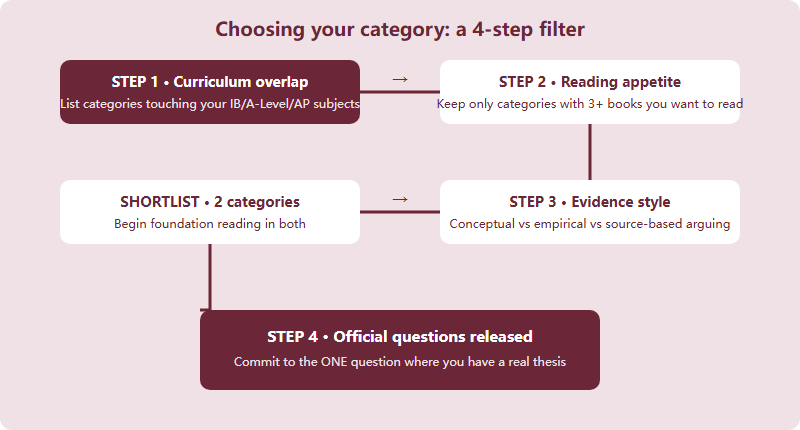
When we help students choose, we weigh four factors in order:
- 1. Curriculum overlap. A category that overlaps your IB, A-Level or AP subjects gives you a semester’s head start in vocabulary, core models and reading. This is the single biggest predictor of essay depth we observe.
- 2. Reading appetite. A competitive essay typically sits on top of weeks of reading. Pick the category whose books you would read anyway. If you cannot name three books you’d be excited to read in a category, it is the wrong category.
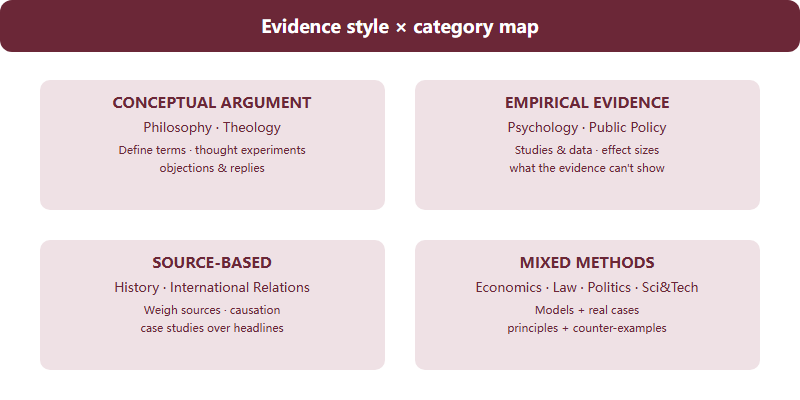
- 3. Evidence style. Philosophy and Theology run on conceptual argument; Psychology and Public Policy run on empirical studies; History runs on sources; Economics and Law mix both. Match this to how you naturally argue.
- 4. Question fit in the release year. Categories publish several questions each cycle. Keep two candidate categories alive until the official questions are released, then commit to the single question you can say something genuinely interesting about. Question release timing varies by year — confirm on johnlockeinstitute.com.
Common matches: mapping curricula to categories
For China-based international-school students, these are the pairings we see work repeatedly:
- IB Economics / A-Level Economics / AP Micro-Macro → Economics or Public Policy. Public Policy is the underrated sibling: it uses the same toolkit but often produces fresher essays because fewer students frame their thinking in policy terms.
- IB History / A-Level History → History or Politics. Your coursework already trains source evaluation and causal argument.
- IB Global Politics / Model UN experience → International Relations or Politics. If IR interests you, read our dedicated breakdown of how to pick and build an International Relations essay before deciding.
- IB Psychology / AP Psychology → Psychology, provided you are willing to go beyond the textbook to actual journal papers.
- TOK enthusiasts and debate students → Philosophy. TOK’s habits of questioning knowledge claims transfer directly.
- STEM-heavy students (physics, CS) → Science & Technology, where a technical background becomes a genuine differentiator when discussing, say, AI governance — as long as you remember the essay is an argument, not an explainer.
- No obvious match / strong faith-literacy or classics background → Theology and Law reward students who bring unusual preparation; both demand very careful reading of the question.
What our coaching results suggest about category choice
In the 2026 cycle, students supported through Hanlin’s programmes earned 86 shortlist places and 76 global awards across categories (per Hanlin internal records, de-identified). Three patterns stand out from that cohort, offered as observations rather than guarantees:
- Alignment beat ambition. Students writing in a category adjacent to their school coursework consistently produced deeper essays than equally able students who picked an unfamiliar category for strategic reasons.
- The “second-choice” question often won. Several successful essays came from the question a student initially ranked second — chosen because they discovered they had a genuinely original angle, not just interest. Angle beats affinity.
- Cross-category skills transferred. Students who had previously written in one category and switched (for example, Economics → Public Policy) carried their argumentative discipline with them. The category is a container; the skill is the argument.
None of this means a particular category will improve your odds — the Institute judges essays on quality of thought and writing, and no category choice can substitute for that.
A worked decision: two realistic student profiles
Profile A — Year 11, IB Economics HL, debate club, reads Freakonomics-style books for fun. Shortlist: Economics and Public Policy. Recommendation: begin reading in both from summer; expect to commit to whichever released question offers a sharper contrarian angle. The essay skeleton — thesis, strongest counter-argument, reply — will look the same either way, as covered in our anatomy of a winning essay.
Profile B — Grade 9, strong writer, no economics yet, fascinated by geopolitics after Model UN. Shortlist: International Relations and Politics. Recommendation: spend the year building an IR reading base (one framework text, two regional case studies), and if under the age threshold, consider whether the Junior Prize is the right entry point this cycle — check the age rules on johnlockeinstitute.com before assuming.
FAQs
Is any John Locke category easier to win than others?
Unknown — the Institute does not routinely publish per-category entry or award numbers. Choose for fit and depth, not imagined odds; a strong essay in a “popular” category beats a weak one anywhere.
Can I submit essays in more than one category?
The Institute’s rules govern how many essays you may enter and how; rules can change between cycles, so confirm the current policy directly on johnlockeinstitute.com before planning multiple entries.
Should I pick my category before the questions are released?
Shortlist two categories early and read in both, but make the final call only after seeing the actual questions. The right question matters more than the right category.
Does my school subject choice limit which category I can enter?
No — categories are open regardless of coursework. But curriculum overlap is the biggest practical advantage we observe, so weigh it heavily when choosing.
This is an independent guide operated by Hanlin Education for China-based international-school students. We are not affiliated with, endorsed by, or sponsored by the John Locke Institute. Competition rules, categories, dates and eligibility change; always confirm current details on johnlockeinstitute.com. Factual errors reported to us are corrected within 7 working days.