Why do so many well-written John Locke essays still miss the shortlist? Usually not because of weak English — but because of a fixable flaw that caps the score: a thesis nobody could disagree with, description dressed up as argument, a dodged counter-argument, decorative evidence, or answering a slightly different question than the one asked. Fixing these seven pitfalls is what moves a polished near-miss toward a genuine contender.
Argument pitfalls: a safe thesis and pure description
Pitfall 1 — a thesis that can’t be argued against. The most common ceiling is a thesis that is true but uncontested. “Democracy has both strengths and weaknesses” or “technology changes society” cannot lose, which is exactly why it cannot win — there is nothing at stake for a marker to be persuaded of. John Locke essays reward a claim a well-informed specialist could reasonably reject, and then defend it anyway. Before you write, stress-test your thesis with one question: “could a smart reader argue the opposite in good faith?” If not, sharpen it until they could. A contestable thesis creates the tension that carries roughly 2,000 words (confirm the exact word limit on the official site).
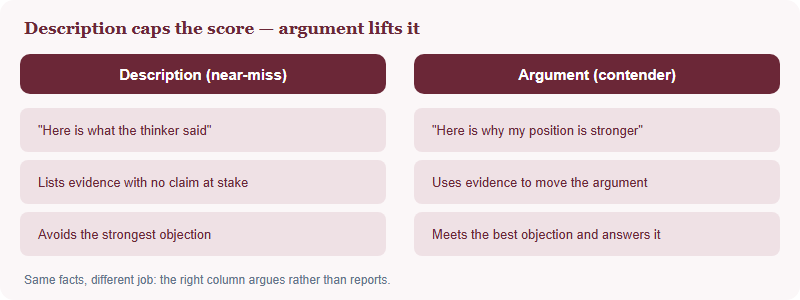
Pitfall 2 — describing when you should be arguing. Many strong students write a beautifully organised summary — of a thinker, a period, an experiment — and mistake it for an essay. Description tells the reader what happened; argument tells the reader why your position is more defensible than the alternatives. A page of accurate exposition with no claim being advanced is where a lot of near-misses quietly lose. After each paragraph, ask “what am I proving here, and to whom?” If the answer is “I’m explaining,” convert it into a step in your argument or cut it. Our guide to how winning essays are structured shows what an argument-first paragraph looks like in practice.
Evidence pitfalls: no counter-argument and decorative citations
Pitfall 3 — ignoring the strongest counter-argument. Weaker essays either ignore objections or knock down a straw version of them. Assessors at this level read for intellectual honesty, and the fastest way to signal it is to meet the best case against you — not the weakest — and answer it. An essay that only sees one side reads as advocacy; an essay that survives its own toughest objection reads as scholarship. Devote a real section to the strongest counter-argument, stated so fairly that its supporters would nod, then show precisely why your thesis still holds. This is not hedging — it is how you demonstrate that your conclusion was earned.
Pitfall 4 — evidence as decoration. Quote-dumping and name-dropping feel rigorous but often do the opposite. A parade of citations that are never actually used to advance the claim reads as anxiety, not authority. The question is never how many sources you can list; it is whether each one does real work in the argument. One well-interrogated study or text usually beats five that are merely mentioned. For every source, finish the sentence “I cite this because it lets me show that…”. If you can’t, the citation is decoration — cut it or make it work, and handle referencing to the standard the official rules require.
Control pitfalls: question drift and padding
Pitfall 5 — answering a different question than the one asked. John Locke prompts are worded with care, and the single most expensive error is drifting to the question you wish you had been asked. A question about whether something is justified is not a question about how it happened; a question about a specific concept is not an invitation to write everything you know about the topic. Underline every load-bearing word in the prompt and keep the exact question visible as you write. Different categories reward different moves — compare how our International Relations guide frames analytical demands, and note that the Junior Prize sets its own age-appropriate expectations.
Pitfall 6 — padding, and losing control of length. Because the word limit is tight, students either pad to reach it or sprawl past it — both signal a lack of editorial control. Padding shows up as throat-clearing introductions, repeated points in fresh outfits, and long quotations standing in for analysis. Write long, then cut hard: aim to say more in fewer words on the second pass, deleting any sentence that does not advance or defend the thesis. Concision is not just compliance with a limit; it is evidence that you know which of your ideas actually matter.
The ending pitfall: a conclusion that only summarises
Pitfall 7 — a conclusion that only restates. A conclusion that merely repeats the introduction wastes your most memorable real estate. By the end, the reader has followed your argument and met your counter-argument; a summary tells them nothing new. The strongest closings state what now follows if the reader accepts your thesis — the implication, the limit, or the harder question it opens. End on consequence, not recap: one earned, forward-looking sentence about what your argument means beats a paragraph that repeats what you already proved.
A pre-submission diagnostic
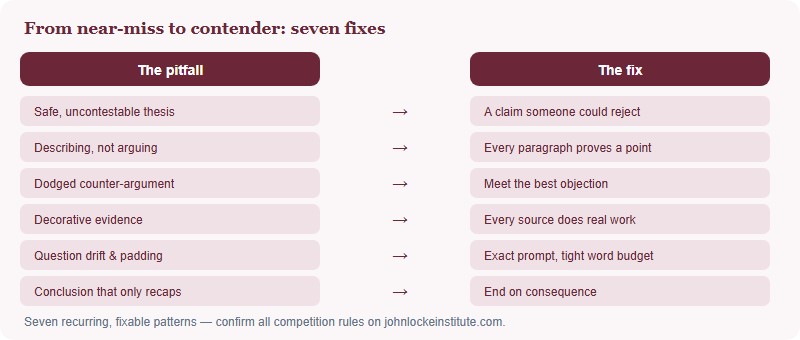
Run this table over your draft before you consider it finished. In our own coaching, the same handful of fixes recur across hundreds of drafts — and they are almost always the difference between “well written” and “shortlisted.”
| Pitfall | Symptom in the draft | The fix |
|---|---|---|
| Safe thesis | No reader could disagree | Make it contestable |
| Description | Paragraphs report, not prove | Turn each into an argued step |
| No counter-argument | Only one side is seen | Meet the strongest objection |
| Decorative evidence | Citations are merely listed | Make each source load-bearing |
| Question drift | Answers a nearby question | Keep the exact prompt visible |
| Padding | Filler to reach the limit | Write long, then cut hard |
| Flat conclusion | Restates the introduction | End on consequence |
A first-party note, offered honestly: across the drafts Hanlin coaches, these seven patterns account for most of the gap between “good” and “shortlisted.” In the 2026 cycle, students we coached recorded 86 shortlist places and 76 global awards (Hanlin’s own de-identified coaching figures, not official Institute statistics, and no result guarantees any outcome). The takeaway is not a promise — it is that these ceilings are learnable, and the students who break through are usually the ones who diagnosed their own draft ruthlessly before submitting.
Frequently asked questions
What is the most common reason John Locke essays are cut?
A thesis that is true but uncontestable, so there is nothing at stake for a marker to be persuaded of. Make the claim genuinely arguable.
Do I need lots of sources to be competitive?
No. Quality beats quantity — every citation should do real work in the argument. Confirm referencing rules on johnlockeinstitute.com.
How important is answering the exact question?
Decisive. Drifting to a nearby question can sink an otherwise excellent essay, so keep the exact prompt visible while you write.
Should I include a counter-argument?
Yes. Meeting the strongest objection fairly and answering it is how you show your conclusion was earned, not merely asserted.
This is an independent guide operated by Hanlin Education for China-based international-school students. It is not affiliated with, endorsed by, or sponsored by the John Locke Institute. Competition rules, dates, eligibility, prizes and process can change — always confirm current details on johnlockeinstitute.com. Spotted an error? We correct verified issues within 7 working days.