
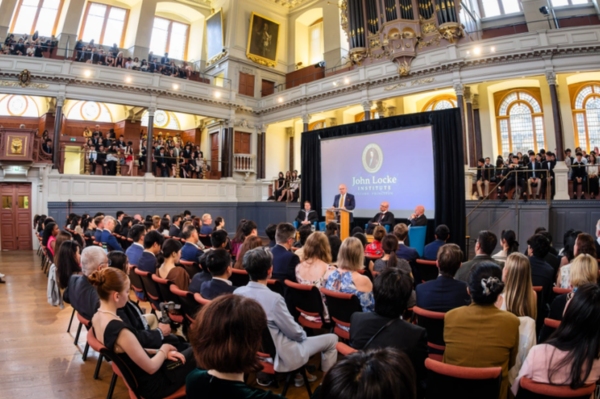
The John Locke Essay Competition is widely recognized as the premier academic contest for humanities and social sciences applicants. It serves as one of the most highly valued academic credentials for students targeting Oxbridge, G5 universities, and Ivy League liberal arts programs.
The data speaks for itself:
-
2020: Approximately 2,700 submissions
-
2025: Surpassed 63,000 submissions
-
Over a 20-fold increase in just six years, making it one of the most competitive and widely participated high school academic writing competitions globally.
With the submission deadline for the 2026 season rapidly approaching, many participants are urgently refining their writing strategies to secure top scores. Meanwhile, students planning for the 2027 season often wonder how to begin their preparation. This guide provides targeted answers to these essential preparation questions.
01 Key Elements for a High-Scoring John Locke Essay
Organized by the John Locke Institute, an independent educational institution affiliated with the University of Oxford, the competition is judged by professors from Oxford, Princeton, and other elite universities. The evaluation criteria consistently prioritize logical rigor as the primary differentiator. A clear logical framework is the foundation of a standout essay, and five core elements serve as the key to achieving a high score.
1. A Strong and Novel Thesis
High-scoring essays always feature a relatively novel and compelling thesis, rather than an obvious or superficial viewpoint. They avoid vague, neutral stances like social media has both pros and cons, and instead present clear, assertive claims, such as Meta should be held legally liable for adolescent depression caused by its algorithmic recommendations.
2. Interdisciplinary Argumentation
Winning essays excel at integrating knowledge from multiple academic disciplines to build their arguments. This requires participants to have a solid grasp of the core theoretical frameworks across different fields.
3. A Rigorous Logical Chain
Excellent essays do not merely cite authoritative opinions; they actively construct opposing viewpoints and provide strong rebuttals. The complete thought process of Propose a thesis → Develop the argument → Address counterarguments → Refine the stance forms the essential skeleton of an award-winning paper.
4. Real-World Case Support
Abstract theories appear hollow without concrete examples to anchor them. High-scoring essays skillfully incorporate vivid, real-world cases to substantiate their claims. Examples should follow the principle of broad coverage with deep analytical excavation.
5. Standard Academic Formatting
Many students overlook formal details, which is a regrettable way to lose points. The Junior category requires 800–1,500 words, while the Senior category requires 1,500–2,000 words. Use Times New Roman or Arial font, 12-point size, and double spacing. Adhere to standard citation formats such as APA, MLA, or Chicago. What truly impresses the judges, however, is replacing bland phrasing with concise, clear, and engaging academic language.
02 Where Should Beginners Start?
Step 1: Build a Core Knowledge Reserve
Establishing a solid reading foundation is the key to efficient preparation.
Subject-Specific Reading Recommendations: For Economics, start with Adam Smith’s The Wealth of Nations to build a foundation, and explore Richard Thaler’s works on behavioral economics to analyze real-world issues like personalized pricing. For Philosophy, begin with Kant’s Groundwork of the Metaphysics of Morals (deontology), Mill’s Utilitarianism (consequentialism), and Rawls’ A Theory of Justice (political philosophy). For Politics and History, Thomas Hobbes’ Leviathan, the works of Hannah Arendt, and E.H. Carr’s What is History? are essential reading.
(Note: A curated list of 90 essential reading books for the John Locke competition is highly recommended for comprehensive preparation.)
Step 2: Closely Analyze Past Winning Essays
Reading books alone is not enough. Past winning essays are the best learning templates.
Why Winning Essays Matter: They directly reflect the qualities Oxford judges value most, from topic selection and structural design to argumentation methods and stylistic tone.
When preparing, analyze essays from two key perspectives:
First, study how winners seamlessly integrate abstract theoretical frameworks with real-world case studies.
Second, deconstruct their argumentation pathway: the complete chain of State a viewpoint → Introduce evidence → Address counterarguments → Refine or defend the stance.
Print 3–4 essays closely aligned with this year’s prompt directions. Annotate the argumentation techniques, citation layers, and logical transitions paragraph by paragraph. Compare these annotations with your own drafts to identify gaps and areas for improvement.
03 John Locke Competition: Excellent Essay Examples
Reviewing high-quality past submissions is crucial for understanding the expected standard. Focus on how successful candidates structure their introductions, develop nuanced arguments, and maintain academic rigor throughout their papers.
Get FREE John Locke Preparation Materials
Scan the QR code below to access free practice papers, study guides, and past competition materials. Start preparing today!