
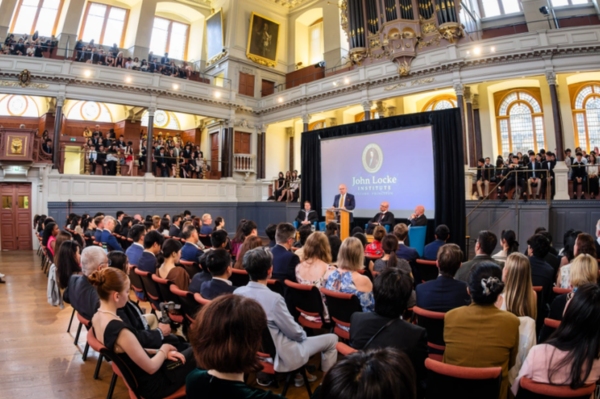
Under the backdrop of major judging reforms, the 2026 John Locke Essay Competition has surpassed 100,000 participants, a staggering 36-fold increase from 2020! The shortlist rate continues to drop, and judging standards are tightening…
The 2026 John Locke Institute Global Essay Prize is one of the most prestigious humanities and social sciences academic writing competitions for high school students worldwide. Hosted by the John Locke Institute in Oxford, UK, its judging panel comprises professors from top universities such as Oxford and Princeton.
John Locke’s Participation Scale Has Changed Dramatically in Just 6 Years
- 2020: Only 2,740 participants
- 2023: Surpassed 19,000
- 2024: Skyrocketed to 34,823
- 2025: Jumped directly to 63,328
- 2026: Exceeded 100,237, a growth of over 36 times compared to 2020! The level of competition will be the highest in history.
Shortlist Rates Continue to Decline, Judging Standards Tighten
- 2020: 26% shortlist rate (approx. 1 in 4)
- 2021-2023: Stabilized at 20%-23%
- 2024: Plummeted to 16.9%
- 2025: Only 18.65%
Major Reforms for 2026
- Category Expansion: Increased from 7 to 10 disciplines, adding Public Policy, International Relations, and Science & Technology.
- Earlier Timeline: The regular submission deadline has been moved forward from late June to May 31, compressing the preparation period by about one month.
- Separation of Registration and Submission: Registration must be completed by March 31; otherwise, the submission portal will not be generated. (Note: This deadline has already passed.)
- Junior Category Adjustment: No longer features separate prompts. Junior and Senior categories now share the same question bank but are judged separately.
- Award Structure Adjustment: Each discipline category now offers 6 awards (3 for Junior and 3 for Senior).
Key Dates (2026)
- Registration Opens: February 2
- Registration Deadline: March 31 (Closed; unregistered students cannot participate)
- Submission Opens: April 1
- Regular Submission Deadline: May 31, 23:59 GMT (Free)
- Late Deadline (7 days): June 7 (Fee: £25 / $35)
- Late Deadline (21 days): June 21 (Fee: £75 / $100)
- Shortlist Notification: July 7 (Released earlier than in previous years)
- Academic Conference & Awards Ceremony: October 2-4 (London); Awards Ceremony on October 3
Eligibility
- Senior Category: Under 19 years old on May 31, 2026 (born on or after July 1, 2007)
- Junior Category: Under 15 years old on May 31, 2026 (born on or after July 1, 2011)
- Open to high school students of any nationality worldwide, with no restrictions on school or curriculum system.
Submission Guidelines (Strict Red Lines)
- Word Limit: Maximum 2,000 words for the main text (excluding charts, data tables, endnotes, references, and author declarations). Footnotes are strictly prohibited; use endnotes instead.
- File Format: Must be PDF.
- Naming Convention: FirstName-LastName-Category-QuestionNumber.pdf (e.g., Alexander-Popham-Psychology-2.pdf). Files with spaces or incorrect formatting will be automatically rejected by the system.
- Anonymity: The participant’s name must not appear anywhere in the main text of the essay.
- Academic Referee: Provide the email address of a non-relative referee familiar with your academic writing (preferably a subject teacher). The official committee will send an email to verify originality.
- Language: Only English essays are accepted.
Academic Integrity & AI Policy (2026 Focus)
The 2026 official guidelines have adopted a strictly tightened stance on AI usage:
- Strictly prohibited to use AI tools like ChatGPT or Claude to generate text, rewrite, or polish essays.
- All submissions will be screened by AI detection systems. Any traces of AI-generated content will result in immediate disqualification with no right to appeal.
- Participants must retain complete drafts, revision records, and other evidence of originality for verification.
Additionally, this year introduces an optional 15-minute random online interview to verify originality and academic communication skills. Participation is voluntary and does not affect essay grading, but active participation is highly recommended.
- Interview Format: Online video call, approximately 15 minutes
- Interview Content: Focuses on your submitted essay, requiring you to explain your writing process, core arguments, research methodology, and engage in interactive discussion with the judges.
Award Structure
- Each discipline category awards a Winner (Champion), Second Prize, and Third Prize.
- Each discipline is split into Junior and Senior categories, with 3 awards given per category.
- Grand Prize: Selected from all category winners for the best overall essay. The recipient receives a John Locke Institute Junior Fellowship and a substantial scholarship.
- Each category winner receives a $5,000 scholarship to attend John Locke Institute programs.
10 Subject Categories
Philosophy, Politics, Economics, History, Psychology, Theology, Law, Public Policy (New), International Relations (New), and Science & Technology (New).
Each category features 3 prompts. Participants must choose one to answer.
Official Prompts & Prep Strategies
Part 1. Economics
Q1. Should we fear a cashless society?
Q2. Technology now allows personalised pricing. If this came to be widely used, what effects should we expect?
Q3. Did Jeff Bezos get rich at the expense of his customers, his employees, neither or both?
Prep Strategy: Avoid purely theoretical derivations; embrace “real-world economics.” For Q2, do not just discuss consumer surplus; delve into information asymmetry in the big data era. Q3 requires students to find a logical balance between economies of scale and labor rights.
Part 2. History
Q1. “The arc of the moral universe is long, but it bends toward justice.” Is it? Does it?
Q2. What might the world look like if the Library of Alexandria didn’t burn down?
Q3. Does Che deserve his iconic T-shirt?
Prep Strategy: Beware of mere “storytelling”; focus on historiography. Q2 is a classic counterfactual reasoning question examining how knowledge dissemination drives civilization. Q3 explores the symbolization and commodification of historical figures.
Part 3. International Relations (New)
Q1. Does foreign aid help or hurt poor people?
Q2. Is the US economy harmed by cheap imports from China?
Q3. Should a coalition of countries (or of billionaires) run an experiment with a libertarian microstate?
Prep Strategy: Shift to a “great power competition” perspective. Q1 requires exploring the “aid trap” and institutional building. Q2 necessitates applying the Stolper-Samuelson theorem for a structured analysis of interest distribution. Q3 tests the challenge to the essence of national sovereignty.
Part 4. Law
Q1. If legislators and judges all accepted the philosophical theory of determinism, what would be the effect on criminal sentencing?
Q2. To what extent should criminal sentencing take into account the effect on the perpetrator’s family?
Q3. Is trial by jury obsolete?
Prep Strategy: Elevate from rule-based thinking to “jurisprudence.” Q1 questions the legal foundation of free will. Q3 requires arguing by integrating AI in justice, expert decision-making, and the dynamics of civic participation.
Part 5. Philosophy
Q1. Is it ever wrong to do the right thing for the wrong reasons?
Q2. What consolations does philosophy offer?
Q3. Why is incest wrong?
Prep Strategy: Pursue extreme logical coherence. Q1 examines the conflict between virtue ethics and consequentialism. Q3 requires students to step beyond visceral disgust and reconstruct moral taboos using rational frameworks (e.g., social contract theory or evolutionary psychology).
Part 6. Politics
Q1. Is the right to self-determination absolute?
Q2. Did the pandemic normalise authoritarianism?
Q3. Is democracy in crisis?
Prep Strategy: Capture the fractures in contemporary institutions. Q2 requires analyzing the administrative inertia of emergency powers. Q3 demands deep reflection on how information echo chambers impact representative democracy.
Part 7. Psychology
Q1. Why do we care what happens to our body after death?
Q2. Is mental illness over-diagnosed now, or just better recognised?
Q3. Surveys show a widening gender ideological gap in recent years. Why?
Prep Strategy: Focus on the interaction between individual psychology and social structures. Q3 requires a social-psychological analysis combining social media algorithms with trends in value polarization.
Part 8. Public Policy
Q1. What discount rate should be applied to long-run environmental policies? Why?
Q2. Which unintended consequence was most devastating and why did we fail to predict it?
Q3. Should vaccination be mandatory in a public health emergency?
Prep Strategy: Simulate a policymaker’s perspective. Q1 tests intergenerational justice: what is the environment 100 years from now worth today? Q2 tests deep cognitive understanding of complex social systems.
Part 9. Theology
Q1. Is religious experience better explained by neuroscience or by theology?
Q2. Research shows a strong inverse correlation between religiosity and per-capita spending on education. Does one cause the other?
Q3. If you achieve enlightenment, how will you know?
Prep Strategy: Engage empirical science with a priori faith. Q1 examines whether physical reductionism can explain the spiritual world. Q2 is a rigorous social science statistical analysis question.
Part 10. Science & Technology (New)
Q1. What discount rate should be applied to long-run environmental policies? Why?
Q2. Which unintended consequence was most devastating and why did we fail to predict it?
Q3. Should vaccination be mandatory in a public health emergency?
Prep Strategy: Explore human agency and technological boundaries. Q3 superficially tests etiquette, but actually examines anthropomorphic ethics: will our attitude toward AI inversely shape our own personalities?
The 2026 John Locke Competition maintains its high prestige while further raising the entry threshold and academic rigor through category expansion, an earlier timeline, mandatory pre-registration, and strict AI controls.
With the regular submission deadline (May 31) rapidly approaching, registered participants must seize the remaining time to finalize and submit their essays.
Get FREE John Locke Preparation Materials
Scan the QR code below to access free practice papers, study guides, and past competition materials. Start preparing today!