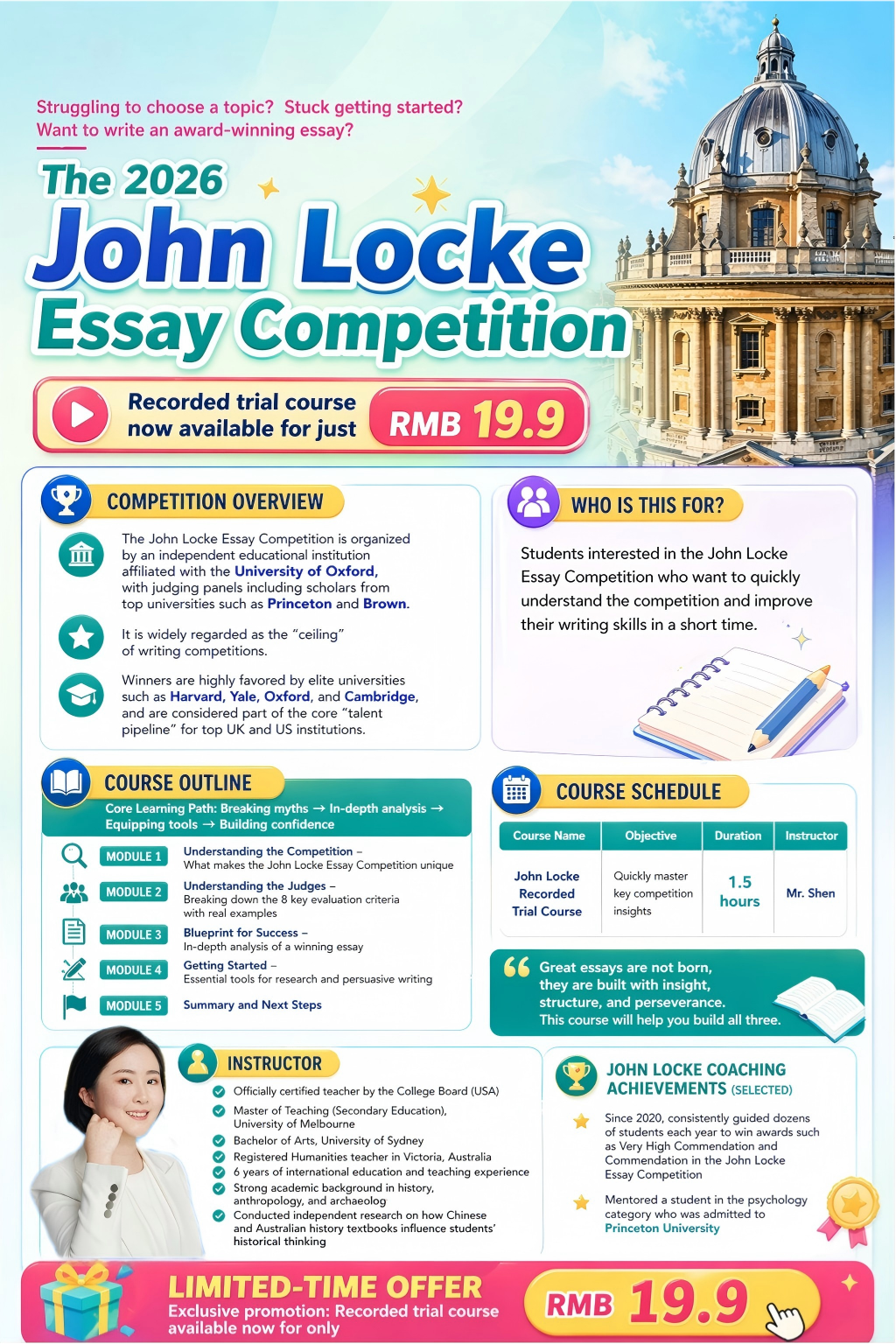

On February 2, the official organizers of the John Locke Institute released all essay prompts for the 2026 competition season, along with updated timelines and competition rules.
Major Updates for the 2026 Season
1. Three New Categories Added
The competition has expanded from 7 to 10 categories. The full list now includes:
Politics, Economics, History, Philosophy, Law, Theology, Psychology, Public Policy (new), Science & Technology (new), and International Relations (new).
2. Junior Category Rule Changes
- Junior participants may now answer any question across all categories
- Junior submissions will be evaluated separately within age groups
2026 Competition Timeline
- Registration Deadline: March 31, 2026
- Submission Deadline: May 31, 2026
- Late Submission Options:
- June 7, 2026 (7-day extension, £25 fee)
- June 21, 2026 (21-day extension, £75 fee)
- Shortlist Notification: July 7, 2026
- Academic Conference: October 2–4, 2026
- Awards Dinner: October 3, 2026
Scan the WeChat QR code to consult with John Locke!

Law Category Essay Questions: Deep Analysis
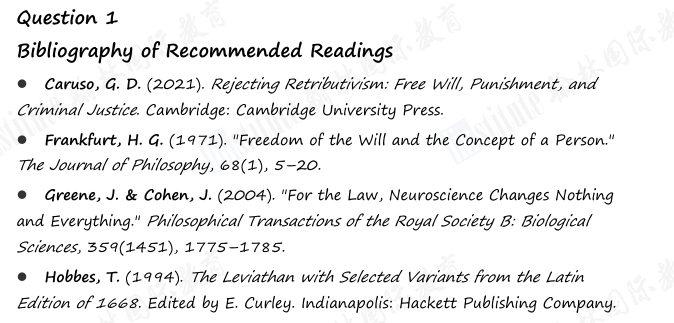
Question 1
If legislators and judges all accepted the philosophical theory of determinism, what would be the effect on criminal sentencing?
This question places criminal law under a philosophical lens. Determinism suggests that all human actions are shaped by prior causes, challenging the concept of free will.
Core tension: Retributivism vs. Utilitarianism
- Traditional sentencing assumes individuals make free choices and deserve punishment
- Determinism reframes crime as the result of genetics, environment, and psychology
Possible implications for sentencing:
- Shift from punishment to rehabilitation
- Indeterminate sentencing based on risk rather than fixed terms
- Greater focus on social and environmental intervention
Suggested angles:
- Compatibilism as a middle ground
- Classical vs. positivist schools of criminal law
- Neuroscience and legal responsibility
Strong essays should argue that sentencing would not disappear, but rather transform—from moral blame to risk management and public health logic.
Get a Free List of eBooks
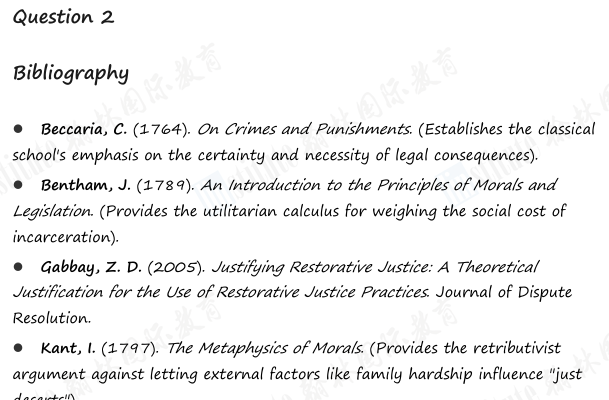
Question 2
To what extent should criminal sentencing take into account the effect on the perpetrator’s family?
This question explores a major ethical dilemma: should justice focus only on the offender, or also consider broader social consequences?
Three analytical dimensions:
- Victim Perspective Conflict
- Supporting family consideration: avoids creating “secondary victims”
- Opposing: risks diluting justice for victims
- Real Judicial Practice
- Judges often implicitly consider family impact
- However, such factors are rarely formalized in sentencing guidelines
- Systemic Fairness Issues
- Could create inequality between social classes
- May advantage defendants with stable family structures
Recommended strategy:
Apply the principle of proportionality—family impact may matter more in minor crimes and less in severe offenses. Consider how such factors could be standardized to avoid arbitrariness.
Get a Free List of eBooks
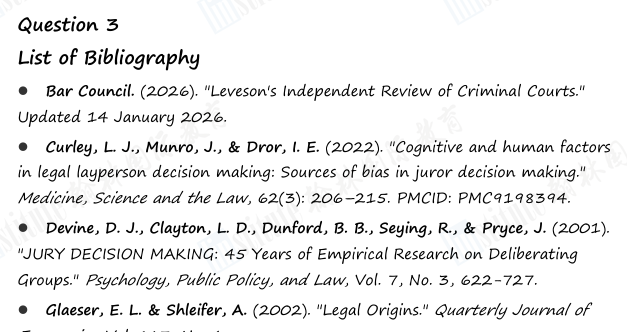
Question 3
Is trial by jury obsolete?
This is a highly debated institutional question requiring nuanced analysis.
Arguments for “obsolete”:
- Jury trials are increasingly rare (“vanishing trial” phenomenon)
- Plea bargaining dominates modern legal systems
- Jurors may struggle with complex cases
- Bias and media influence threaten neutrality
- High cost and inefficiency
Arguments against:
- Essential for democratic participation
- Enhances transparency and legitimacy
- Jury nullification as a safeguard against unjust laws
- Collective decision-making reduces individual bias
- Increasing adoption of citizen participation in global systems
Advanced perspective:
Rather than arguing for or against, strong essays explore institutional evolution. Consider reforms such as:
- Allowing juror note-taking
- Expert explanations during trials
- Hybrid systems combining judges and lay participants
The most compelling argument views the jury not as outdated, but as adapting to modern pressures.
Get a Free List of eBooks
Key Writing Strategy
Winning essays in the John Locke Competition demonstrate more than knowledge—they show intellectual depth and originality.
- Question 1: Bridge philosophy and legal systems
- Question 2: Balance ethical reasoning with practical frameworks
- Question 3: Analyze institutions dynamically across time
Judges look for clarity, evidence, and the ability to construct a strong, independent argument.
Recommended Research Topics
- Philosophy of criminal law
- Sentencing guidelines
- Restorative justice
- Comparative jury systems
- Legal realism
- Judicial discretion
The above analysis of the John Locke Law essay questions was provided by Mr. Shen from Hanlin Education.
Mr. Shen is an AP-certified teacher and holds a Master of Teaching (Secondary Education) from the University of Melbourne, as well as a Bachelor of Arts from the University of Sydney. He is a registered teacher in Humanities disciplines in the state of Victoria, Australia, including History, Politics, Geography, Economics, Religion, and Ethics. He also serves as a state-level judge for the National History Challenge (Australia’s equivalent of National History Day), with deep familiarity in the evaluation criteria of international humanities competitions.
Selected Coaching Achievements:
- Since 2020, Mr. Shen has consistently guided dozens of students each year to achieve awards such as Very High Commendation and Commendation in the John Locke Essay Competition. One of his students in the psychology category was successfully admitted to Princeton University.
- In 2022, he mentored students in the Australian National History Challenge, helping them advance to the regional finals.
- He has also helped students pass the SCAT (School and College Ability Test) for gifted youth, enabling their admission to summer programs at Johns Hopkins University.
Competition Overview
The John Locke Essay Competition is organized by the John Locke Institute, in collaboration with scholars from leading universities such as Oxford and Princeton. The competition aims to cultivate independent thinking, depth of knowledge, and persuasive writing skills among young scholars.
Eligibility
- Senior Category: Ages 15–18
- Junior Category: Age 14 and under
Participants may submit essays in multiple categories, but each essay must not exceed 2000 words (excluding references and appendices).
Submission Requirements
Essays are evaluated based on:
- Understanding of the topic
- Use of evidence
- Quality of argument
- Structure and clarity
- Writing style and persuasiveness
Accepted citation formats include APA, MLA, or footnotes.
AI Usage Policy
Participants may use AI tools to support research and idea development, but must not rely on them to generate final essays. Original thinking and authentic writing remain essential, and evaluation systems are designed to detect non-original work.
Awards
- Grand Prize: $10,000 scholarship
- Category Winners: $2,000 scholarship
- High Commendations for outstanding submissions
If you would like to learn more details about the John Locke Essay Competition, you are welcome to scan the QR code to consult with one of our advisors.
Hanlin Helps JohnLocke Sprint for Awards
John Locke covers a wide range of subjects and has difficult topics. Therefore, Hanlin specially offers 1v1 customized tutoring. Hanlin tutors will fully provide students with professional advice on research and writing, helping them polish and write high-quality papers. In the final stage, Hanlin tutors will lead students to make the final sprint!
Hanlin JohnLocke Course Content Includes
John Locke Essay Competition Outline (1v1)
Course 1 (online-1.5h) – Review the rules and requirements of the John Locke Contest to ensure compliance and understanding. Discuss the prompt for the contest essay and explore different possible approaches to tackle it effectively. Share successful strategies for winning essay contests, including tips on writing style, organization, and persuasive techniques. Highlight the first major tools for success in essay writing, such as thorough research, critical thinking skills, and effective communication.
Course 2 (online-1h) Reading for Critical Thinking: Analyze texts by identifying the main arguments and supporting evidence. Evaluate the author’s credibility, biases, and logical reasoning. Form reasoned opinions by considering different perspectives. Citation and Bibliography: Understand citation styles such as APA, MLA, or Chicago for academic writing. Properly cite sources to avoid plagiarism and give credit to original authors. Create a bibliography to list all sources used in your research.
Course 3 (online-2h) – Formatting an Outline: Learn proper outline structure for organizing ideas effectively. Sorting your Research: Develop strategies to categorize and prioritize research materials. Reading for critical thinking: Analyze texts, evaluate arguments, identify biases, and form reasoned opinions. Citation and bibliography: Understand the importance of accurate citations in academic writing.
Course 4 (online-2h) – Explore various research methods suitable for the topic and prompt. Learn how to evaluate sources for credibility and accuracy. Conduct initial research for the essay topic. Discuss how to develop an effective research plan.
Course 5 (offline-2h) – Develop an outline: create a well-structured essay outline that presents a clear and logical flow of ideas. Seek writing center support: consultations with the tutor for guidance in refining your research and identifying appropriate sources. Receive feedback from teacher: Submit your outline to your teacher for review and revision suggestions.
Course 6 (online-2h) – Receive constructive feedback on the outline. Discuss how to conduct detailed research and analyze sources.
Course 7 (offline-2h) First Draft: Write the first draft of the essay based on the discussed outline. The first draft of the essay should include a clear thesis statement that captures the main argument or point of the essay. Each paragraph should be organized around a topic sentence that supports and expands on the thesis statement. Incorporate relevant evidence from credible sources to support your arguments and provide examples or real-life scenarios to illustrate your points.
Course 8 (online-2h) – Discuss strategies for effective writing and addressing the contest prompt. Analyze the introduction, body, and conclusion of the essay.
Course 9 (offline-1.5h+1.5h) Second Draft of the Essay – Work on the second draft of the essay, incorporate feedback from the rough draft review.
Course 10 (online-1.5h) – Make the essay stand out by ensuring clarity, coherence, and a strong thesis statement. Incorporate unique perspectives or original insights to differentiate your essay from others on similar topics. Provide compelling evidence from credible sources to strengthen your arguments.
Course 11 (offline-1h) Final Polishing: Smaller edits important for polishing finished product.