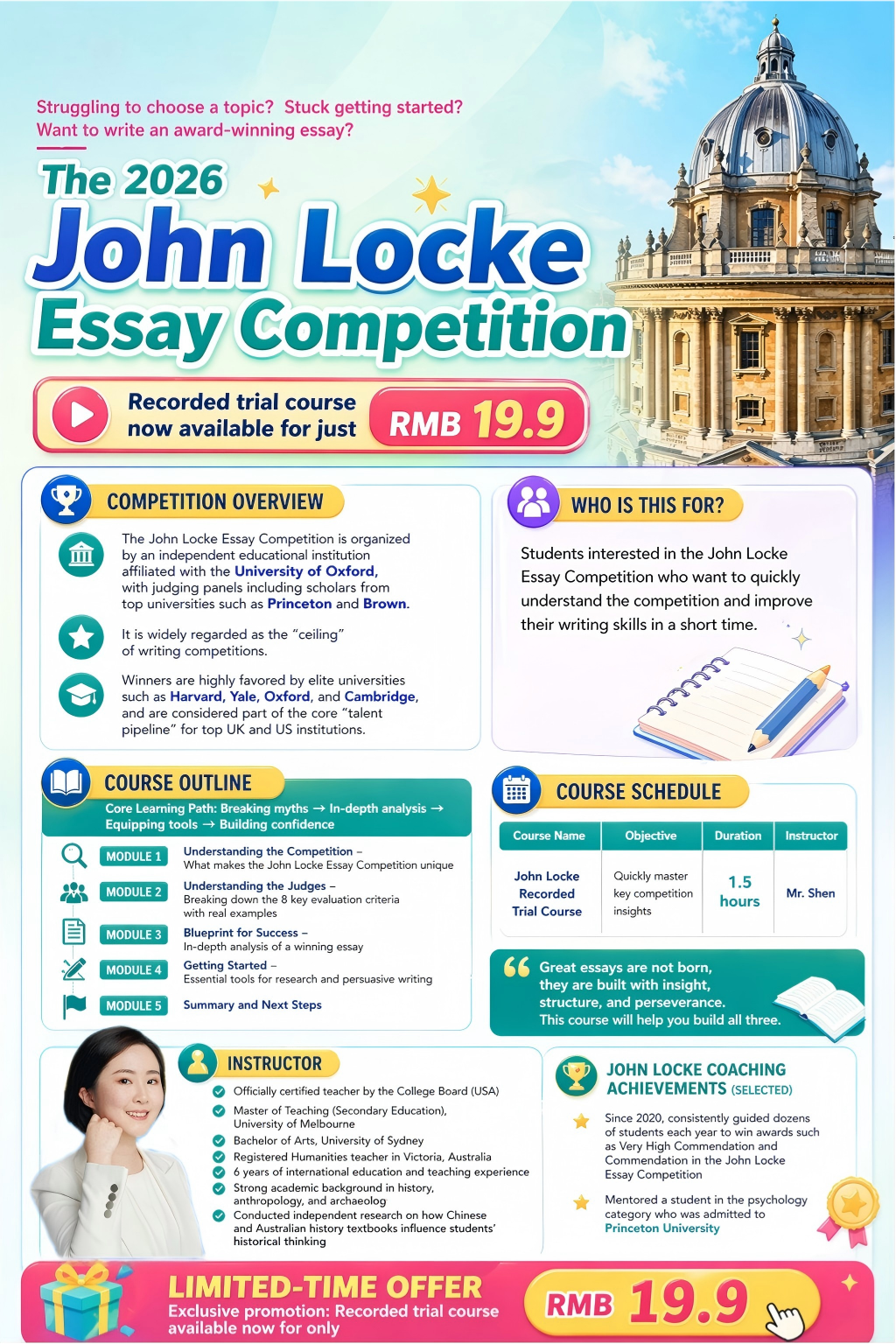
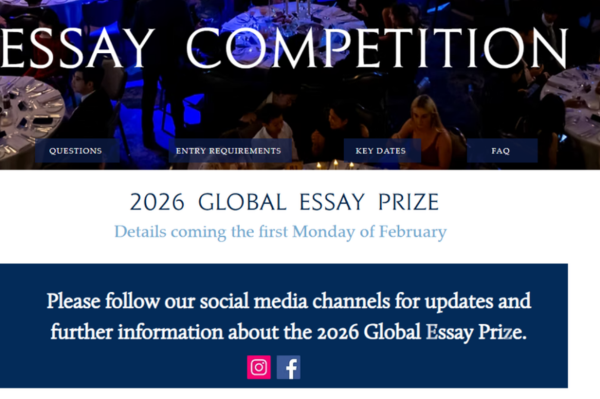
The 2026 John Locke Essay Competition has officially released its prompts. To help students clarify their thinking and develop strong writing directions, Hanlin mentors present a comprehensive breakdown of the History category—along with recommended readings.
Registration for the 2026 competition opened on February 2. All participants must complete registration before March 31, 2026 (GMT).
Each year, the History category offers some of the most intellectually demanding questions. This year is no exception. The three prompts explore themes ranging from the myth of moral progress, to the fate of knowledge in the Library of Alexandria, to the paradox of Che Guevara as a global icon. At their core, all three questions ask: How do we narrate history, and how do those narratives shape us?
Question 1
“The arc of the moral universe is long, but it bends toward justice.” Is it? Does it?
This question challenges what appears to be a self-evident truth. The phrase originated with Theodore Parker in 1853, who framed it as an act of faith rather than proof. Later, Martin Luther King Jr. quoted it with caution, while modern political rhetoric has transformed it into a confident assertion.
A strong approach is not to simply argue whether justice inevitably prevails, but to analyze how the idea of “inevitable progress” has been constructed—and whose interests it serves.
Key analytical directions:
- Justice as a product of human struggle rather than historical inevitability
- Critiques of progress narratives from marginalized perspectives
- The transformation of theological belief into political ideology
Three argument pathways:
- Theological–Political Critique
Examine how religious ideas of destiny have been reframed as historical certainty. - Victim-Centered Perspective
Argue that progress narratives often exclude those who continue to suffer systemic injustice. - Institutional Design Approach
Shift focus from abstract progress to concrete systems that produce justice.
For your convenience, we have curated a selection of classic and practical literature and books to share; additional titles may be consulted based on your individual interests and needs.
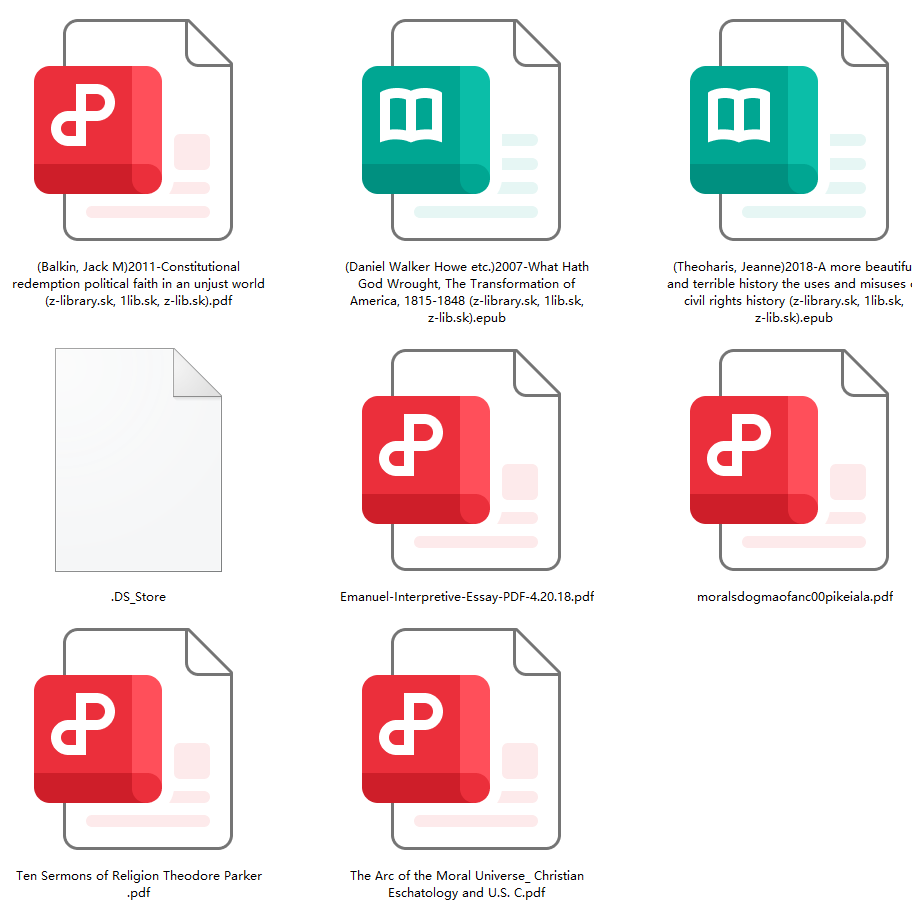 Scan the WeChat Code to Get the Booklist for Free

Question 2
What might the world look like if the Library of Alexandria didn’t burn down?
This is not truly a counterfactual history question. Instead, it is about the sociology of knowledge.
The destruction of the Library is often romanticized as a single catastrophic event. In reality, knowledge loss was gradual, shaped by material, economic, and cultural forces.
Core insight:
Knowledge is not simply destroyed—it is filtered, forgotten, and replaced.
Key analytical directions:
- The transition from papyrus to parchment as a knowledge filter
- Economic and religious influences on which texts were preserved
- The myth of a “lost golden age” of knowledge
Three argument pathways:
- Meta-Historical Critique
Challenge the assumption that knowledge accumulates linearly. - Media Determinism
Analyze how material forms of knowledge storage shape intellectual history. - Sociology of Knowledge
Explore why modern society is so invested in the myth of the Library’s destruction.For your convenience, we have curated a selection of classic and practical literature and books to share; additional titles may be consulted based on your individual interests and needs.
Scan the WeChat Code to Get the Booklist for Free
Question 3
Does Che deserve his iconic T-shirt?
This question is not about whether Che Guevara was morally good or bad. It is about whether his image deserves its iconic status.
The famous photograph by Alberto Korda has become one of the most reproduced images in history, appearing across fashion, advertising, and global youth culture.
Core insight:
Che Guevara is no longer just a historical figure—he is a symbol.
Key analytical directions:
- The commercialization of revolutionary imagery
- The transformation of political figures into cultural symbols
- The instability of meaning in widely reproduced images
Three argument pathways:
- Critical Approach (Image as Theft)
Argue that capitalism and consumer culture have appropriated and depoliticized Che’s image. - Defensive Approach (Symbolic Freedom)
Suggest that meaning is created by users, not controlled by historical accuracy. - Diagnostic Approach (Age of Simulacra)
Analyze how modern media transforms historical figures into self-referential symbols.
For your convenience, we have curated a selection of classic and practical literature and books to share; additional titles may be consulted based on your individual interests and needs.
Scan the WeChat Code to Get the Booklist for Free
Key Writing Strategy
Top essays in the John Locke Competition go beyond knowledge—they demonstrate intellectual independence and analytical depth.
- Question 1: Connect philosophy with historical reality
- Question 2: Move beyond surface-level counterfactuals
- Question 3: Analyze symbols rather than individuals
Judges value clarity, originality, and strong argumentation.
Recommended Research Topics
- Philosophy of history
- Historiography and narrative construction
- Sociology of knowledge
- Media theory and cultural symbols
- Political ideology and memory
This analysis of the John Locke History essay questions was provided by Mr. Shen from Hanlin Education.
Mr. Shen is an AP-certified teacher with a Master of Teaching (Secondary Education) from the University of Melbourne and a Bachelor of Arts from the University of Sydney. He is a registered Humanities teacher in Victoria, Australia, and a state-level judge for the National History Challenge.
Since 2020, he has guided numerous students to achieve awards such as Very High Commendation and Commendation in the John Locke Essay Competition. His students have also gained admission to top institutions such as Princeton University.
If you would like to learn more about the John Locke Essay Competition or receive personalized guidance, you are welcome to consult with Hanlin advisors.