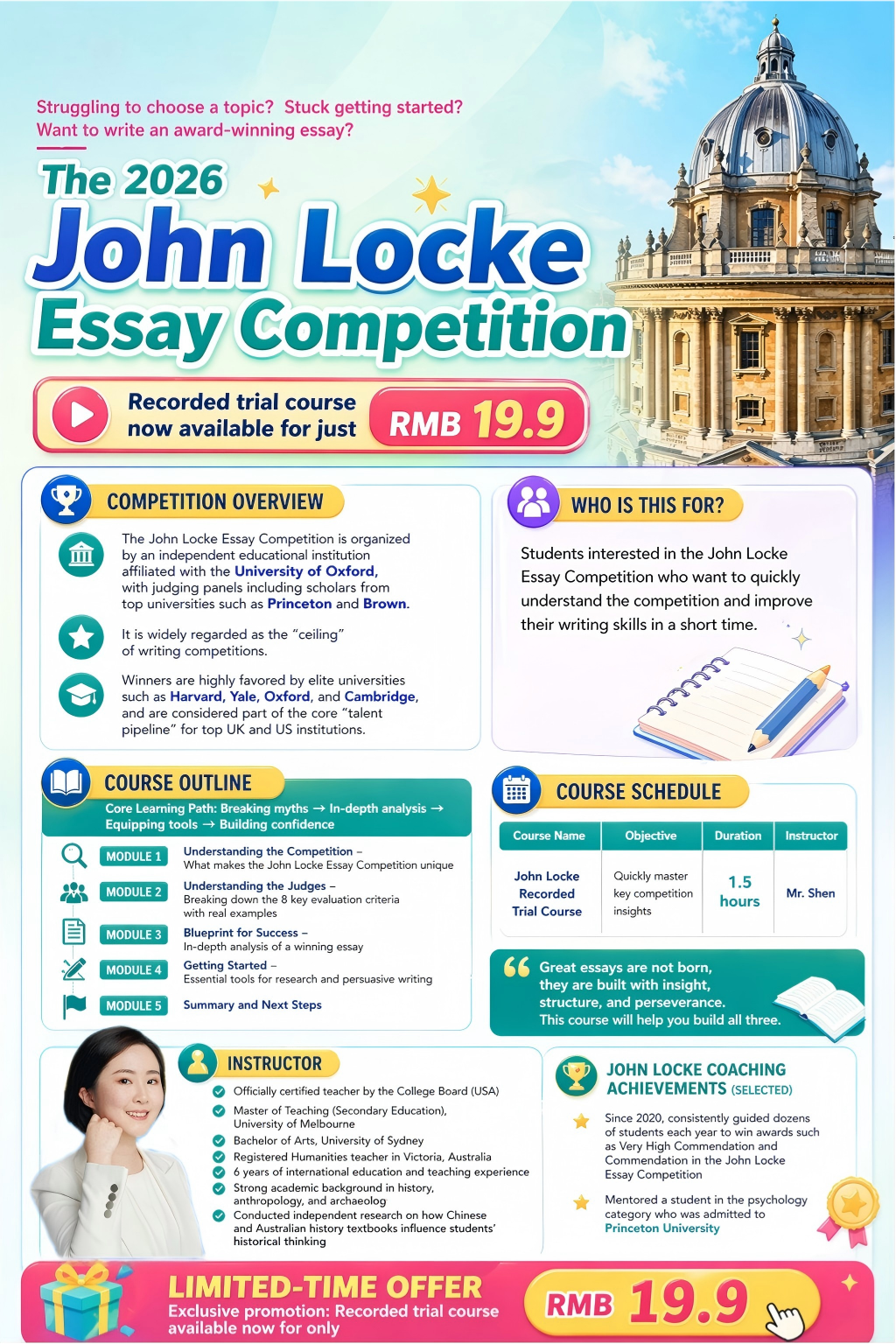

Registration for the 2026 John Locke Essay Competition opened on February 2. All participants must complete registration by March 31, 2026 (GMT).
This year’s economics questions invite students to engage deeply with real-world issues. Below is a structured breakdown of the prompts, recommended approaches, and foundational knowledge to guide your preparation.
2026 Economics Questions Analysis
Q1: Should we fear a cashless society?
From Bitcoin to central bank digital currencies, monetary innovation has accelerated rapidly. In many developed economies, cash usage is steadily declining. In China, mobile payment systems such as Alipay and WeChat Pay have already reshaped consumer habits, especially among younger generations.
Possible approaches:
- Examine the historical evolution of money and assess whether its core functions change in a cashless society.
- Analyze how electronic payments influence modern consumption behavior.
- Evaluate whether digital currencies could replace physical cash as the dominant medium of exchange.
- Consider the implications for central banks, including both advantages and challenges for monetary policy implementation.
Key concepts:
Definition and functions of money
History of money
Monetary policy
Monetary tools
Personal finance
Recommended reading:
The Future of Money by Eswar S. Prasad
The Curse of Cash by Kenneth S. Rogoff
Get a Free List of eBooks

Q2: Technology now allows personalised pricing. If this came to be widely used, what effects should we expect?
Technological progress reshapes markets, but not always in ways that benefit consumers. Perfect price discrimination was once considered unrealistic, yet personal devices and data tracking have made it increasingly feasible. Cases of algorithmic price discrimination are already widely discussed.
Possible approaches:
- Use stakeholder analysis to evaluate impacts on consumers, firms, and platforms.
- Reassess market structures and how technology may disrupt traditional classifications.
- Explore the ethical implications of personalised pricing in business contexts.
- Apply behavioral economics to examine how bounded rationality interacts with data-driven pricing strategies.
Key concepts:
Price discrimination
Market structure
Business objectives
Business ethics
Behavioral economics
Information failure
Recommended reading:
Misbehaving by Richard H. Thaler
Platform Revolution by Sangeet Paul Choudary
The Age of Surveillance Capitalism
Virtual Competition
Get a Free List of eBooks
Q3: Did Jeff Bezos get rich at the expense of his customers, his employees, neither, or both?
Billionaires often inspire both admiration and criticism. Jeff Bezos built Amazon from an online bookstore into one of the most powerful global retail platforms.
Possible approaches:
- Evaluate whether wealth accumulation necessarily involves trade-offs with stakeholders.
- Assess whether Bezos’ success reflects value creation or exploitation.
- Analyze the case through different theoretical lenses, such as Marxist critiques of capitalism versus Weber’s concept of disciplined, rational entrepreneurship.
Key concepts:
Economic systems
Business ethics
Entrepreneurship
Recommended reading:
Amazon Unbound: Jeff Bezos and the Invention of a Global Empire
Capital in the Twenty-First Century
Invent and Wander
The Value of Everything
Bourgeois Dignity
The Wealth of Nations
The Culture of the New Capitalism
Get a Free List of eBooks
How to Stand Out in the John Locke Competition
Strong English reading and writing skills are essential. High-quality essays demonstrate:
- Clear and well-supported arguments
- Logical structure and coherence
- Originality and independent thinking
- Effective use of evidence
- Persuasive writing style
According to the official guidelines, the best essays are those capable of changing the reader’s perspective. Essays that fail to address counterarguments are unlikely to succeed. Strong output is built on extensive reading and critical thinking.
The competition also strictly enforces rules against plagiarism, ghostwriting, and overreliance on AI tools. While AI may be used as a research aid or for idea testing, it must not replace original human authorship.
Who Should Apply
The competition is well suited for students who:
- Have strong English reading and writing abilities
- Enjoy writing and intellectual exploration
- Are curious and willing to investigate complex questions
- Are committed to extensive reading
- Value the learning process as much as the outcome
2026 Competition Rules and Timeline
The John Locke Essay Competition is organized by the John Locke Institute, an independent educational organization based in Oxford, in collaboration with academics from leading universities such as Oxford, Princeton, Brown, and the University of Buckingham. The program aims to develop independent thinking, depth of knowledge, clear reasoning, critical analysis, and persuasive writing.
Eligibility
Senior Category: Age 15–18 (must be 18 or younger at submission)
Junior Category: Age 14 or below
Timeline
February 2, 2026: Questions released and registration opens
March 31, 2026: Registration deadline
May 31, 2026: Submission deadline
June 7, 2026: Late submission (7 days, £25 fee)
June 21, 2026: Extended late submission (21 days, £75 fee)
July 7, 2026: Shortlist announcement
October 2–4, 2026: Academic conference
October 3, 2026: Awards dinner
Submission Requirements
Word limit: Up to 2,000 words per essay (excluding charts, tables, footnotes, bibliography, and author declaration). Multiple submissions across disciplines are allowed.
Content expectations: Essays are evaluated based on subject knowledge, understanding of relevant materials, effective use of evidence, quality of argumentation, structure, writing style, and persuasiveness.
Referencing: Recommended sources include Google Scholar, JSTOR, Our World in Data, PubMed, government documents, and think tank reports. Citation styles may include footnotes, APA, or MLA.
AI policy: AI tools may assist with research and idea development but must not replace original writing. The competition uses methods to detect AI-generated content and rewards authentic, original thought.
Awards
Grand Prize: One winner receives a $10,000 scholarship for John Locke Institute programs.
Subject Prizes: Winner, Second Prize, and Third Prize in each category receive $2,000 scholarships.
High Commendations: Awarded to other outstanding submissions.
Success in the John Locke Essay Competition depends not only on writing ability but also on intellectual curiosity, depth of reading, and the capacity for independent thought.