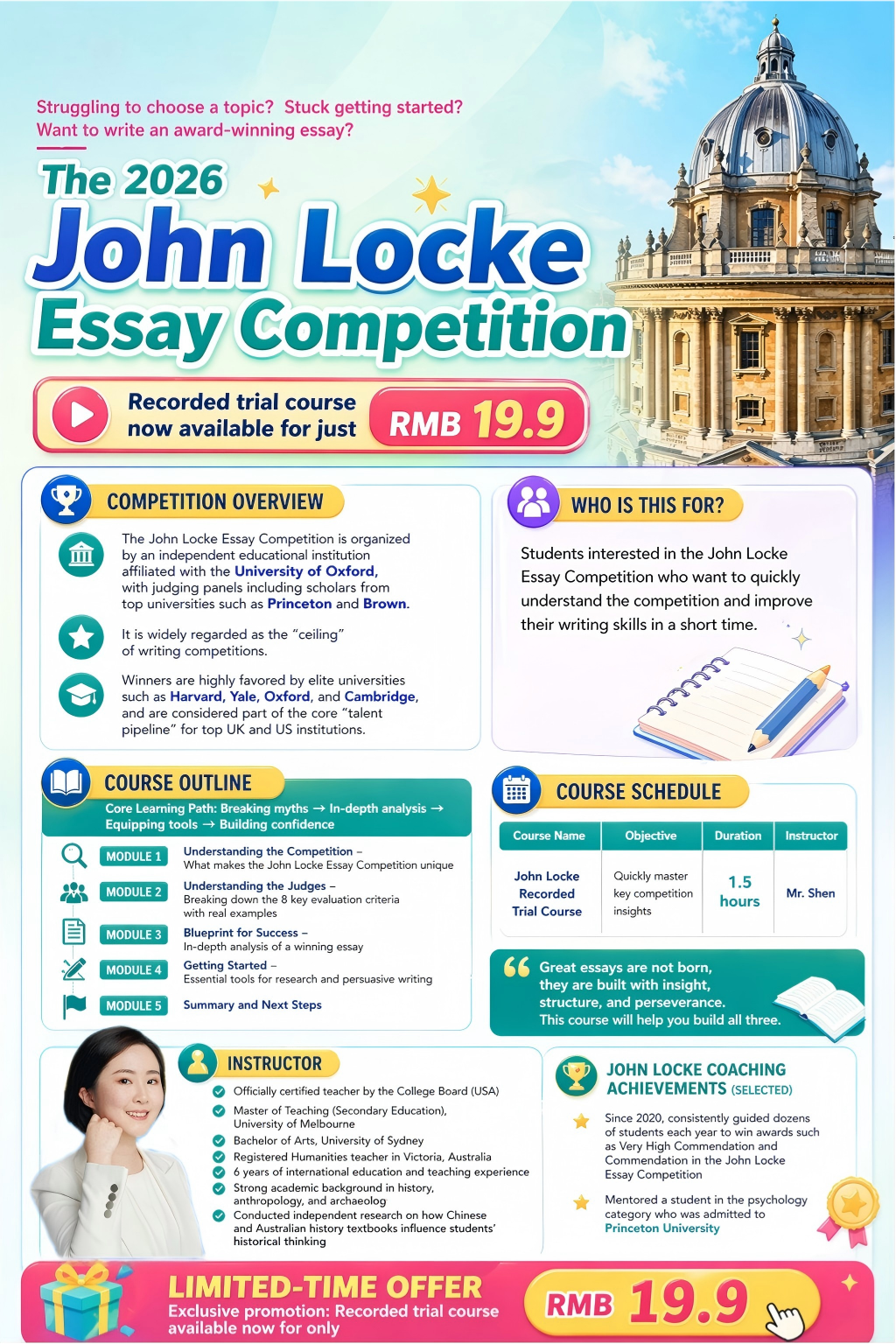

2026 John Locke Essay Competition: 3 Days Left to Register — Public Policy Essay Guide & Preparation Tips
The John Locke Institute Essay Competition opened registration on February 2, 2026. All participants must complete registration by March 31, 2026 (Greenwich Mean Time). With only three days remaining, it is strongly recommended to register as early as possible to avoid last-minute website congestion.
Producing an outstanding essay requires careful drafting and revision. Every step—from selecting a topic to constructing arguments—matters. To help students clarify their thinking and approach the questions effectively, this guide provides an in-depth breakdown of the 2026 Public Policy prompts.
2026 John Locke Public Policy Essay Questions: Analysis
Question 1
What discount rate should be applied to long-run environmental policies? Why?
Analysis
Economic decisions shape our future, influencing billions of dollars in investments and guiding responses to climate change, inequality, and environmental challenges. While human life depends on economic activity, that same activity significantly impacts the environment. Relying solely on collective moral responsibility for environmental protection is often insufficient. Instead, rational policy design—grounded in economic tools such as discount rates—offers a more effective approach.
This question integrates economics with environmental policy. Students should adopt a long-term perspective, considering sustainability, ESG trends, and intergenerational impacts. It is particularly suitable for those interested in environmental issues and public policy.
Key Concepts to Understand
- Discount Rate
- Monetary Policy
- Tragedy of the Commons
- Cost-Benefit Analysis
- Stakeholder Analysis
- Intergenerational Equity
Recommended Reading
A solid foundation in public policy and environmental economics literature will strengthen your argument.
Get a Free List of eBooks

Question 2
Which unintended consequence was most devastating and why did we fail to predict it?
Analysis
Public discourse is filled with warnings about catastrophic risks—from nuclear war and ecological collapse to pandemics and asteroid impacts. However, the most dangerous threats are often not the most obvious ones. This question invites a deeper exploration of how unintended consequences emerge, and why decision-makers fail to anticipate them.
Although the question appears to focus on specific events, its deeper focus lies in decision-making systems. It challenges students to examine bureaucratic structures, cognitive limitations, and the complexity of modern governance. Can linear thinking address nonlinear systems? Do national governments have the capacity to manage global crises? Could institutional structures themselves contribute to systemic failure?
Key Concepts to Understand
- Feedback Loops (time lags, complex systems thinking)
- Incentives
- Policy Trade-offs
- Information Failures (principal-agent problem, moral hazard, adverse selection)
- Bounded Rationality
- State Capacity (rent-seeking, path dependence, regulatory capture)
Recommended Reading
- Why Things Bite Back
- Seeing Like a State
- Power Without Knowledge
- The Logic of Failure
Get a Free List of eBooks
Question 3
Should vaccination be mandatory in a public health emergency?
Analysis
The COVID-19 pandemic demonstrated that individual health decisions can have global consequences. Vaccination generates positive externalities by improving overall public welfare. However, mandating vaccines raises ethical concerns about individual freedom, bodily autonomy, and medical risk.
Policy-makers must balance collective benefits against individual rights. Additional complexities include vaccine effectiveness, public trust, implementation feasibility, and ethical considerations for different populations, such as children.
Key Concepts to Understand
- Public Goods
- Externalities
- Free-Rider Problem
- Trust in Government
- Proportionality
- Policy Implementation and Compliance
Recommended Reading
Engaging with public health policy literature will help develop nuanced and balanced arguments.
Get a Free List of eBooks
Advice for Writing a Strong Essay
To stand out in the competition, strong English reading and writing skills are essential. High-quality essays demonstrate:
- Clear and logical argumentation
- Effective use of evidence
- Originality and critical thinking
- Well-structured organization
- Persuasive writing style
As noted by the competition organizers, the best essays are those capable of changing the reader’s mind. Essays that fail to address counterarguments are unlikely to succeed.
Extensive reading is fundamental. Strong writing is built on deep intellectual input. Without broad reading and critical engagement, it is difficult to produce compelling arguments. Writing should be treated as an intellectual dialogue, not merely an exercise in expression.
The competition explicitly prohibits plagiarism, ghostwriting, and over-reliance on AI tools. While AI can assist with brainstorming and research, it must not replace original thought. Overuse of AI risks producing generic arguments, reducing competitiveness.
Competition Overview
The John Locke Essay Competition is organized by the John Locke Institute, an independent educational organization based in Oxford. The judging panel includes scholars from institutions such as University of Oxford and Princeton University.
High-performing participants often gain admission to top universities, including Harvard University, Yale University, Stanford University, University of Cambridge, and others.
Eligibility
- Senior Category: Ages 15–18
- Junior Category: Age 14 and under
Timeline
- February 2, 2026: Questions released and registration opens
- March 31, 2026: Registration deadline
- May 31, 2026: Submission deadline
- June 7 or June 21, 2026: Late submission deadlines (with fees)
- July 7, 2026: Shortlist announcement
- October 2–4, 2026: Academic conference
- October 3, 2026: Awards dinner
Requirements
- Maximum 2,000 words (excluding references and appendices)
- Judged on knowledge, evidence, argument quality, structure, style, and persuasiveness
- Acceptable sources include academic databases and official reports
- Citation formats: APA, MLA, or footnotes
Awards
- Grand Prize: $10,000 scholarship
- Subject Winners: $2,000 scholarships
- High Commendations: Recognition for outstanding entries
If you enjoy writing, critical thinking, and intellectual exploration, this competition is an excellent opportunity. Approach it with curiosity, discipline, and originality—and make your argument count.