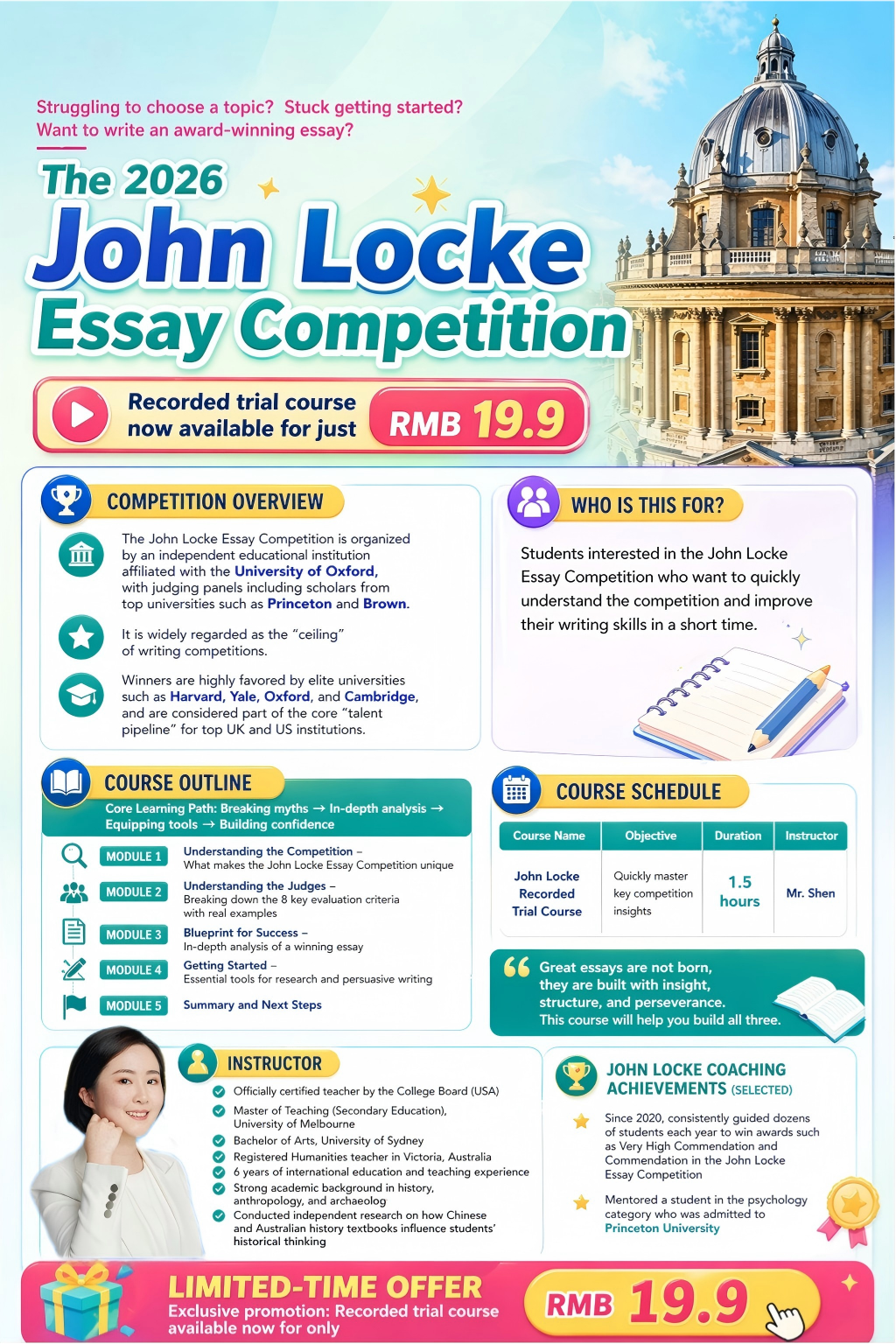

Important Update
The John Locke Institute has officially reopened registration for the 2026 essay competition.
Students who missed the March 31 deadline now have another opportunity. According to the latest announcement, a late registration option is available for a $10 fee, allowing eligible participants to enter the competition.
Global Essay Prize 2026
The regular registration period for the 2026 Global Essay Prize has ended. Registered candidates may log in to access their accounts and submit essays. Those who have not yet registered can still do so through the late registration option.
Late registration is open until April 30, 2026, with a fee of $10. This is a valuable second chance for those who missed the original deadline.
The essay submission portal opened on April 1, 2026. The standard submission deadline is May 31, 2026, which is earlier than in previous years. Students now have less than 60 days remaining to finalize their topic, structure, and revisions.
2026 John Locke International Relations Essay Questions: Analysis
This year’s International Relations questions address three major areas: the effectiveness of foreign aid, the economic impact of trade between major powers, and experimental governance models. Each question invites both empirical analysis and ethical reflection.
Question 1
Does foreign aid help or hurt poor people?
Analysis
The debate over foreign aid has persisted for decades without a definitive conclusion. The key issue is not whether aid exists, but how it is delivered and the institutional context in which it operates.
Recent advances in empirical methods, particularly meta-analysis and randomized controlled trials, have shifted the debate from ideology to evidence. Studies of unconditional cash transfer programs across dozens of low- and middle-income countries show significant positive effects on consumption, income, education, food security, mental health, and asset accumulation. Importantly, there is little evidence supporting the claim that aid creates dependency by reducing work incentives.
However, the effectiveness of aid depends heavily on governance quality, institutional capacity, and macroeconomic stability. When aid is not integrated into national development strategies, it may reinforce dependency rather than alleviate poverty.
Further research highlights the importance of complementary fiscal policies. Aid combined with effective education and healthcare spending has been shown to increase household income and reduce poverty levels in several regions. These findings suggest that aid itself is not a solution; its success depends on how it is embedded within domestic policy frameworks.
Advanced Writing Angles
- Differentiate types of aid: humanitarian vs. development, bilateral vs. multilateral, technical assistance vs. budget support
- Emphasize recipient-country ownership and autonomy
- Critically evaluate the “dependency theory” narrative using empirical evidence
Question 2
Is the US economy harmed by cheap imports from China?
Analysis
The so-called “China shock” remains a central issue in economic debates. Recent data provides an opportunity to reassess its effects.
On one hand, research shows that imports from China have generated measurable benefits for US consumers and firms. Increased imports are associated with lower consumer prices and reduced production costs for businesses relying on imported inputs. In some periods, overall employment effects were neutral or slightly positive when accounting for supply chain dynamics and price effects.
On the other hand, these gains are unevenly distributed. Manufacturing regions—particularly in the Midwest and the South—have experienced job losses and economic decline, while coastal and technology-driven regions have benefited more significantly.
Recent trade shifts also reveal that declining imports from China do not necessarily translate into domestic manufacturing growth. Instead, supply chains have been restructured, with production shifting to other regions. Reduced reliance on low-cost imports has also contributed to higher consumer prices.
Advanced Writing Angles
- Focus on distributional effects rather than aggregate outcomes
- Analyze supply chain restructuring and global trade rebalancing
- Move beyond “winners vs. losers” narratives to examine policy responses
Question 3
Should a coalition of countries (or of billionaires) run an experiment with a libertarian microstate?
Analysis
In recent years, there has been growing interest in experimental governance models, including libertarian microstates, seasteading projects, and charter cities. These initiatives aim to test alternatives to traditional nation-states through small-scale, autonomous communities.
Islands and remote regions are often chosen due to their geopolitical positioning. Projects such as Próspera in Honduras, floating city proposals in French Polynesia, and crypto-based communities in Puerto Rico illustrate this trend. These initiatives often rely on blockchain technologies to establish governance systems, manage finances, and regulate participation.
A notable example is Liberland, founded in 2015 on disputed land between Croatia and Serbia. It has attracted hundreds of thousands of citizenship applications and developed blockchain-based governance mechanisms. However, it has not been formally recognized by any United Nations member state.
Despite their innovative aspirations, these experiments raise significant ethical concerns. Local populations may be marginalized, governance structures often lack democratic legitimacy, and risks associated with failure are typically borne by host communities rather than investors.
Advanced Writing Angles
- Distinguish between different models (charter cities vs. sovereign microstates)
- Explore the philosophical basis of “exit rights” in libertarian thought
- Examine ethical double standards in applying experimental governance abroad
- Draw historical parallels with colonial enterprises and charter companies
Essay Submission Tips
Success in the John Locke Essay Competition requires more than strong language skills. High-quality essays demonstrate:
- Clear and structured arguments
- Effective use of evidence
- Original and critical thinking
- Engagement with counterarguments
- Persuasive and coherent writing style
Extensive reading is essential. Strong essays are built on deep intellectual engagement and critical analysis. Writing should be approached as a dialogue of ideas rather than a mechanical task.
The competition strictly prohibits plagiarism, ghostwriting, and over-reliance on AI tools. While AI may assist with brainstorming, it must not replace independent thinking. Originality remains the key to standing out.
Key Dates
- Late Registration Deadline: April 30, 2026
- Submission Deadline: May 31, 2026
With limited time remaining, students should act quickly to finalize registration and begin refining their essays.
If you are passionate about global issues, enjoy analytical thinking, and are willing to engage deeply with complex questions, this competition offers an excellent platform to develop and showcase your ideas.