
Important Notice
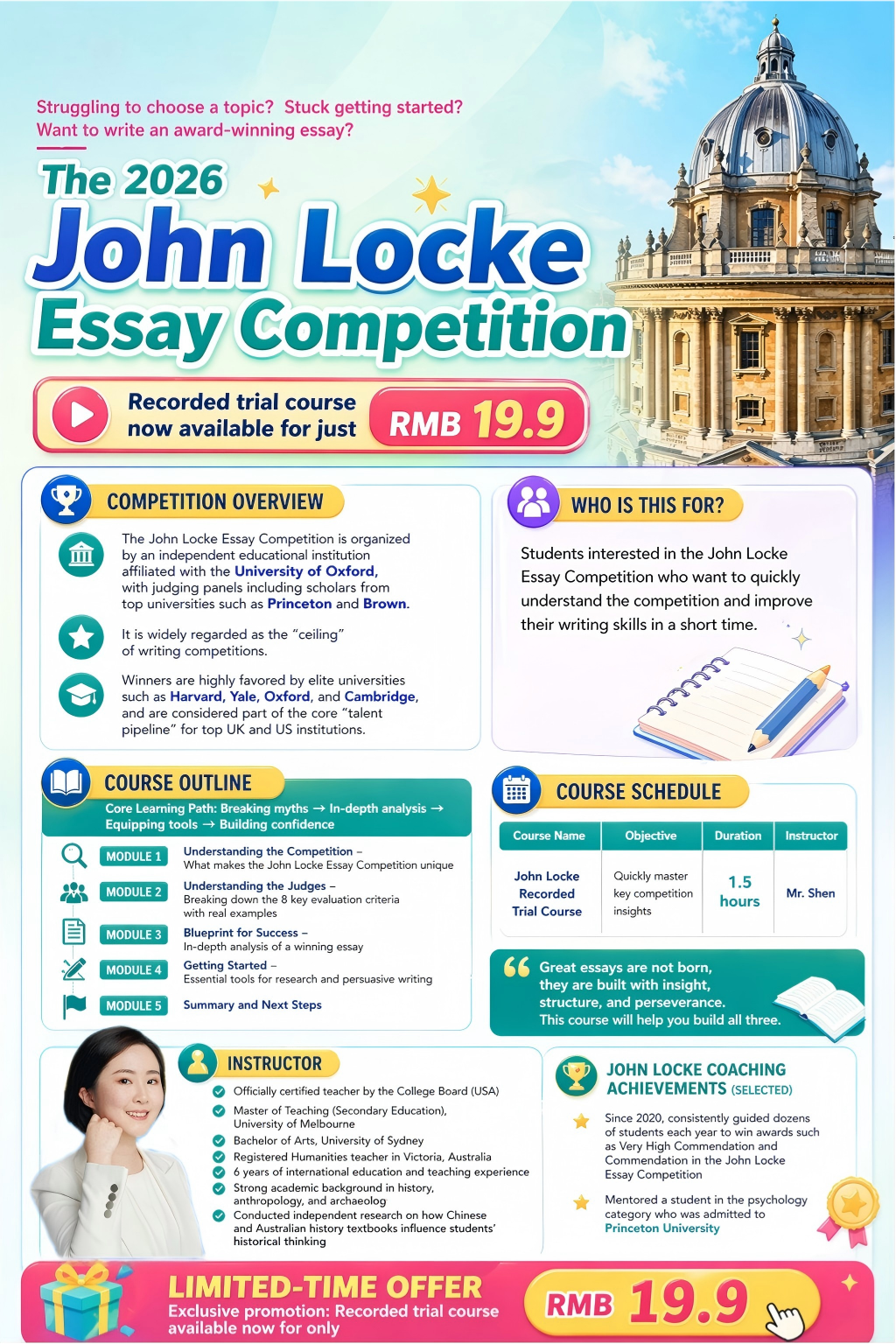
The John Locke Institute 2026 essay competition has reopened a late registration channel. The deadline for late registration is April 30, 2026.
According to the latest official update, regular registration closed on March 31 at 23:59 GMT. A new late registration option is now available: applicants may register between April 1 and April 30, 2026, by paying a $10 fee to gain eligibility for submission.
Global Essay Prize 2026
The regular registration period for the 2026 Global Essay Prize has ended. Registered participants can log into their accounts to submit essays.
For those who have not yet registered, late registration is still available until April 30, 2026.
The essay submission portal opened on April 1, 2026. The standard submission deadline is May 31, 2026—one month earlier than in previous years. This leaves less than 60 days for topic selection, research, and writing.
2026 Political Science Essay Questions: Analysis
The Political Science section this year focuses on sovereignty, power, and democracy. Each question explores a foundational tension in modern political theory and international relations.
Question 1
Is the right to self-determination absolute?
Analysis
The right to self-determination is one of the most compelling concepts in international law. It appeals simultaneously to cosmopolitan ideals and nationalist movements, to both left and right political ideologies. However, this universality is precisely what makes its “absolute” status questionable.
1. The internal paradox of self-determination
Self-determination contains an inherent contradiction: when one group exercises it, another group’s autonomy may be undermined. In plural societies, one group’s self-determination may restrict another’s. This makes it fundamentally different from prohibitions such as genocide or slavery, where no justification is acceptable.
The International Court of Justice, particularly in its Chagos advisory opinion, effectively linked self-determination to decolonization, giving it a quasi-jus cogens status in that context. Outside decolonization, however, it becomes a weaker “right to be heard” rather than an enforceable absolute principle.
2. Success and failure of implementation
Self-determination appears successful in decolonization cases, where many former colonies achieved independence. However, in other contexts—such as post-World War I Europe, Kosovo, Quebec, and Catalonia—its application is inconsistent.
In many cases, self-determination succeeds only when the “parent state” agrees to separation. Where legal conflict arises, its effectiveness becomes limited.
3. Instrumentalization risks
In contemporary geopolitics, self-determination can be used strategically. States may support separatist movements abroad for geopolitical leverage. This transforms a legal principle into a political tool.
Ultimately, self-determination is not absolute because it must be balanced against territorial integrity, state sovereignty, and minority rights within states. Its strongest legal force exists only in the context of anti-colonialism.
Recommended reading
Klabbers, J. (2019). Shrinking Self-determination: The Chagos Opinion of the International Court of Justice, ESIL Reflection.
Get a Free List of eBooks

Question 2
Did the pandemic normalise authoritarianism?
Analysis
This question examines the tension between emergency governance and democratic resilience. The COVID-19 pandemic forced governments worldwide to impose extraordinary restrictions on civil liberties, including limits on movement, assembly, and political participation.
1. Governance transformation during crisis
During the pandemic, many states adopted emergency measures that restricted democratic participation. In some cases, executive power expanded significantly, raising concerns about democratic backsliding.
Countries such as Hungary and Turkey illustrate how emergency powers can be used to consolidate authority and bypass institutional checks and balances.
However, strong legislative, judicial, and local government oversight in some democracies helped preserve accountability.
2. “Governmentality of unease”
A key analytical framework is the idea of a “governmentality of unease.” Governments encouraged compliance by cultivating public anxiety, framing emergency measures as necessary for collective protection.
This form of governance is neither purely coercive nor purely caring. It operates through a hybrid system of behavioral control, administrative regulation, and digital surveillance.
Even in formally democratic systems, this approach can normalize expanded surveillance and predictive governance under the justification of public safety.
3. Was authoritarianism normalised?
The answer depends on definition. If normalization means permanent institutionalization of emergency powers, evidence is limited. If it means increased public acceptance of state intervention, the evidence is stronger.
The key concern is not temporary emergency governance, but whether such practices become permanent governance templates without adequate safeguards.
Recommended reading
Degerman, D., Flinders, M., & Johnson, M. (2025). “Obedience in Times of COVID-19 Pandemics: A Renewed Governmentality of Unease?” In COVID-19 and the Politics of Fear, Bristol University Press.
Get a Free List of eBooks
Question 3
Is democracy in crisis?
Analysis
This question addresses one of the most pressing issues in contemporary political science: the stability and future of democratic systems.
Recent data from the V-Dem Institute shows a significant shift: for the first time in two decades, the number of authoritarian regimes (91) exceeds the number of democracies (88).
1. Symptoms of democratic crisis
The Munich Security Report 2026 highlights growing support for political movements that prioritize disruption over reform. These movements emerge from widespread dissatisfaction with institutional performance and declining trust in political systems.
In many G7 countries, only a small proportion of citizens believe current policies improve outcomes for future generations. Governments are increasingly perceived as bureaucratic, rigid, and unresponsive.
This creates space for anti-establishment actors who gain support not through constructive programs, but through promises to dismantle existing institutions.
2. Geopolitical dimension
Democratic crisis is also global. Uncertainty about the reliability of major democratic powers undermines confidence in the international liberal order.
External authoritarian actors contribute through disinformation and political interference, while internal actors exploit institutional openness to weaken democratic systems.
3. Democratic resilience
Despite these challenges, democracy is not necessarily collapsing. Crisis also functions as a stress test of institutional resilience.
Countries with strong checks and balances—legislatures, courts, and local governments—have demonstrated the ability to manage crises effectively.
Indicators such as political freedoms, civic engagement, and institutional trust remain measurable and, in many cases, stable.
Democracy is therefore simultaneously in crisis and resilient. The outcome depends on whether institutions can adapt and reform rather than remain static.
Conclusion
The Political Science section of the John Locke Essay Competition challenges students to engage with foundational tensions in sovereignty, governance, and democratic theory.
Late registration remains open until April 30, 2026, with essay submission due May 31, 2026.