

The John Locke Institute Essay Competition caps every essay at 2,000 words (not counting endnotes, bibliography, tables or the authorship declaration; confirm the current rule on johnlockeinstitute.com). The word limit is not an obstacle — it is the test. Judges reward quality of argumentation, structure, and originality, so the skill you are actually being marked on is making every one of those 2,000 words earn its place. This guide gives you a working method to do exactly that.
Why the limit is the whole point
Most first drafts by strong students run 2,600–3,200 words and then get hacked down in a panic the night before the deadline. That is the wrong way round. A 2,000-word ceiling forces three decisions that separate a shortlisted essay from an also-ran: which question you are really answering, which single line of argument you will defend, and what you are willing to leave out. An essay that tries to say everything about a big topic says nothing memorable. An essay that defends one sharp claim, all the way down, is the kind of writing the John Locke Institute says it is looking for.
The Institute is explicit that essays are assessed on knowledge and understanding, competent use of evidence, quality of argumentation, originality, structure, writing style and persuasive force. Notice what is not on that list: length, number of sources, or breadth of coverage. Padding actively costs you — it dilutes your argument density and signals to a referee that you could not decide what mattered.
Budget your words before you write a paragraph
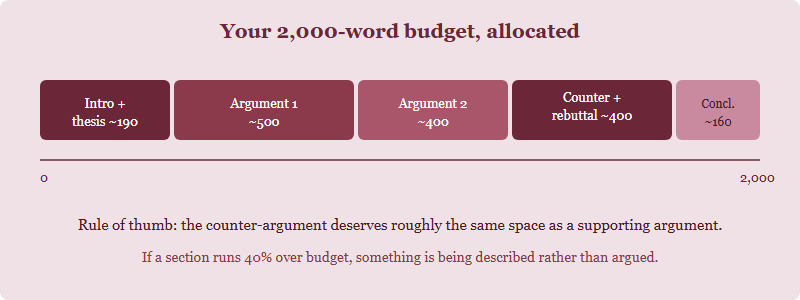
Treat 2,000 words like a fixed budget and allocate it on paper first. A defensible split for an analytical essay looks like this. Adjust the ratios to your question, but keep the discipline of pre-allocating.
| Section | Target words | Job it must do | Failure mode if bloated |
|---|---|---|---|
| Introduction + thesis | 150–220 | Name the question, stake one clear claim, signal the route | Throat-clearing; “Since the dawn of time…” |
| Strongest supporting argument | 450–550 | Evidence → reasoning → sub-conclusion | Description without analysis |
| Second supporting argument | 350–450 | A different mechanism, not a restatement | Repeats argument one in new words |
| Counter-argument + rebuttal | 350–450 | Steelman the objection, then defeat it | Strawman; skipped entirely |
| Conclusion | 120–200 | Answer the question; state what follows | Summary of what you just said |
The counter-argument line is where marks are won. A referee scoring for persuasive force and critical thinking wants to see you take the best objection seriously and still win. Reserving 400 words for it up front stops you burning your whole budget on exposition and arriving at the objection with 80 words to spare.
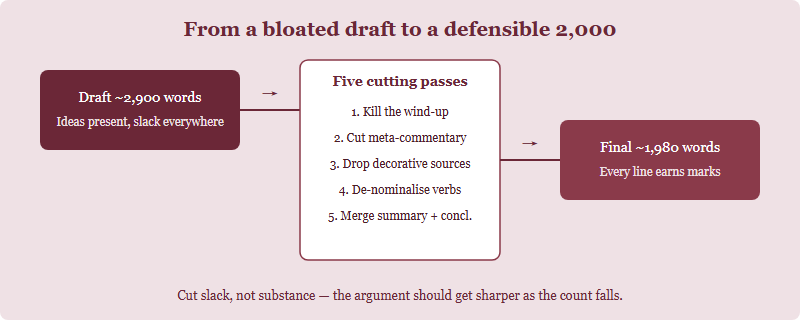
The five cuts that recover 500 words without losing an idea
When your draft is over budget, do not delete arguments — delete slack. These five passes routinely recover 400–600 words while the argument gets sharper, not thinner:
- Kill the wind-up. Openers like “In the modern world, it is often said that…” and “This essay will attempt to explore…” can almost always go. Start on the claim.
- Cut meta-commentary. “As I will argue below” and “Having established this, I now turn to” are scaffolding you can remove once the essay stands.
- Collapse evidence you are only citing to show you read it. One well-analysed example beats three name-dropped ones. If a source is not doing argumentative work, it is decoration.
- De-nominalise. “The implementation of a reduction in…” → “cutting…”. Turning noun-phrases back into verbs typically saves 15–20% and reads with more force.
- Merge the summary-conclusion into a real conclusion. Do not restate; answer the question and say what follows from your answer.
A quick self-test: for every sentence, ask “if I deleted this, would the argument be weaker?” If the honest answer is no, it is padding — even if it is beautifully written.
The paragraph test: is each paragraph pulling its weight?
At 2,000 words you can afford roughly 10–14 substantial paragraphs. That is a scarce resource, so each one should do a single, nameable job. The strongest analytical paragraphs follow a repeatable internal shape — claim, evidence, reasoning, link back to the thesis — and the weakest ones are the ones you cannot summarise in a phrase. When a draft feels bloated, it is usually not because sentences are too long; it is because two or three paragraphs are doing the same job.
Run this diagnostic on your own draft. Write a two- or three-word label in the margin of every paragraph (“defines term”, “gives example”, “raises objection”, “rebuts objection”). Then read the labels down the page:
- If two adjacent labels are identical, you have a repeat — merge them and reclaim 150–250 words.
- If a label is purely descriptive (“gives background”) and never turns into analysis, that paragraph is a candidate for deletion or heavy compression.
- If there is no “raises objection” label anywhere, your essay is one-sided and is leaving persuasive-force marks on the table.
- If the labels don’t build in a logical order, your structure — which judges score explicitly — needs resequencing, not more words.
This is far more reliable than re-reading the whole essay and “feeling” whether it flows. Labels expose repetition and gaps that prose fluency hides. A tight John Locke essay is one where every margin label is distinct and the sequence tells the argument’s story on its own.
What counts, and what doesn’t — so you don’t self-sabotage on a technicality
Getting the mechanics wrong can cost you before a judge reads a word. Per the Institute’s stated rules (verify the current version before you submit):
| Element | Counts toward 2,000? | Coach’s note |
|---|---|---|
| Main body prose | Yes | This is your budget. |
| Endnotes & bibliography (clearly titled) | No | Permitted; footnotes are not — use endnotes. |
| In-text citations (e.g. APA style) | Yes | Every “(Author, 2021)” eats your budget — factor this in. |
| Tables of data, diagrams | No | Do not smuggle prose arguments into “tables” to dodge the count. |
| Authorship declaration | No | Required; formatting per official guidance. |
The in-text vs. endnote distinction has a real strategic edge: if you are close to the limit and using an in-text style, switching to an endnote-based style can free up space that the word counter was charging you for. Choose your referencing style deliberately, not by habit. (We break down referencing and academic-honesty rules in a companion piece linked below.)
A one-week concision plan for China-based students
For students juggling IB/A-Level coursework, the practical challenge is finishing early enough to cut properly. A workable rhythm before your submission window (dates per the official site):
- Days 1–2: Write to 2,600 words deliberately — get the full argument down, over budget, without self-censoring.
- Day 3: Run the five cutting passes to reach ~2,100. Do not touch structure yet.
- Day 4: Read only the topic sentences in order. If they don’t tell the argument’s story on their own, your structure — not your word count — is the problem.
- Day 5: Final trim to under 2,000, verify the count using the official counting rules, and confirm endnotes/bibliography are titled correctly.
One first-party observation from coaching John Locke entrants: the students who improve most between drafts are almost never the ones who add material. They are the ones who cut a paragraph they were proud of because it did not serve the single claim they chose to defend. That instinct — to protect the argument by subtracting from it — is exactly what a 2,000-word ceiling is designed to teach.
Frequently asked questions
Is the John Locke word limit really 2,000?
Yes — essays “must not exceed 2,000 words,” excluding endnotes, bibliography, tables and the authorship declaration. Always confirm the current figure and exclusions on johnlockeinstitute.com before submitting.
Do footnotes count toward the limit?
Contestants are told not to use footnotes; endnotes and a titled bibliography are allowed and do not count. In-text citations (e.g. APA) are counted. Verify on the official site.
Will a longer essay score higher?
No. Judging criteria reward argumentation, originality and structure, not length. Padding dilutes your argument and can hurt you.
What if I go a few words over?
Do not risk it — treat 2,000 as a hard ceiling and finish under it. Exact handling of overlength entries is set by the Institute; check current rules before you submit.
Related reading on this site: our companion guide to referencing, endnotes and academic honesty for the John Locke essay, and our overview of how to choose and build a winning John Locke argument.
This is an independent guide operated by Hanlin Education for China-based international-school students. It is not affiliated with, endorsed by, or sponsored by the John Locke Institute. Competition rules — including the word limit, referencing requirements, eligibility, deadlines and prizes — are set by the Institute and may change; confirm all current details on johnlockeinstitute.com. Any error will be corrected within 7 working days of notice.