

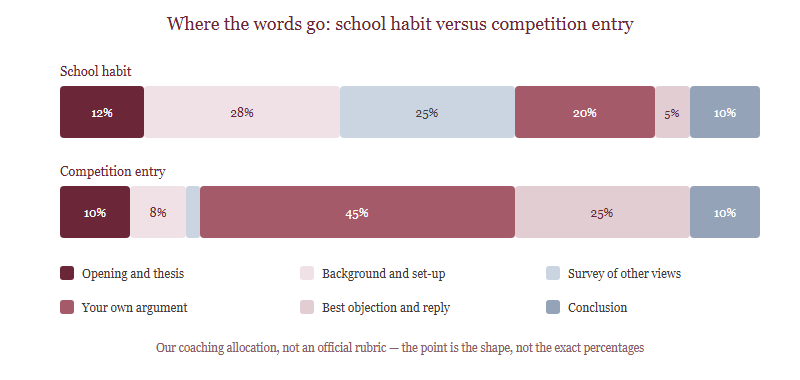
The strongest school writer in your year group is not automatically a strong John Locke entrant, and the reason is genre, not ability. An Extended Essay, an A-Level coursework piece and a competition entry share the word “essay” and very little else. School writing rewards coverage, balance and visible method; a competition entry rewards one defended claim in very few words. This guide names the five habits that transfer badly, and how to retrain before the next cycle opens.
Before anything procedural: word ceilings, deadlines and their timezone, eligibility ages, the fee position, formatting requirements and the interview arrangements are all set by the John Locke Institute and change between cycles. Confirm every one of them on johnlockeinstitute.com. Nothing below depends on a specific figure; it is about how the writing itself has to change.
Two Genres, One Word
The distinction is easiest to see through the reader. Your teacher is a paid assessor working through a mark scheme with criteria to evidence; showing range is part of the job, and an unbalanced answer is a risk. A competition judge is a senior academic working through a large pile of entries, and our coaching assumption is that the opening paragraph has to earn the rest of the read. That reader is not checking whether you covered the field. They are asking, from the first paragraph, whether this writer has something to say and whether they can defend it.
Chinese international-school students are hit hardest by this shift, and not for the reason usually assumed. It is not the English. It is that the systems most of our students come through — IB, A-Level, AP — are unusually good at teaching structured coverage, so the habits are deeply grooved and produce genuinely high school marks right up until the moment they stop working.
| Format | Assessed primarily on | What the reader wants | What a competition judge would cut |
|---|---|---|---|
| IB Extended Essay (about 4,000 words, per IB guidance — confirm with your school) | Research question, method, engagement with sources, reflection | Evidence of a sustained, documented research process | The methodology discussion, the reflective framing, most of the literature survey |
| A-Level or IGCSE essay answers | Coverage of assessment objectives against a published mark scheme | The named content, deployed to spec, under time pressure | The signposted “on the one hand / on the other” scaffolding |
| AP free-response and document-based writing | Thesis plus prescribed use of provided evidence, marked to a points rubric | Point-scoring moves executed reliably in exam conditions | Formulaic thesis templates and the ritual restatement in the conclusion |
| School “research paper” | Breadth of reading and correct citation practice | Proof that the student found and organised material | Background chapters that summarise rather than argue |
| John Locke entry (short ceiling — confirm current limit officially) | The organiser publishes its own criteria; in practice, argument quality carries the essay | A contestable claim, defended, with the best objection answered | Everything that does not move the claim forward |
The Five Habits That Cost You
1. Front-loading context. School essays open with background because the assessor needs to see that you understand the setting. In a short competition essay, three paragraphs of scene-setting spend a fifth of your ceiling before the reader learns what you think. Fix: open with the claim, then supply only the context each argumentative step actually requires, at the moment it requires it.
2. Balance as a default. “Some scholars argue X, others argue Y, and the truth lies somewhere in between” is a mark-scheme reflex. It reads to a competition judge as a writer who has not decided. Fix: commit, then take the strongest opposing position seriously — which is a different move, and a much harder one.
3. The literature survey. Reviewing what has been written is a research skill your school rightly trains. Here it is only useful where a specific source is doing work in your argument. Fix: no source appears unless the argument would change if it were removed.
4. Method talk. There is no methodology section in an argumentative essay. “This essay will first examine… it will then consider…” is not a plan, it is a table of contents that costs you words. Fix: delete every sentence describing what the essay is about to do. If the argument is ordered well, the reader does not need the map.
5. Vocabulary as display. School rewards the visible technical term. A judge reads unearned jargon as padding. Fix: keep a term only where it lets you say something you could not say in ordinary words, and define it at the point of use.
The Thesis Test: From Topic to Contestable Claim
Most rejected drafts we read never had a thesis at all — they had a subject wearing a thesis costume. The test is simple: could a well-informed adult read your sentence and say “no, that is wrong”? If not, you have written a topic or a truism, and no amount of good prose downstream will rescue it.
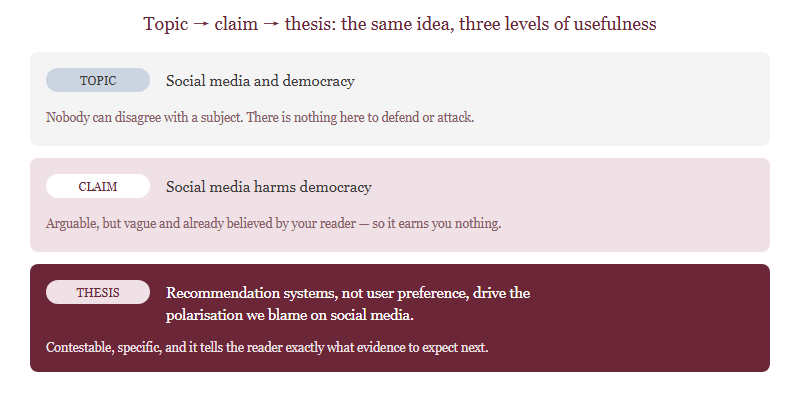
Notice what the third version buys you. It names a mechanism, which gives the essay a spine; it excludes a rival explanation, which tells you what the objection section must handle; and it implies a standard of evidence, so the reader knows what would count as a win. Our breakdown of how a winning entry is structured takes that spine and shows what each subsequent paragraph has to do with it.
Balance Versus Commitment: How the Objection Really Works
The habit hardest to break is the balanced conclusion, because school marks it well. Here is the difference in one line: balance presents two views and declines to choose; commitment chooses, then shows the reader you understand the cost of choosing.
A well-built objection paragraph does four things in order: state the strongest version of the opposing case, in its own terms and without caricature; concede what it genuinely gets right; identify precisely where it fails, on evidence or on logic; and show why your claim survives in a slightly modified, more honest form. That last step is the one school never asks for, and it is where the best entries separate from the merely competent ones. An argument that emerges from its objection completely unchanged usually means the writer chose a weak objection.
Two warnings. First, do not strawman — a judge in the relevant field knows the real counter-argument and will notice the substitution instantly. Second, do not bury the objection in the final paragraph. A concession that arrives after the conclusion has been drawn reads as an afterthought rather than as a test your claim passed.
A Retraining Drill for the Next Cycle
Habits are not fixed by understanding them; they are fixed by repetition on low-stakes material. Between now and the point where you begin drafting for the next cycle, run this weekly. It costs under an hour.
- Weeks 1–2 — the thesis drill. Take three pieces of writing you already admire and reduce each to one contestable sentence. If you cannot, the piece may not have an argument, which is itself worth noticing.
- Weeks 3–4 — the deletion drill. Take an old school essay and cut it by half without losing the argument. Track what you removed: it is a map of your padding habits.
- Weeks 5–6 — the objection drill. Write 250 words defending a position, then 250 words attacking it as strongly as you can. Most students discover their attack is better than their defence — which usually means they picked the wrong side.
- Ongoing — the first-paragraph drill. Rewrite the opening paragraph of anything you produce so the claim appears in it. Everywhere. Including school work, where it will usually still be fine.
A first-party note on what this retraining is worth, offered as coaching experience rather than as any promise. In the 2026 cycle, the entrants we worked with produced 86 shortlisted essays and 76 global awards across categories, per Hanlin's internal records, reported de-identified and in aggregate. Results vary widely, and no competition result causes a university offer. What we can say about that group is narrower and more useful: the drafts that improved most between first and final version were almost never the ones where we added material. They were the ones where a school-trained writer stopped hedging and committed to a claim on page one. Younger students, incidentally, often find this transition easier — if you are in the junior age band, see our Junior Prize guide for how the expectations differ there.
Questions Students Ask
Can I submit my Extended Essay to John Locke?
Treat it as source material, not a submission. The genre, length and the competition's own rules differ — check johnlockeinstitute.com.
Is a five-paragraph structure acceptable?
The Institute lists structure among its published assessment criteria, but no fixed template is required. Use as many paragraphs as the claim needs and cut those that do not move it.
Should I include a methodology section?
No. This is an argument, not a research report. Define terms where they do real work, then get to the claim.
My teacher says to stay balanced. Who is right?
Both, differently. School balance shows range; a competition essay shows judgement — commit, then answer the best objection.
This is an independent guide operated by Hanlin Education for China-based international-school students. We are not affiliated with, endorsed by, or sponsored by the John Locke Institute. Questions, categories, word limits, formatting rules, eligibility ages, fees and deadlines are set by the Institute and change between cycles — always confirm current details on johnlockeinstitute.com before acting on anything here. Factual errors reported to our editorial desk are corrected within 7 working days.