

The John Locke Institute Essay Competition runs a separate Junior category for younger students: entrants who are under the age of 15 as of 31 May are judged as juniors, competing against their own age group rather than sixth-formers. They answer the same subject questions and write to the same essay length, but they are scored and ranked separately. This guide explains who qualifies, how the junior route differs from the senior one, and how a Year 8–9 student in China realistically prepares. Confirm every date and rule on johnlockeinstitute.com, as the Institute sets the current terms.
Who counts as a “junior”?
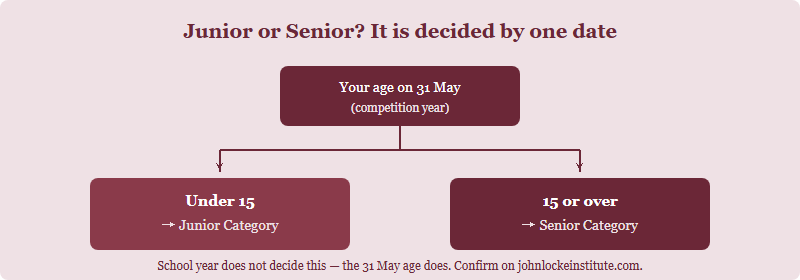
Per the Institute’s stated rule, “students who are under the age of 15 as of 31 May will be judged in the Junior Category.” That single cut-off date is what matters — not your school year label, which varies by curriculum and country. If you turn 15 on or before 31 May, you compete as a senior; if you are still under 15 on that date, you are a junior. Because the John Locke essay draws students from many systems (IB, A-Level, US, national curricula), the age cut-off is the fair common denominator.
For a China-based international-school family, the practical check is simple: work out the student’s age on 31 May of the competition year and confirm the current cut-off wording on the official site before registering.
How the junior route differs from the senior prize
The junior and senior competitions share a great deal — the same subject categories, the same essay length, the same emphasis on argument and originality. The core difference is that juniors are judged as a separate cohort with their own prizes, so a 13- or 14-year-old is not measured against a polished 18-year-old. Here is the honest comparison; treat the specifics as “confirm officially” because the Institute sets and updates them each cycle.
| Feature | Junior Category | Senior (main) competition |
|---|---|---|
| Who competes | Under 15 as of 31 May | Under 19 as of the submission deadline |
| Subject questions | Choose one question in your subject | Choose one question in your subject |
| Essay length | Up to ~2,000 words (per official rules) | Up to ~2,000 words |
| Judged against | Other junior entrants only | Senior entrants worldwide |
| Prizes | Junior awards (per official schedule) | Senior scholarships + grand prize |
| Registration & deadlines | Per official calendar | Per official calendar |
The exact prize amounts, the subject list open to juniors, and whether any shortlisting or ceremony applies are all set by the Institute — check the current year’s page rather than assuming they match a previous cycle. The essential takeaway is that the junior route is a genuine, age-appropriate on-ramp, not a watered-down consolation event.
Is the Junior Prize worth it for a Year 8–9 student?
For most younger students the honest answer is: yes, but for the process more than the prize. Writing a 2,000-word argued essay at 13 or 14 is a stretch that pays off long before any result is announced. It teaches a student to read a serious source, form a claim, anticipate an objection and defend a position — skills that compound through IGCSE, IB or A-Level and into competitive university applications. A place or commendation in a globally recognised competition is a strong early signal; but even an unplaced essay leaves the student a markedly better writer and thinker.
We do not promise results, and no coaching can guarantee an award — the field is large and judged by academics. What the junior route reliably delivers is an early, structured experience of real analytical writing. That is the value a parent should weigh.
A realistic preparation path for younger writers
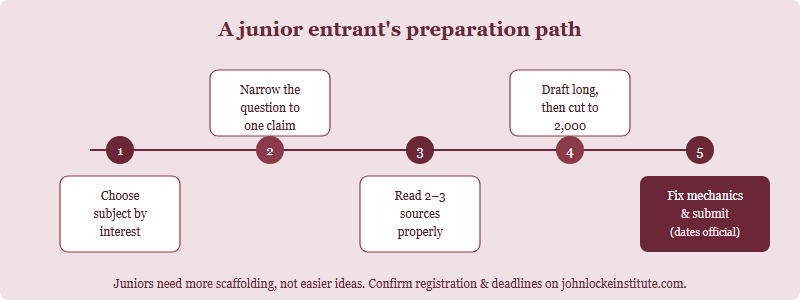
Junior entrants usually need more scaffolding than seniors — not easier ideas, but more support turning a big question into a manageable essay. A sensible sequence for a China-based student over roughly eight to ten weeks:
- Pick the subject to the student, not the trophy. A curious reader of history or philosophy will go deeper than a student chasing the “most impressive” category. Genuine interest is what produces originality.
- Narrow the question hard. The most common junior mistake is trying to answer the whole question. Help the student defend one specific claim — depth beats breadth every time at 2,000 words.
- Read two or three sources properly, not ten superficially. One well-understood text a junior can actually engage with is worth more than a long reading list they skim.
- Draft long, then cut. Get the argument down over the limit, then teach the student to trim slack — the discipline of concision is exactly what a strong essay demonstrates. (See our guide to writing tight inside the 2,000-word limit.)
- Get the mechanics right. Endnotes not footnotes, a titled bibliography, the essay entirely the student’s own work. Our referencing and academic-honesty guide walks through these rules.
The five mistakes that cost junior entrants marks
Across a large field of younger writers, the essays that under-perform tend to fail in the same predictable ways — and every one of them is fixable with guidance rather than genius. If you help a junior avoid these, you have done most of the coaching that matters:
| Common junior mistake | Why it costs marks | The fix |
|---|---|---|
| Answering the whole question | Spreads 2,000 words thin; no depth on anything | Defend one specific sub-claim in full |
| Describing instead of arguing | Judges score argumentation, not summary | After every fact, ask “so what does this prove?” |
| No counter-argument | Persuasive force and critical thinking go unshown | Name the best objection, then answer it |
| Reading list padding | Name-dropping sources reads as decoration | Engage 2–3 sources deeply and cite what you use |
| Leaving mechanics to the last night | Footnote/word-count errors sink strong essays | Fix endnotes, bibliography and count with days to spare |
Notice that none of these is about being cleverer than the field. A 13-year-old who defends one claim, takes an objection seriously, and gets the mechanics right will out-score a nominally “smarter” essay that tries to cover everything and argues nothing. That is genuinely encouraging news for younger students: the winnable ground is discipline, and discipline can be taught.
What parents can — and can’t — do
For a younger child, parents are naturally more involved than they would be with a sixth-former, and that is fine within limits. The boundary is the same one the Institute draws for everyone: the essay “must be entirely the work of a single individual,” and “no part of your essay may be written by anyone else.” Translated into everyday support:
- Helpful: talking through the question over dinner, helping the student find good sources, reading a draft and asking “what do you actually mean here?”, and keeping them on schedule so they finish early enough to revise.
- Helpful: proof-listening — having the student read the essay aloud so they hear their own clumsy sentences and fix them themselves.
- Off-limits: writing or rewriting sentences, choosing the argument for them, or “tidying up” the prose so it no longer reads like the child’s own work. A referee verifies original authorship, and an essay that sounds like an adult wrote it is a liability, not an asset.
The most useful thing a parent of a junior entrant can do is protect the timeline. Younger students almost always underestimate how long a 2,000-word argued essay takes; the single biggest quality gain comes from finishing the first full draft a week early so there is time to narrow, cut and correct. Confirm the registration and submission dates on the official site and work backward from them.
Where Hanlin fits — honestly
Hanlin Education has a real track record coaching John Locke entrants, and younger writers are often where structured guidance helps most: a coach can teach a 13-year-old to narrow a question and defend a claim without ever writing the essay for them. But the honest framing matters — a coach develops the student’s thinking and gives feedback; the essay must remain entirely the work of a single individual, as the Institute requires. No programme, ours included, can promise a junior award. What good coaching can do is turn a curious younger student’s first serious essay into a genuinely well-argued one, and that is worth doing on its own terms.
Frequently asked questions
Who qualifies for the John Locke Junior Prize?
Students who are under 15 as of 31 May of the competition year are judged in the Junior category. Confirm the current cut-off on johnlockeinstitute.com.
Do juniors write shorter essays than seniors?
The same essay-length rules apply (up to about 2,000 words per official guidance). Juniors are judged separately from seniors, not given a shorter limit. Verify officially.
Is the Junior Prize worth entering?
For most younger students, yes — mainly for the skills gained. It teaches serious analytical writing early; no award is guaranteed. Weigh it as process value.
Which subjects can juniors enter?
Juniors choose one question in a subject category; the exact subjects open to juniors are set by the Institute. Check the current year’s official page before registering.
Related on this site: writing tight inside the John Locke 2,000-word limit and our referencing and academic-honesty guide.
This is an independent guide operated by Hanlin Education for China-based international-school students. It is not affiliated with, endorsed by, or sponsored by the John Locke Institute. Junior eligibility, subjects, deadlines, prizes and rules are set by the Institute and may change; confirm all current details on johnlockeinstitute.com. Any error will be corrected within 7 working days of notice.