
Does a John Locke award actually help your university applications? Honestly: it can be a genuine signal of independent scholarship — but it is one data point in a much larger picture, not a guarantee of admission anywhere. Its value depends on how it fits your wider profile and, above all, on how you talk about the thinking behind it rather than the trophy itself.
What the award actually signals
Set aside the prestige for a moment and ask what an admissions reader learns about you. A John Locke entry — shortlisted, commended, or simply completed to a high standard — evidences three things that applications otherwise struggle to prove: that you can pursue a question independently, that you can write to a demanding external standard rather than a school rubric, and that you have intellectual initiative, because nobody made you do it.
That is a meaningful signal precisely because it is externally validated and hard to fake. But notice what it signals: scholarly capacity and initiative — not a place at any particular university. Admissions decisions weigh many factors, and no single competition result is decisive on its own.
How it reads in a UK / Oxbridge context
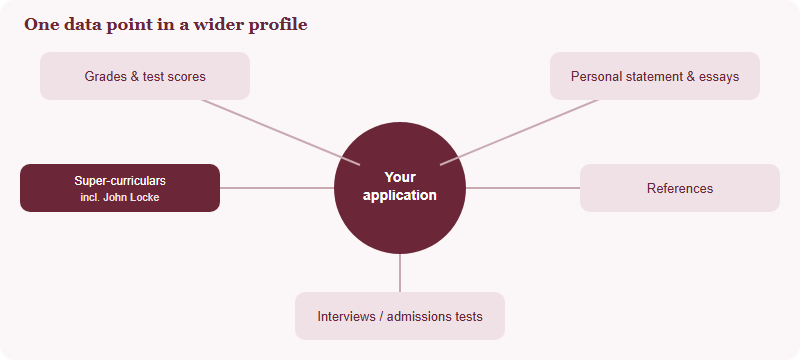
UK admissions for competitive courses lean heavily on evidence of genuine engagement beyond the syllabus — often called super-curricular activity. A John Locke essay is close to an ideal example, because it is subject-specific, argument-driven, and produces an artefact you can actually discuss. For an applicant to Philosophy, PPE, Law, History or a related course, the essay gives you concrete material for a personal statement and a real argument to defend if you reach interview.
The important caveat: universities set their own selection criteria and do not award places for competition results. Treat the award as strong supporting evidence that you engage with your subject at a high level, and confirm what any specific university values through its own official guidance rather than assuming a competition “counts.” The essay helps most when it is one coherent thread in a profile, not a stray line hoping to impress.
How it reads in a US / holistic context
US admissions are holistic, weighing academics, activities, essays, recommendations and context together. A John Locke result can appear in an activities or honours list, but its deeper value is quieter: the essay itself is a serious writing sample and evidence of intellectual life, and the ideas you developed can surface authentically in supplemental essays. Readers are looking for a coherent story, and a genuine passion for a subject — expressed through independent work — reads far better than a trophy dropped in for prestige.
Here too, honesty matters. A single line in an activities list is weak; the same experience, woven into how you think and what you want to study, is strong. The award is raw material — what you build from it is the signal.
The honest limits
This is where a lot of well-meaning advice overreaches, so let us be plain. A John Locke result — at any level — does not guarantee admission to Oxbridge, the Ivy League, or anywhere else. Admissions are competitive and multi-factorial, and no external prize overrides grades, fit, references and everything else in the file.
A few distinctions worth keeping straight:
- Participation is not an award, and a strong entry that missed the shortlist is still legitimate evidence of engagement — describe it accurately.
- A shortlist is not a win, and a subject prize is not proof you are “the best” — describe the level honestly.
- Overclaiming backfires. Experienced readers spot inflated language instantly, and it costs you credibility you cannot get back.
The strongest applicants under-claim and let the substance speak. For younger students, this is also why an early credential such as the Junior Prize matters as a foundation to build on, not a finish line.
How to actually use it well
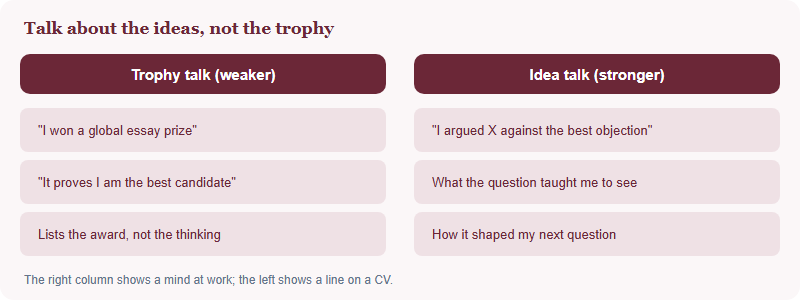
The rule of thumb: talk about the ideas, not the trophy. An admissions reader is far more persuaded by “I argued that X, and defending it against the obvious objection changed how I see Y” than by “I won a global essay prize.” The first shows a mind at work; the second shows a line on a CV.
| What students are tempted to claim | The honest reframe | How to use it |
|---|---|---|
| “It guarantees a top offer” | It is supporting evidence, not a decision | Let grades and fit lead; add depth |
| “A shortlist means I won” | Shortlist is a strong stage, not the prize | State the level accurately |
| “The prize proves I’m the best” | It proves serious, independent scholarship | Discuss the argument, not the ranking |
| “I can just list the award” | A bare line signals little | Connect it to what you want to study |
Choosing the right subject early makes this far easier, because a category that genuinely fits you produces ideas you actually want to keep discussing — our International Relations guide is one example of how the demands vary by category. And whatever you write, the qualities admissions readers respect are the same ones markers reward, which is why how a winning essay is structured is worth studying even if your goal is the application, not the prize.
A first-party note, offered honestly: in the 2026 cycle, students Hanlin coached recorded 86 shortlist places and 76 global awards (Hanlin’s own de-identified coaching figures, not official Institute statistics). We are proud of that work — and we still tell every student the same thing: no result guarantees a university place, and the essay helps your application most when you use it to show how you think, not to claim a rank.
Frequently asked questions
Does a John Locke award guarantee a place at Oxbridge or the Ivy League?
No. It is supporting evidence of independent scholarship; admissions are competitive and multi-factorial, and no single result is decisive.
Is a shortlist worth mentioning if I did not win?
Yes, described accurately. A shortlist or strong entry is legitimate evidence of engagement — just state the level honestly.
How should I reference it in an application?
Talk about the argument you made and what it taught you, not just the prize. Connect it to what you want to study.
Does the subject I choose matter for admissions value?
Yes. A category that fits your intended field gives you coherent material to discuss; confirm what each university values on its own site.
This is an independent guide operated by Hanlin Education for China-based international-school students. It is not affiliated with, endorsed by, or sponsored by the John Locke Institute. Competition rules, dates, eligibility, prizes and process can change — always confirm current details on johnlockeinstitute.com. Spotted an error? We correct verified issues within 7 working days.