
You submitted by 31 May 2026 (or bought one of the paid extensions), and shortlist emails went out by 7 July. So what is actually happening between now and October? Three things: referee verification, possible online integrity interviews, and the judging that decides category prizes — announced at the awards dinner in London on 3 October 2026. Here is what each stage involves, and what to do if your name was not on the list.
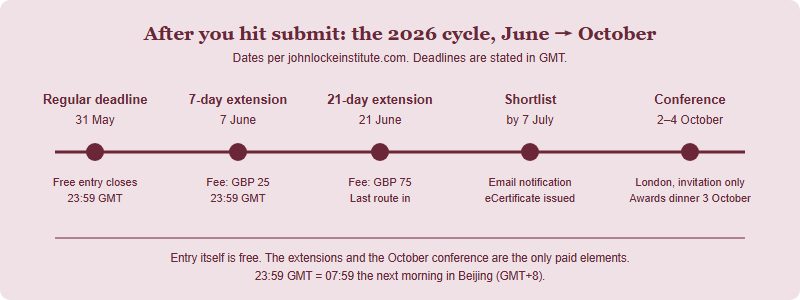
The post-submission calendar, in one table
Most of the anxiety in July comes from not knowing what the remaining checkpoints are. There are only five, and all of them are published on johnlockeinstitute.com.
| Stage | Date (2026 cycle) | What it actually means |
|---|---|---|
| Regular submission deadline | 31 May, 23:59 GMT | Free entry closes |
| Seven-day extension | 7 June, 23:59 GMT | Fee of GBP 25 |
| Twenty-one-day extension | 21 June | Fee of GBP 75 |
| Shortlist notification | by 7 July | Email; shortlisted entrants receive an eCertificate |
| Academic conference | 2–4 October, London | Invitation-only; attendance optional; not free |
| Awards dinner | 3 October, London | Prizes announced; attendees receive signed certificates |
One detail that quietly catches out students in China: the competition states its deadlines in GMT. Beijing is GMT+8, so 23:59 GMT on 31 May lands at 07:59 on the morning of 1 June in Beijing. That looks like a free extra day. It is not — it is the hour you are asleep or on the bus to school, with no time left to fix a corrupted PDF. Treat the Beijing evening of 31 May as the real cut-off.
What the shortlist is — and what it is not
The shortlist is the judges saying your essay cleared the first bar on the published criteria: knowledge and understanding of the relevant material, competent use of evidence, quality of argumentation, originality, structure, writing style and persuasive force. The judging panel is drawn from academics at Oxford, Cambridge, Harvard, Princeton and Stanford, chaired by Terence Kealey.
It is not the prize list. Prizes are announced later, at the October dinner. Junior and Senior entries are judged separately within each of the ten categories, so an entrant who is under 15 at the deadline is judged only against other under-15s, not against eighteen-year-olds, for the same three places — a point we set out in detail in our guide to the Junior Prize and how the age split works.
Two things follow from the official line that “the judges’ decisions are final, and no correspondence will be entered into”. First, there is no appeals process. Second, there is no written feedback to wait for. If you want to know why an essay did or did not land, you have to get it read by a teacher yourself, against those seven published criteria.
For a sense of scale from one coaching cohort: across the 2026 cycle, Hanlin-coached students recorded 86 shortlistings and 76 global awards (figures per Hanlin, de-identified). We publish those two numbers separately on purpose — a shortlisting and an award are different outcomes, and conflating them is one of the most common pieces of marketing noise in this space. No programme, ours included, can promise either.
The integrity layer: your referee, and the possible interview
When you registered, you supplied the email address of an academic referee — a school teacher if possible, or another responsible adult who is not related to you. The Institute emails those referees to verify that submitted essays are genuinely the contestants’ own work.
This has a very practical consequence for students in China: that email may land during the summer holiday, when your teacher is travelling, off their school account, or behind a firewall they only check from campus. Message your referee now and tell them what to expect. A verification email that sits unread is a self-inflicted problem.
Separately, the official site states that some candidates will be invited to an online interview as part of the measures protecting the integrity of the competition, and that participants under 18 need parental consent. The Institute does not publish the selection criteria or the format, so anyone telling you exactly what will be asked is guessing. What is safe to prepare is the only thing an integrity conversation can reasonably be about — your own essay:
- Reread the essay you actually submitted, not the draft you remember writing.
- Be able to say, in a sentence, what your thesis is and what the strongest objection to it would be.
- Know why you chose each substantial source, and roughly what it argues.
- Be able to name the part you are least happy with. Candour reads better than a rehearsed defence.
On AI: the Institute’s published position is that large language models are welcome as a thought partner but not as a substitute, and it notes that over-reliance tends to produce writing very similar to thousands of other essays. The practical test is simple — if a tool was involved anywhere in your process, you should still be able to explain the reasoning in your own words, unprompted.
October in London: the conference, the dinner, and the maths of going
The academic conference runs 2–4 October 2026, with the awards dinner on 3 October, in London. It is invitation-only for shortlisted essayists and prize-winners. Two facts from the official site matter more than anything else here: unlike the competition, the conference and dinner are not free, and nobody is required to attend. You can win a prize without travelling to London.
That reframes the decision for a family in Shanghai or Shenzhen. You are not buying a better chance at a prize — the prize is already decided. You are buying three days of an academic conference and a dinner, against the cost of long-haul flights, London accommodation, conference fees and, for most Chinese passport holders, a UK visa application with its own lead time. Some students will judge that worth it; plenty will not, and skipping it costs them nothing in the results.
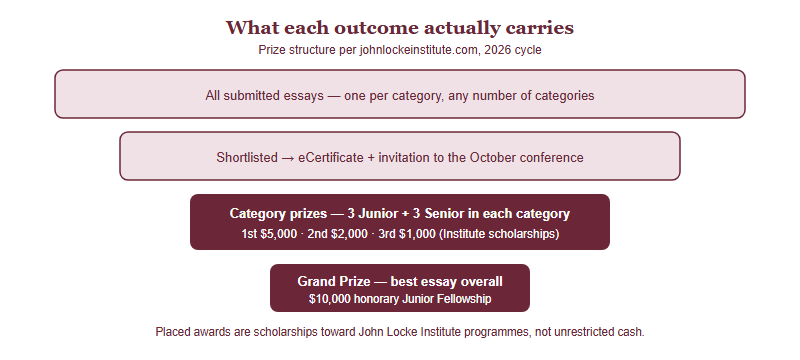
The prize detail most commonly misreported in Chinese parent groups is the nature of the money. First, second and third places are scholarships toward John Locke Institute programmes; the Grand Prize is an honorary John Locke Institute Junior Fellowship, which comes with a US$10,000 scholarship toward the Institute’s summer schools or visiting-scholars programmes — one package, not a fellowship plus a separate award — and the official site notes that travel grants may supplement scholarships in certain cases. If a family is budgeting on the assumption that a first place is a $5,000 cash transfer, they have misread the scheme. Check the current wording before you plan around it; our results page records recent prize-winners as announced by the Institute.
Not shortlisted? Three things worth doing in August
Most entrants are not shortlisted, and the absence of feedback makes it tempting to file the whole thing away. That wastes the most valuable asset you now own: a finished 2,000-word argument on a hard question, written under a real deadline.
- Get a proper diagnosis, not a grade. Hand the essay to a teacher with the seven published criteria and ask which one is weakest. In our coaching work the answer is rarely “writing style” — it is far more often that the essay described a debate instead of taking a side, or leaned on secondary summaries where the question demanded evidence.
- Salvage the research, not the essay. The reading behind a John Locke entry usually outlives the entry. It can become an EPQ, a school journal piece, or the intellectual spine of a personal statement. What it cannot become is a second submission elsewhere in violation of another competition’s rules — and the Institute requires that each submitted essay be entirely the work of a single individual, so recycling someone else’s framing is never an option.
- Choose next cycle’s category now, in August, not next April. The students who struggle most are the ones who pick a question in the same fortnight they start writing. If you are drawn to power, alliances and conflict, our breakdown of the International Relations category is a good place to see what that subject actually demands. If you want to understand what a placed essay looks like structurally, work through how a winning John Locke essay is built before you write a word.
One honest note on university applications. A John Locke shortlisting is a credible supercurricular signal for humanities and social-science applicants, precisely because the competition is open globally, free to enter and judged on a published rubric. It is still one line in a file that also contains grades, references and a personal statement. No essay competition — and no coaching programme — determines an admissions outcome, and you should be sceptical of anyone who implies otherwise.
Frequently asked questions
When was the 2026 John Locke shortlist announced?
Shortlisted essayists were notified by 7 July 2026, per the official site. Confirm each cycle’s date on johnlockeinstitute.com.
Do I have to travel to London to win a prize?
No. The official site states that nobody is required to attend and that you can win a prize without travelling to London.
What is the John Locke online interview for?
It is an academic-integrity measure. Some candidates are invited; under-18s need parental consent. The format is not published.
Are John Locke prizes paid in cash?
First, second and third places are scholarships toward John Locke Institute programmes, per the official site — not unrestricted cash.
This is an independent guide operated by Hanlin Education for China-based international-school students. We are not affiliated with, endorsed by, or sponsored by the John Locke Institute. Competition rules, dates, fees and prizes change between cycles — always confirm current details on johnlockeinstitute.com. Factual errors reported to our editorial desk are corrected within 7 working days.