

If you are aiming at the next John Locke cycle, the useful work starts in August — six months before registration even opens. In 2026 the Institute opened registration on 2 February, closed it on 31 March, and took submissions until 31 May, 23:59 GMT. That puts the deadline inside international exam season. The students who cope are the ones who did their reading in the autumn. Here is the calendar, working backwards.
What the 2026 calendar tells you about pacing
The Institute has not published the 2027 dates at the time of writing, so treat everything below as the 2026 rhythm rather than a promise — confirm the real dates on johnlockeinstitute.com when they appear. But the shape of the year is what matters for planning, and the shape is unusually informative.
| Stage | 2026 date | Cost | Planning implication |
|---|---|---|---|
| Registration opens | 2 February | Free | The 2026 questions were available from the opening of the window — reading should already be underway |
| Registration closes | 31 March | Free | The hard gate: miss it and you pay or you are out |
| Submissions open | 1 April | — | You can submit early; you may re-upload before the deadline, but your referee has to approve each time |
| Late registration closes | 30 April, 23:59 GMT | $10 | A safety net, not a plan |
| Submission deadline | 31 May, 23:59 GMT | Free | Collides with IB, AP and A-level season |
| Seven-day extension | 7 June, 23:59 GMT | GBP 25 | Buys a week, not a rewrite |
| Twenty-one-day extension | 21 June | GBP 75 | Final route in |
| Shortlist notification | by 7 July | — | Your referee must be reachable over the summer |
| Conference & awards | 2–4 October, London | Paid, optional | Attendance never affects the result |
Read that table as a designer would. In the 2026 cycle the questions were available from the opening of the registration window; the Institute does not publish a fixed release date for them, so check johnlockeinstitute.com. On that pattern you get two clear months between the questions appearing and registration closing, and two more between registration closing and the deadline. Four months looks generous — until you overlay a Chinese international-school spring.
The collision map: where this calendar hits your school year
This is the part no official page can tell you, because it depends on your curriculum. The competition deadline sits at the end of the international examination season: the IB May session, the AP exam fortnight and the first A-level papers all fall in that window. Check your own school’s timetable rather than trusting a generic date, but assume May is not a writing month.
| Month | Competition stage (2026 pattern) | Typical school pressure | What to do |
|---|---|---|---|
| August | Off-season | Summer holiday | Read widely; shortlist two candidate categories |
| Sept–Oct | Off-season (conference runs in October) | Term starts; new syllabus load | Build a source base; read last cycle’s question types |
| Nov–Dec | Off-season | Mocks and winter assessments | Write one practice essay on an old question, to length |
| January | Off-season | End-of-term exams | Narrow to one category; line up a referee |
| February | Registration opens | Chinese New Year travel | Register in the first fortnight; read the new questions |
| March | Registration closes | Spring mocks, university interviews | Register before the gate closes; outline the argument |
| April | Submissions open | Exam revision ramps up | Complete a full first draft — this is the real writing month |
| May | Deadline, 31 May | IB / AP / A-level papers | Edit only. Submit a week early |
| June | Paid extensions | Exams continue | Extensions cost money and rarely improve an essay |
| July | Shortlist by 7 July | Summer holiday | Make sure your referee is checking email |
Two collisions deserve naming. First, February: registration opens as Chinese New Year approaches, and families travel. A student who plans to “look at it after the holiday” is starting in March with one month of runway. Register in the first two weeks of February and the rest of the calendar relaxes. Second, May: whatever your curriculum, the submission deadline arrives while you are sitting public examinations. Any plan whose critical path runs through May is a plan that fails.
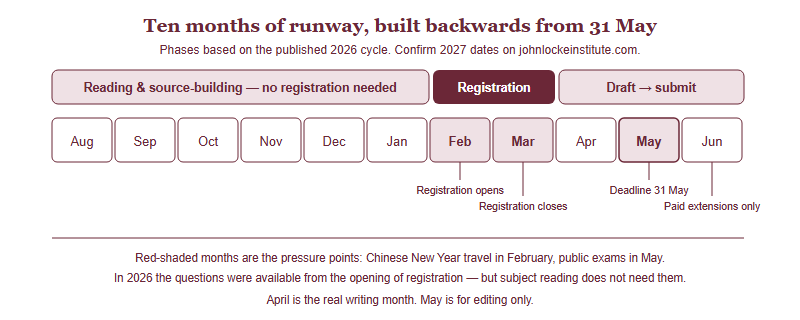
August to January: what to do before the questions exist
The single most common planning error we see is students waiting for the questions before doing anything. That is backwards. The questions change every cycle; the subject does not. A student who spent the autumn reading seriously in one discipline can meet a brand-new question, whenever it lands, with a stocked mind. A student who starts only once the questions appear is doing background reading and argument construction simultaneously, in the same weeks their school workload peaks.
Concretely, the off-season is for four things:
- Choosing a discipline, not a topic. Two candidate categories in August, one by January. If you are drawn to states, alliances and the mechanics of conflict, read our breakdown of what the International Relations category actually demands before committing — the gap between “I find geopolitics interesting” and “I can argue rigorously about it in 2,000 words” is wider than most students expect.
- Building a source base you have actually read. Six to ten substantial works you can cite from memory beats a bibliography assembled in April.
- Writing one full practice essay, to length. Use a question from a previous cycle. The point is not the content; it is discovering how 2,000 words feels. Almost everyone’s first attempt is a 3,000-word essay wearing a 2,000-word label. The structural discipline that fixes this is set out in our guide to how a strong John Locke essay is built.
- Identifying your referee. You will need an academic referee’s email at registration — a teacher if possible, or another responsible adult who is not a relative — and the Institute emails them to verify the work is yours. Ask in January, not in May.
February and March: register early, then triage the questions
Registration is the one irreversible gate in the calendar. In 2026 it opened 2 February and closed 31 March, with a late-registration window to 30 April carrying a $10 fee. Entry to the competition itself is free; that $10 is the price of disorganisation. Our registration walkthrough sets out the steps in order, so the fortnight you spend on it in February is mostly clerical.
Once the questions appear, resist the urge to pick the one that sounds most impressive. In practice you are choosing among thirty options — ten categories with three questions each — and the right filter is evidence access, not prestige. Ask whether you can actually reach the primary material a serious answer would require, in a language you read fluently, from where you sit. A magnificent question you cannot source is worse than a modest question you can.
One age-related point to settle in February rather than May: your category is fixed by your age on the submission deadline, with entrants under 15 judged as Juniors and everyone else as Seniors. A student whose fifteenth birthday falls in the spring can land on either side of that line depending on the exact date, which changes who they are judged against. Our guide to the Junior Prize and the age cut-off works through that arithmetic.
April, May and the GMT deadline arithmetic
April is when the essay gets written; May is when it gets cut and checked. Aim to submit in the second week of May, not the last. Resubmission is permitted before the deadline, so an early upload is a safety net rather than a commitment — you can still improve it. Note the condition, though: your referee has to approve the essay again each time you re-upload, so do not plan on repeated revisions.
Then there is the timezone. The Institute states its deadlines in GMT, and Beijing runs eight hours ahead. That systematically shifts every cut-off into the following morning in China, which students consistently misread as bonus time.
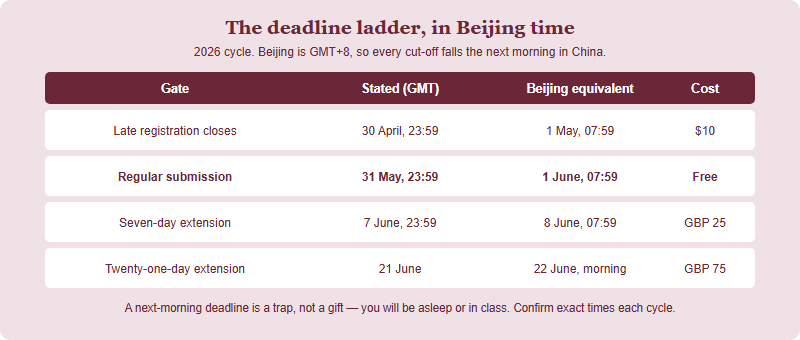
The extension trap
The paid extensions look like insurance. In practice they usually buy a week of the same essay, written more tiredly, in the middle of exam season, for GBP 25 or GBP 75. An extension is worth buying for exactly one reason: a genuine disruption — illness, a family emergency, a school crisis — that cost you a block of writing time. It is not worth buying because you want to keep polishing. Essays do not improve indefinitely; past a point, editing just sands away the argument’s edges. The eligibility, calendar and format requirements behind this ladder are collected on our rules and format page.
For context on what disciplined preparation can produce, Hanlin-coached students recorded 86 shortlistings and 76 global awards across the 2026 cycle (figures per Hanlin, de-identified). What we can say honestly from that cohort is a process observation, not a promise: the students who finished calmly were, almost without exception, the ones who had chosen a category before Chinese New Year. No programme can guarantee a shortlisting, and you should treat any claim otherwise with suspicion.
Frequently asked questions
When does John Locke registration open?
In the 2026 cycle it opened 2 February and closed 31 March. The 2027 dates were not published at the time of writing — check johnlockeinstitute.com.
Is there a fee to enter?
No. The official site states there is no charge to enter; fees apply only to late registration and the deadline extensions.
What time is the deadline in Beijing?
Deadlines are stated in GMT. 23:59 GMT falls at 07:59 the next morning in Beijing, which is GMT+8. Confirm current wording officially.
Can I edit my essay after uploading it?
Yes. You may delete and re-upload before the relevant deadline — but the official site notes your referee has to approve the essay again each time, so do not plan on repeated revisions.
This is an independent guide operated by Hanlin Education for China-based international-school students. We are not affiliated with, endorsed by, or sponsored by the John Locke Institute. Competition dates, fees and rules change between cycles — always confirm current details on johnlockeinstitute.com. Factual errors reported to our editorial desk are corrected within 7 working days.