

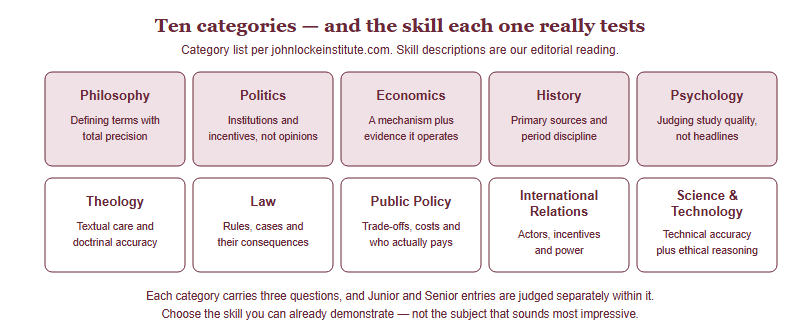
The John Locke Institute publishes ten subject categories with three questions in each — thirty questions in total. You may submit one essay per category, you may enter as many categories as you like, and you may win in more than one. That freedom is exactly what makes the choice hard. Here is a practical way to triage thirty questions down to one, and an honest answer to whether writing two essays is ever worth it.
The rules that actually shape the decision
Before strategy, the constraints. Everything in this table is published on johnlockeinstitute.com and summarised on our rules and format page; each line changes how you should think about choosing.
| Rule | What it says | Why it matters for choosing |
|---|---|---|
| Categories | Ten: Economics, History, International Relations, Law, Philosophy, Politics, Psychology, Public Policy, Science & Technology, Theology | Your real choice set is thirty questions, not ten subjects |
| Entries per category | One essay per category | You must pick one of the three questions in a category — you cannot hedge |
| Multiple categories | Permitted; prizes can be won in more than one | Volume is legal. Whether it is wise is a separate question |
| Word limit | 2,000 words, excluding diagrams, tables, endnotes, bibliography and authorship declarations | Rules out questions that need a literature review before the argument starts |
| Age bands | Under 19 to enter; under 15 at the deadline judged as Junior | You are compared with your own band, not the whole field |
| Authorship | Each essay entirely the work of one individual; a referee verifies | No collaboration, no division of labour across categories |
| Cost | No charge to enter | Entering a second category costs time, not money |
Note the interaction between two of those lines. Entry is free and multiple categories are allowed, which is why every year a number of students decide to write three or four essays. But authorship must be individual and each essay is judged against the same seven criteria — knowledge and understanding, use of evidence, quality of argumentation, originality, structure, writing style, persuasive force. Nothing about entering more categories makes any one essay better.
Why “which category is easiest” is the wrong question
The most common message we get in February is some version of: which subject has the weakest competition? It is an understandable instinct and a bad plan, for three reasons.
First, you cannot observe the field. The Institute does not publish entry numbers by category, so any claim that “Theology is less competitive than Economics” is speculation dressed as data. Be sceptical of forum posts that assert otherwise.
Second, judging is by category and by age band — three Junior and three Senior places in each of the ten categories. That structure already prevents a single fashionable subject from crowding out the rest. You are not competing against the whole entry pool.
Third, and decisively: a subject you chose tactically is a subject you have not read in. The seven criteria lead with knowledge and understanding of the relevant material. An essay written by someone with a thin grasp of a field reads thin, and experienced academic judges detect it in a paragraph. The tactical choice defeats itself.
Four filters that take thirty questions down to one
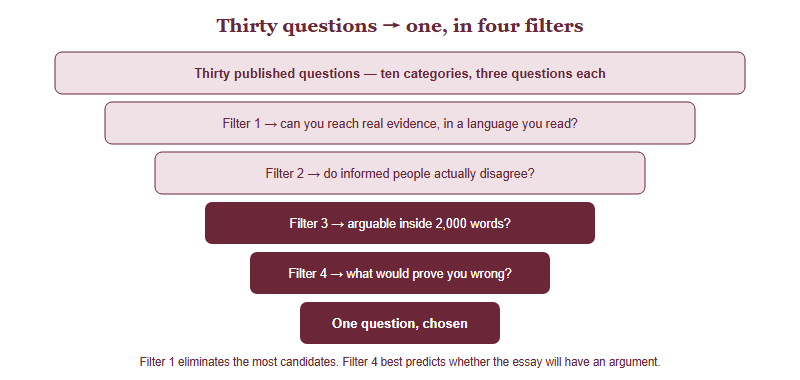
Run every question that interests you through these four filters, in order. Most students find that thirty collapses to three or four within an hour, and the survivors are rarely the ones they expected.
Filter 1 — can you reach real evidence? Not “is there information online”, but: can you get to the material a serious answer requires, in a language you read fluently, from where you are? A question about an obscure legal tradition whose scholarship is mostly in German is closed to you if you do not read German. A question requiring recent empirical work is closed if you cannot access the journals. This filter kills more questions than any other, and it should.
Filter 2 — do informed people actually disagree? If every knowledgeable person answers the same way, there is no argument to make, only a summary to write, and summaries do not score on originality or persuasive force. Test it by trying to state the strongest case for the side you do not hold. If that case sounds silly to you, you either have the wrong question or an incomplete picture of it.
Filter 3 — is it tractable in 2,000 words? The limit excludes diagrams, tables, endnotes and bibliography, but 2,000 words of argument is short. It is roughly enough for one thesis, three supporting moves, one serious objection and a reply. If a question needs 800 words of background before your position can even be stated, it is the wrong question for this competition. Our breakdown of how a strong John Locke essay is structured shows what that budget looks like in practice, and the past winning essays are the place to see it done — read them to work out how one argument is sustained to the end, not to borrow a topic.
Filter 4 — can you say what would prove you wrong? This is the filter almost nobody applies, and it is the best predictor of a good essay. If you can name the evidence or argument that would defeat your thesis, you have a falsifiable position and a natural counter-argument section. If you cannot, you have a preference, and it will read as one.
The case for one essay — and the narrow case for two
Our default advice is one essay, done properly. The reasoning is arithmetic rather than ideology. You have a fixed number of usable hours between the questions appearing for the cycle and a deadline at the end of May, and that window overlaps your school’s examination season. Splitting those hours across two categories does not produce two essays of the same quality as one; it produces two essays of visibly lower quality, because the reading behind each is halved.
There are two situations where a second entry genuinely makes sense:
- Genuine dual expertise. A student who has read seriously in two fields for a year — say a committed historian who also follows constitutional law closely — is not splitting their preparation, only their writing time. The source base already exists in both.
- Two questions that share a source base. Occasionally a Public Policy question and an Economics question, or a Politics question and an International Relations question, draw on overlapping literature. You still write two independent essays with different arguments — recycling an argument across categories is not the aim — but the reading cost is shared rather than doubled.
What does not count as a reason: “more entries means more chances”. Each essay is judged on its own merits, and two mediocre essays do not aggregate into a stronger candidate. If you would need to write the second one quickly, that is your answer.
For Junior entrants the case for restraint is stronger still. Under-15s are judged in their own band against other under-15s, so the field is age-appropriate — but they are usually also the students with the least experience of writing to a hard word limit. One well-supervised essay teaches more than three rushed ones. We set out what the Junior band involves in our guide to the Junior Prize and the under-15 cut-off.
Four ways students mis-pick
| The mis-pick | What it looks like | The fix |
|---|---|---|
| Choosing by intended university course | An applicant to Economics assumes they must enter Economics | Judges assess the essay, not its fit with your UCAS choice. Write where your evidence is |
| Choosing the grandest question | A sweeping civilisational question that needs a book | Apply Filter 3. A narrow question argued fully beats a vast one gestured at |
| Choosing a settled question | The essay becomes a well-organised summary | Apply Filter 2. If you cannot construct the opposing case, change question |
| Choosing late | Question picked in the same fortnight the writing starts | Decide before the reading, not after. February decisions produce May essays that hold together |
A note on where International Relations sits in all this, because it draws a disproportionate share of interest from students in China. It is a genuinely rewarding category, but it is also the one where Filter 1 bites hardest: strong IR essays need real engagement with how states, institutions and incentives actually behave, not commentary assembled from news coverage. Our subject guide to the International Relations category works through what that evidence base looks like.
One last piece of context, offered honestly. Across the 2026 cycle, Hanlin-coached students recorded 86 shortlistings and 76 global awards (figures per Hanlin, de-identified). The pattern we can report from that work is about process, not guarantees: students who chose their question early and wrote one essay tended to finish with something they could defend, and defensibility is what an integrity interview and a set of academic judges are ultimately testing. No competition result can be promised by any programme, ours included.
Frequently asked questions
How many essays can I submit to John Locke?
One essay per category, across as many of the ten categories as you like, and prizes can be won in more than one category.
Which John Locke category is easiest?
Entry numbers by category are not published, so any ranking is guesswork. Choose where your reading and evidence access are strongest.
Do I have to pick the category matching my degree course?
No. Essays are judged on their own merits against the published criteria, not on how they align with your university application.
How long can a John Locke essay be?
Up to 2,000 words, excluding diagrams, tables, endnotes, bibliography and authorship declarations, per the official site.
This is an independent guide operated by Hanlin Education for China-based international-school students. We are not affiliated with, endorsed by, or sponsored by the John Locke Institute. Categories, questions, word limits and rules change between cycles — always confirm current details on johnlockeinstitute.com. Factual errors reported to our editorial desk are corrected within 7 working days.