

The great majority of John Locke entrants are not shortlisted in any given year, so a no carries almost no diagnostic information on its own. What it does is give you a rare asset: a finished, submitted, timed piece of argumentative writing that you can now read coldly. This article is a protocol for reading it — a four-part self-audit, a decision on whether to reuse the topic, and a triage system for the research you already did.
First, read the result correctly
Competitions with very large entry numbers and a small shortlist produce a specific kind of feedback: binary, unexplained, and heavily influenced by the density of strong entries in your particular category that year. The Institute does not return marks or comments to unsuccessful entrants, and it assesses on “knowledge and understanding, competent use of evidence, quality of argumentation, originality, structure, writing style and persuasive force” — seven dimensions collapsed into one outcome.
Three things a no does not tell you:
- Which of the seven criteria let you down. An essay can fail on originality alone while being excellent on every other axis.
- Whether you were close. There is no published band structure between “shortlisted” and “not,” so “nearly” is not a category you can occupy.
- Whether the topic was wrong. The same question, argued differently, is a completely different essay.
And one thing it does tell you: whatever you submitted did not, on this reading, stand out against the field. That is a real signal, and the honest response is to find out why yourself rather than to guess. Two notes on the wider cycle: some candidates are invited to an online interview as part of the Institute's integrity checks, and the shortlisted are invited to an invitation-only academic conference and awards dinner in London in early October, which the Institute states are not free and which nobody is required to attend — dates, format and eligibility all per johnlockeinstitute.com.
Before the audit, three things to avoid in the week after results, because each destroys information you are about to need:
- Do not compare with classmates. Different categories draw different fields in different years, and a friend's outcome tells you nothing about your essay. The only useful comparison is between your submitted draft and what you now think it should have said.
- Do not pick next year's topic yet. Choosing a new question in the first week is an emotional decision dressed as a strategic one, and it locks you in before you know what actually went wrong.
- Do not immediately trade down. Switching to a competition with a higher acceptance rate solves the feeling, not the weakness. If your argument was under-evidenced here, it will be under-evidenced there.
The four-file self-audit
Open your submitted essay. Do not edit it. Run these four tests in order, because a failure at an earlier stage makes later tests meaningless — there is no point auditing your prose if the question was never answerable in 2,000 words.
| Failure mode | Symptom in your draft | The test | Fix cost before next cycle |
|---|---|---|---|
| 1. Question fit | You needed 3,000 words to do the topic justice and compressed instead | Write your thesis in one sentence. Count the distinct claims you must prove. More than three? Wrong scope. | Low — a scoping decision, not new work |
| 2. Thesis strength | Your position could be summarised as “both sides have merit” | Ask what evidence would make your thesis false. If nothing would, it is not a thesis. | Medium — usually a rewrite, same research |
| 3. Evidence quality | Examples are illustrative rather than probative; sources are summaries of sources | For each citation, ask: did I open the primary document? Could a reader verify it in a minute? | High — genuine new reading |
| 4. Argued prose | Hedges stacked; long agentless sentences; no plainly stated concession | Read only the first sentence of each paragraph. Does the argument survive? | Low to medium — habit change, fast to train |
In our experience the most common single finding is failure mode 2 sitting underneath a draft that looks polished. An essay can be well-referenced, cleanly written and structurally tidy while never committing to a claim someone could disagree with — and originality is one of the stated criteria. If your audit lands here, the repair is structural rather than cosmetic, and our breakdown of how a winning essay is built around thesis and counter-argument is the right next read.
The decision: same question, same category, or move
Once you know which file failed, the strategic question is what to enter next time. Students default to switching topics entirely, which throws away the most expensive asset they own — subject knowledge. The audit result should drive the decision, not the disappointment.
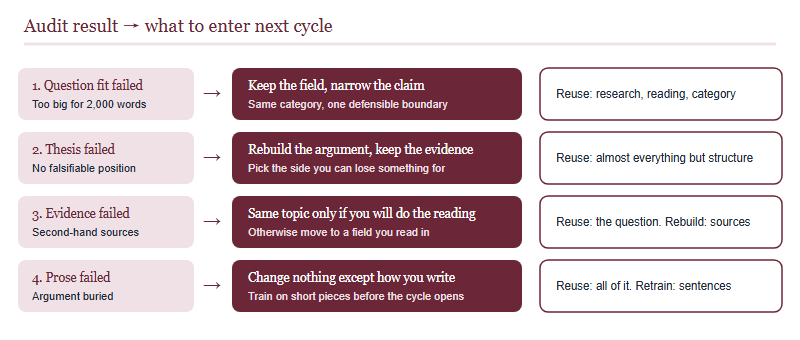
There is one additional case the tree does not cover: you chose a category because it sounded impressive rather than because you read in it. That is worth being honest about now, while switching is free. A student who reads history for pleasure and entered Philosophy because it seemed more prestigious will lose to a philosophy reader every time. The category comparison in our International Relations guide is a useful way to test which kind of claim you actually enjoy defending, and entrants under 15 should check the separate Junior category rules before assuming last year's route still applies.
Triage the research you already have
Most students delete the folder. That is a mistake — a submitted essay usually sits on many hours of reading, and a good portion of it is durable. Sort what you have into three bands before you decide anything about next year.
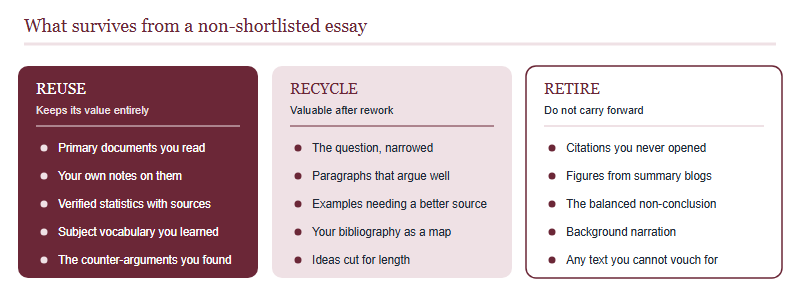
That final caution matters. Reusing your research is normal scholarly practice. Reusing your text across cycles or across competitions raises originality and declaration questions that only the Institute can answer for its own competition — do not assume, and do not rely on what other entrants say.
The eight weeks that actually matter
This is deliberately not a month-by-month plan; full cycle calendars for 2027 already exist elsewhere on this site. The point of the next eight weeks is narrow: convert the audit into a capability, before the next set of questions is published and topic excitement takes over.
- Weeks 1–2: finish the audit and write it down. One page: which file failed, what the evidence is, what you will do differently. Written, not remembered.
- Weeks 3–5: train the weak file specifically. If thesis failed, write five 400-word arguments on questions you do not care about — the constraint teaches commitment. If evidence failed, read three primary documents properly and take real notes. If prose failed, rewrite two pages of your own essay to half their length without losing content.
- Weeks 6–8: read into a field, not a question. Choose the category you will enter and read broadly in it while there are no questions to chase. This is the single highest-return activity available before a cycle opens, and it is impossible once questions are out.
Then wait. The Institute publishes each cycle's questions, registration window and deadlines on its own site; the 2026 cycle ran registration from early February with submissions closing at the end of May, but do not plan against those dates for 2027 — confirm the published 2027 timetable on johnlockeinstitute.com when it appears.
If you were shortlisted or awarded
Two honest observations, kept short. First, the audit above is still worth running — a shortlisted essay usually has one weak file too, and finding it now is cheaper than finding it in a university interview where you may be asked to defend the argument. Second, resist treating the result as a finished project. Judges, admissions readers and interviewers respond to students who can say what they would now argue differently, and that answer only exists if you go back and look.
For context on scale: across Hanlin's 2026 cohort our own de-identified internal records show 86 students shortlisted and 76 global awards across all subjects. Those are our figures, not the Institute's, and we publish no names or schools. The pattern behind them is unglamorous — the students who did best in 2026 were overwhelmingly students who had written and discarded several arguments before the one they submitted, not students who found a clever topic late.
Frequently asked questions
Does the John Locke Institute give feedback on unsuccessful essays?
Entrants are not given marks or comments. Any diagnosis has to come from auditing your own essay against the published criteria.
Can I submit the same essay again next year?
Reusing research is normal; reusing text raises originality questions only the Institute can answer. Check rules on johnlockeinstitute.com.
Should I change category after a rejection?
Only if you chose it for prestige rather than reading. A weak thesis or thin sourcing is fixable inside the same category.
When do the 2027 questions and deadlines appear?
The Institute publishes each cycle's questions and timetable on its own site. Do not plan against a previous year's dates.
This is an independent guide operated by Hanlin Education for China-based international-school students. We are not affiliated with, endorsed by, or sponsored by the John Locke Institute. Results, feedback policy, originality and re-submission rules, questions and deadlines are set by the Institute and change between cycles — always confirm current details on johnlockeinstitute.com before acting on anything here. Factual errors reported to our editorial desk are corrected within 7 working days.