

Science & Technology is one of the ten John Locke subject categories, and it is the one most often chosen by students with strong STEM records and least often written the way it is assessed. It does not reward an explanation of how a technology works. It rewards a defended position on a contested question about science or technology — which is a humanities skill wearing a technical costume.
What the category is actually asking
The John Locke Institute sets fresh questions for each cycle across ten categories: Economics, History, International Relations, Law, Philosophy, Politics, Psychology, Public Policy, Science & Technology and Theology, with a separate Junior category for younger entrants. In the 2026 cycle the Science & Technology questions ranged across the relationship between free expression and scientific progress, the case for and against continued investment in space exploration, and how we ought to treat artificial intelligence systems. Questions change every year and are published by the Institute — take yours from johnlockeinstitute.com and nowhere else.
Notice what those three have in common. None of them can be settled by looking up a number. Each one asks whether something is justified, valuable or owed — a normative question that happens to sit on top of a technical subject. That is the structural fact that decides whether your essay works, and it is the fact most STEM entrants miss. A student who knows a great deal about reinforcement learning has an advantage in this category only if that knowledge is deployed as evidence inside an argument about what we should do. Knowledge on its own is background.
The Institute states that essays are assessed on knowledge and understanding of the relevant material, competent use of evidence, quality of argumentation, originality, structure, writing style and persuasive force. Read that list as a budget. Exactly one of the seven items is satisfied by explaining the science well. The other six are satisfied by what you do with the explanation.
The four habits that sink technically strong drafts
In our coaching we see the same failure pattern in Science & Technology drafts almost regardless of the question. The essays are accurate, current and well-read, and they lose because accuracy is not the same thing as argument. These are the four habits, in the order they most often appear.
| Habit | What it looks like on the page | Why it does not score | The repair |
|---|---|---|---|
| 1. Explaining instead of arguing | Three opening paragraphs on how the technology works before any claim appears | Background satisfies one assessed dimension; argumentation and originality are separate ones and remain empty | Put the claim in the first sentence. Cut the mechanism down to only what the claim depends on. |
| 2. Treating accuracy as persuasion | A stack of precise, correct, entirely uncontested statements standing in for a position | Nothing there can be disagreed with, so nothing is being argued | Ask what a well-informed reader could still deny after finishing your paragraph. If nothing, rewrite it. |
| 3. Outsourcing the normative half | “Whether this is desirable is a question for ethicists rather than engineers.” | The normative half was the question. Handing it away is conceding the essay | Take the value judgement yourself, name the standard you are using, and defend it. |
| 4. Forecasting instead of arguing | Extended predictions about where the technology will be in twenty years | A forecast can be asserted but not evidenced, so it cannot carry an argument | Argue about a claim that is true or false now, and use trajectory only as a supporting consideration. |
Habit 3 deserves a note, because it is the one that feels like intellectual modesty. Students write it believing they are staying in their lane. An examiner reads it as the writer declining to answer. If the question asks whether we should build something, “this raises important ethical considerations” is not a thesis; it is a description of the question you were given.
Turning what you know into evidence that scores
The useful mental model is a pipeline. Technical knowledge enters at one end as description and has to be pushed through three further stages before it earns anything. Most drafts we read stop after the first stage and then compensate by making the description longer, which makes the problem worse rather than better.
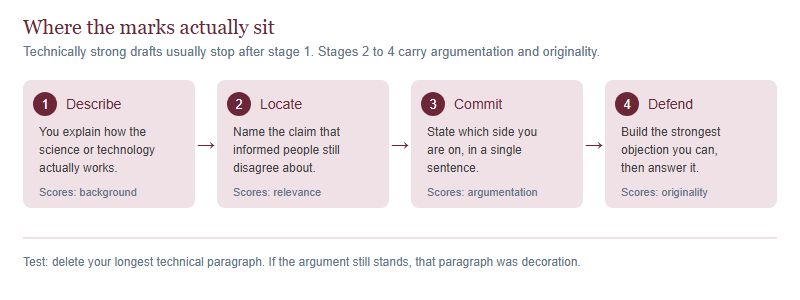
That deletion test is worth running literally. Open the draft, cut the longest block of technical exposition into a separate file, and reread. If the essay still argues what it argued before, the block was serving your comfort rather than your case, and in a 2,000-word limit it was costing you roughly a fifth of the space. The reverse is also true and is the mark of a strong Science & Technology essay: the technical passage is load-bearing, because without it the reader cannot see why the objection you raise later fails.
The general architecture — thesis, concession, counter-argument, reply — is the same one that governs every category, and our breakdown of how a winning John Locke essay is built is the companion piece to this one. What is specific to Science & Technology is the temptation to substitute a mechanism for a middle.
A 2,000-word budget that survives contact with the draft
The limit is 2,000 words. The Institute states that diagrams, tables of data, endnotes, bibliography and the authorship declaration are not counted toward it, and that footnotes are not permitted while endnotes and a bibliography are. For a technical writer that exclusion is a real strategic asset rather than a piece of admin: a table of results is a way to put data in front of the examiner without spending prose on it. Use one. Then spend the prose you saved on the argument.
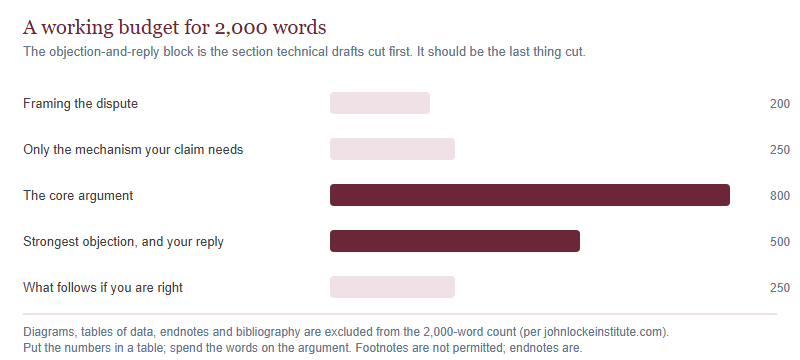
Two practical consequences follow. First, if your framing section has passed 350 words you are almost certainly writing a literature review; stop and move the claim forward. Second, if the objection block is under 300 words you have probably picked a weak objection, because a serious one takes space to state fairly before you can answer it. Examiners reward the fair statement as much as the reply — an objection set up as a straw figure damages the essay it was meant to strengthen.
Science & Technology, or a neighbouring category?
The Institute permits entrants to submit as many essays as they wish across any or all categories, so the constraint here is not permission but depth: two rushed essays beat nothing and lose to one properly researched one. The real decision is which category matches the kind of claim you enjoy defending, because the same underlying interest can be routed four different ways.
| Category | The claim you defend | What counts as evidence | Choose it if |
|---|---|---|---|
| Science & Technology | Whether a technology or scientific practice ought to be pursued, restricted or valued | Technical facts, case histories, ethical reasoning | You can hold the technical detail and the value judgement in the same paragraph |
| Philosophy | Whether a concept or principle survives scrutiny | Arguments, thought experiments, careful distinctions | Your interest is the reasoning itself rather than any application |
| Public Policy | Whether a specific intervention is the right remedy | Trade-offs, implementation, costs, counterfactuals | You want to be judged on the design of a solution |
| Economics | Whether a mechanism produces the outcome claimed for it | Models, incentives, data | You are comfortable defending a causal claim under challenge |
| International Relations | Whether states should act in a given way | State behaviour, institutions, precedent | Your evidence is political rather than technical |
Technology questions sit closest to the last row more often than students expect: an essay on export controls or on the governance of a frontier technology can be written in either category, and the choice determines what evidence the examiner expects. If your natural material is state behaviour and treaty precedent rather than laboratory practice, our International Relations subject guide describes what that field rewards. Entrants who will be under 15 at the relevant deadline are judged in the separate Junior category and should read the Junior Prize rules before planning anything.
The rules that catch technical entrants specifically
Four points from the Institute's published rules cause disproportionate trouble in this category, and all four are avoidable.
- Single authorship. Each submitted essay must be entirely the work of one individual. Students coming from research programmes, science fairs or lab placements are used to collaborative authorship; that norm does not transfer here, and an essay drawn from group work needs to be rewritten as your own argument from the ground up.
- No footnotes. Endnotes and a bibliography are permitted and excluded from the word count; footnotes are not permitted at all. Technical writers default to footnotes. Convert before you submit.
- File naming. Submissions are named in the format FirstName-LastName-Category-QuestionNumber.pdf. Check the category spelling and the question number against the official page rather than from memory.
- Deadlines and eligibility are per cycle. In 2026 entrants had to be under 19 as of the regular submission deadline, with the Junior category for those under 15 on the same date, and there were paid late-registration and late-submission extensions. Every one of those values is reset by the Institute each year. Do not plan against last cycle's calendar — confirm on johnlockeinstitute.com.
One first-party note on scale, offered as context rather than a promise: across our own 2026 John Locke cohort we recorded 86 shortlisted essays and 76 global awards. That is Hanlin's de-identified internal coaching record, not an official statistic and not a prediction for any individual entrant. What it is useful for is the pattern underneath it — in Science & Technology specifically, the essays that travelled were rarely the ones with the most impressive technical content. They were the ones where a student who understood the technology was willing to say what we should do about it, and then take the hardest objection to that seriously.
Frequently asked questions
Do I need to study a science subject to enter Science & Technology?
No subject prerequisite is published. But your evidence has to be accurate, so pick a technology you can describe correctly.
Do diagrams and data tables count toward the 2,000 words?
The Institute states they are excluded, along with endnotes and bibliography. Confirm the current wording on johnlockeinstitute.com.
Can I enter Science & Technology and another category in the same year?
The Institute permits as many essays as you wish across categories. Depth, not permission, is the real limit.
Should I write about artificial intelligence?
Only if you can add something to a crowded field. A common topic raises the originality bar rather than lowering it.
This is an independent guide operated by Hanlin Education for China-based international-school students. We are not affiliated with, endorsed by, or sponsored by the John Locke Institute. Categories, questions, word limits, formatting rules, eligibility ages, fees and deadlines are set by the Institute and change between cycles — always confirm current details on johnlockeinstitute.com before acting on anything here. Factual errors reported to our editorial desk are corrected within 7 working days.