A John Locke question is a specification, not a topic. The commonest fixable failure we see is not weak writing or thin research — it is a well-written essay answering a question adjacent to the one that was set. This piece is about the step between choosing your question and drafting: reading the prompt precisely enough that you know what would count as answering it.
Why the gap opens
The Institute publishes a fresh set of questions each cycle across its ten categories, and every one of them is deliberately compressed — usually a single sentence. Compression is what makes them hard. A one-line question carries an enormous amount of implicit instruction about what kind of claim you are being asked to defend, and students who skip that unpacking convert the question into a topic within about thirty seconds of reading it.
The conversion is almost invisible from the inside. A question asking whether a practice is justified becomes, in the student's head, a question about that practice. They then research the practice thoroughly, write about it fluently, and hand in an essay that never argues about justification at all. The research is real. The prose is good. The essay is answering something else.
This matters because of how the work is assessed. The Institute states that essays are judged on knowledge and understanding of the relevant material, competent use of evidence, quality of argumentation, originality, structure, writing style and persuasive force. Nothing on that list rescues an essay pointed slightly off-target: an argument can be excellent and still be an argument for a proposition nobody asked about. And with the field the Institute describes — tens of thousands of submissions from more than 150 countries — the essays you are competing against will include many that did read the question properly.
The four prompt archetypes
Almost every John Locke question across the ten categories falls into one of four shapes, and each shape demands a structurally different thesis. Learning to classify the question in the first ten minutes is the cheapest improvement available to most entrants, because misclassification is expensive later and free to fix now.
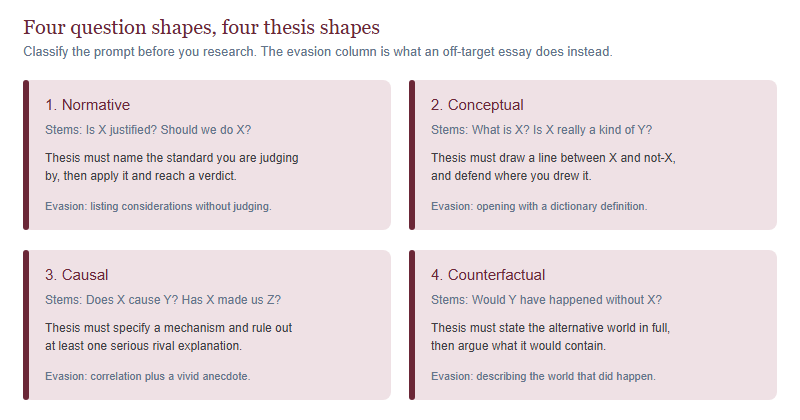
Two clarifications before you use it. First, real questions are frequently hybrids: a prompt can ask whether a policy has caused an outcome and whether it was justified, which means you owe both a mechanism and a standard, in that order. When you find a hybrid, decide which half carries the weight and make the other half serve it — you cannot give equal space to two full arguments inside 2,000 words. Second, the archetype tells you the shape of the answer, not the answer itself. Two students can classify a prompt identically and reach opposite verdicts; both can score well.
The load-bearing word
Nearly every John Locke question turns on one word that is doing far more work than its length suggests, and that word is almost never the noun students fixate on. Consider the general shape “Is it ever justified to do X?” The load-bearing word is ever. It converts the question from a general defence of X into something far easier and far more precise: you now only need to establish one case. A student who argues that X is generally beneficial has done more work than required and answered a harder question badly.
Other examples of the same phenomenon, generically stated:
- “Should we always…” — the burden has flipped. One counterexample defeats the affirmative, so the interesting essay is usually the negative one, and it needs only a case rather than a survey.
- “Is X more important than Y?” — a comparative demands a common scale. If you never say what makes one thing more important than another, you have written two descriptions side by side and no comparison.
- “Does X threaten Y?” — threat is a claim about risk, not about damage already done. Evidence of past harm is relevant but not sufficient; you owe an account of the mechanism by which the risk operates.
- “Can X be said to Y?” — this is a conceptual question wearing empirical clothing. It asks whether the description fits, not whether the thing happened.
The exercise, then, is mechanical: print your question, underline every word, and identify the one whose removal would most change what you have to prove. Then write a sentence beginning “By this word I mean…” and put a version of that sentence in your essay. Examiners assess structure and argumentation, and a stated definition early on is the cheapest structural signal there is — it tells the reader exactly what you have taken on.
The four-step question audit
Run this before you open a single source. It takes under an hour and it prevents the most expensive category of wasted work: three weeks of reading aimed at the wrong claim.
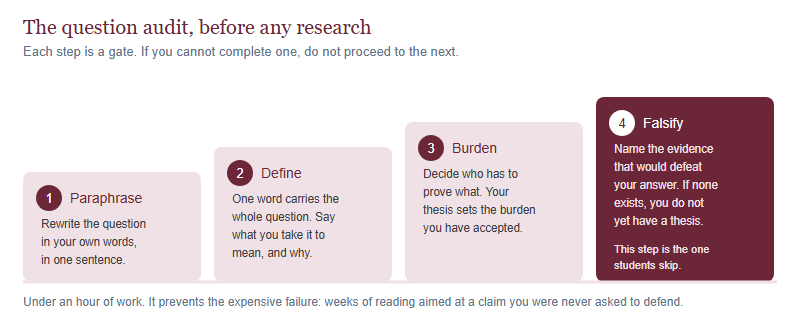
Step 1 is the hardest to do honestly, because paraphrase feels trivial until you try it. If your restatement is longer than the original, you have added assumptions. If it is shorter, you have dropped a condition. Write it, then set the original beside it and check word by word for a qualifier you quietly deleted — ever, always, primarily, in principle. Those are exactly the words that go missing.
Step 3 is where strategy enters. Consider a prompt asking whether some institution is obsolete. You may argue that it is; you may argue that it is not; you may also argue that the question is malformed because obsolescence is the wrong test. Each of those is a different burden of proof, and the third is the highest-risk and highest-originality route — rejecting the framing has to be earned, not asserted, and if you take it you must still say what the right test is and then apply it. Choosing your burden consciously is the difference between an essay that takes a risk and an essay that has accidentally taken one.
Answering versus circling
Once the audit is done, the drafting risk shifts. You now know the question; the danger is producing an essay that gestures at answering it. These are the four circling patterns we most often flag, with the diagnostic that catches each one.
| Circling pattern | How it reads | Diagnostic | Fix |
|---|---|---|---|
| The survey | “There are three schools of thought on this question…” | Could this paragraph appear unchanged in an essay arguing the opposite verdict? | Every position you report must be there because you are about to use or reject it. |
| The deferred verdict | The answer appears for the first time in the final paragraph | Read only your introduction. Does a reader know where you stand? | State the verdict in the opening and spend the essay earning it. |
| The redefinition escape | The term is defined so narrowly that the answer becomes trivial | Would anyone contest your definition? If not, would anyone contest your conclusion? | Define at the point where the question is still hard, then argue. |
| The both-sides close | “Ultimately the answer depends on how one weighs these values.” | Delete the last paragraph. Has anything been lost? | Say how you weigh them and why that weighting is defensible. |
The redefinition escape is the subtlest of the four and the one that costs marks on originality. It is technically legitimate to define your terms — you are required to — but a definition chosen so that the conclusion follows immediately converts an argument into a tautology. The test above is the one to keep: if nobody would dispute your definition and nobody would dispute your conclusion given it, you have not written an argument. The structural repair sits in how the thesis relates to the counter-argument, which is the subject of our companion piece on how a winning John Locke essay is built.
What the rules add to the reading
Two published constraints shape question analysis more than students expect. The first is the 2,000-word limit, which excludes diagrams, tables of data, endnotes, bibliography and the authorship declaration. Two thousand words is enough to defend one claim properly and not enough to defend two, so the audit doubles as a scoping test: if step 1 produces a paraphrase containing an and, you are carrying two questions and need to subordinate one. The second is that submissions are filed against a specific question number, in the format FirstName-LastName-Category-QuestionNumber.pdf, which is a quiet reminder that you are answering a numbered specification rather than writing on a theme.
Beyond that, everything cycle-specific — the questions themselves, deadlines, the under-19 eligibility rule, the separate Junior category for younger entrants, and the fee structure for late registration and late submission — is reset by the Institute each year and published on its own site. In 2026 the Institute also stated that some candidates would be invited to an online interview as part of its academic-integrity checks, which is a further reason to be able to explain, in your own words, exactly what your question was asking and why you framed it as you did. Entrants under 15 at the relevant deadline are judged separately and should start from the Junior category rules; entrants weighing a politically framed prompt may find the field-specific expectations in our International Relations guide useful for calibrating what counts as evidence.
One first-party observation to close. Across our 2026 John Locke cohort we recorded 86 shortlisted essays and 76 global awards — Hanlin's de-identified internal record, not an official statistic and not a prediction for any individual. The pattern worth extracting is not about volume. When we compare drafts that travelled with drafts that did not, the separating feature is rarely research depth and very often the first three hundred words: the essays that went furthest had already told the reader what the question was asking, what the key term meant, and what the writer was about to prove.
Frequently asked questions
Can I reframe a John Locke question if I think it is badly posed?
Yes, but you must earn it: say why the framing fails, propose the better test, then apply it. Assertion alone loses marks.
Should I define my terms in the introduction?
Define the one word your argument turns on. Defining everything wastes space inside a 2,000-word limit.
Where do I find the current questions?
The Institute publishes each cycle's questions on johnlockeinstitute.com. Never work from a previous year's list.
Is it safer to answer a question with an obvious answer?
No. Originality is an assessed dimension, and an uncontested claim gives you nothing to argue for.
This is an independent guide operated by Hanlin Education for China-based international-school students. We are not affiliated with, endorsed by, or sponsored by the John Locke Institute. Questions, categories, word limits, formatting rules, eligibility ages, fees and deadlines are set by the Institute and change between cycles — always confirm current details on johnlockeinstitute.com before acting on anything here. Factual errors reported to our editorial desk are corrected within 7 working days.