

By late August the 2026 John Locke cycle has closed, the shortlist has been published, and most entrants are not on it. Almost all of them then do the same thing: archive the file and move on. That is the mistake. The award was only ever one of the outputs; the essay itself, and the reading underneath it, is an asset you can still spend — and August is exactly when to spend it.
What you actually own now
Start by taking inventory, because students consistently undervalue everything except the outcome. A completed John Locke entry is not one artefact, it is five, and they have very different shelf lives and very different uses.
| Asset | What it really is | Shelf life | Where it gets spent |
|---|---|---|---|
| The submitted essay | 2,000 words of finished, deadline-tested argumentative writing | Long, but the text itself is the least portable asset — see the honesty section | As a writing sample and as proof to yourself of what you can produce |
| The source base | Every book, paper and primary document you actually opened | Very long. Sources do not expire the way a draft does | Coursework, reading lists, interview preparation, next cycle |
| The rejected material | The arguments and evidence you cut to hit 2,000 words | Long, and usually the most valuable thing in the folder | Longer-form coursework, which has room for what the essay could not hold |
| The question you can now answer | A contested claim you have thought about harder than almost any peer | Indefinite, if you keep reading in it | Interviews, supplements, academic conversation |
| The draft history | Evidence of how you revise: what you cut, what you conceded, what you got wrong | Short if you delete it — so do not | Self-diagnosis, and honest answers to “how do you work?” |
Two of those rows deserve emphasis. The rejected material is routinely the strongest content in the folder, because the 2,000-word limit — which excludes diagrams, tables of data, endnotes and bibliography but not prose — forces you to cut arguments that were perfectly good and simply did not fit. Those cuts are pre-researched, pre-thought and homeless. And the draft history is the only record you will ever have of your own revision process; a student who can say precisely which paragraph they deleted and why is in a very different position from one who says they “edited a lot.”
Five places the work can go
The essay is not one credential. It is a research project that happens to have been packaged as a competition entry, and research projects can be repackaged. Here is the realistic map, with the constraint attached to each route.
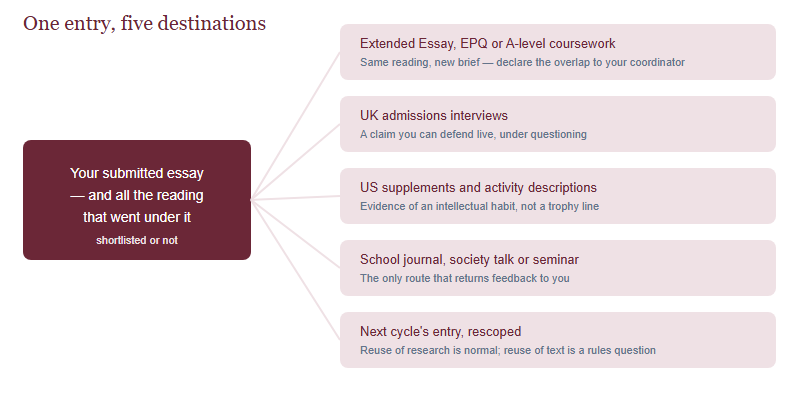
Notice which route is missing: nothing here says “list it as an achievement.” If you were shortlisted or won, that fact stands on its own and needs no help from this article. If you were not, the essay is still worth every hour it cost — but its value is now in what it lets you do next, not in what it lets you claim.
The coursework route, and the honesty line
This is the highest-value conversion and also the one where students get into genuine trouble, so treat the sequence as non-negotiable. A John Locke essay and an IB Extended Essay, an EPQ or an A-level coursework piece share a research base but are different tasks with different briefs, different lengths and different assessment criteria. What transfers cleanly is the reading. What does not transfer cleanly is the text.
- Declare before you write, not after. Tell your EE supervisor, EPQ supervisor or subject teacher that you have already written on this topic for an external competition, and show them the essay. Exam boards and schools have their own rules about submitting work that overlaps with previously produced material, and those rules — not this article — are what govern you. Asking first costs you a conversation; asking afterwards can cost you a grade.
- Change the brief, not just the length. Padding 2,000 words to 4,000 produces a bad long essay. The right move is to take a sub-argument you cut for space and make it the whole question, using the research base you already have. Your rejected material is where to look first.
- Re-derive rather than re-paste. Even where reuse is permitted, rewriting from your notes produces a better piece than editing the old file, because the old file was optimised for a constraint that no longer applies.
- Never reuse someone else's framing without citation. The Institute requires that each submitted essay be entirely the work of a single individual, and every school has an equivalent rule. The standards are the same standards; only the enforcement differs.
- Check re-entry rules separately. If you intend to enter the same or a related question in a future cycle, the rules on resubmission and originality are the Institute's to state — confirm on johnlockeinstitute.com rather than assuming.
One structural note for the conversion. A 2,000-word competition essay is built to defend a single claim with one serious objection answered; longer coursework usually expects a literature position, a method and a limitations discussion as well. Our breakdown of how a winning essay is built around thesis and counter-argument is useful here in reverse — it shows you which parts of your compressed structure need expanding rather than lengthening.
Talking about it — and the honest limits
The second real use is conversational. UK admissions interviews and academic supplements both reward a student who has thought hard about one contested question and can hold a position under pressure. A submitted John Locke essay is unusually good preparation for that, because you have already done the hardest part: committed to a claim in writing and defended it against an objection.
What to actually do with it:
- Re-read it cold, then write down where you now disagree with yourself. This is the single most useful preparation exercise available, and it is what turns a finished essay into live material. “I argued X; I now think the second half was too strong, because…” is a strong answer in almost any academic conversation.
- Be able to name your weakest evidence. Interviewers probe. A student who volunteers the soft point before it is found reads as honest and self-aware; one who defends everything equally reads as rehearsed.
- Keep the reading list to hand. Not to recite — to answer the follow-up. Being able to say which book changed your mind is worth more than being able to list twelve.
- Describe it accurately. “I entered the John Locke Institute Global Essay Prize and wrote 2,000 words arguing that…” is accurate and sufficient. Do not imply a result you did not receive.
Now the limits, stated plainly, because the honest version is more useful to you than the flattering one. An unshortlisted John Locke essay is not a credential, and no essay competition entry — shortlisted or not — guarantees any admissions outcome anywhere. Selective universities see very large numbers of competition entries; the entry itself carries little weight, and what carries weight is whether you can think and talk about your subject at the level the essay implies. That is genuinely good news, because it is the part you still control in August. The essay is evidence of a habit, and the habit is what continues.
Two specific cautions. First, do not manufacture a narrative in which the competition transformed you — it is a widely entered essay prize, and admissions readers know that. Second, if you are still below the senior age band, the strategic picture is different: entrants under 15 at the relevant deadline are judged in a separate category with its own considerations, set out in the Junior Prize guide, and for younger students the point of this year's essay is almost entirely the practice rather than any application value.
An August-to-February working map
The conversions above are not simultaneous. They have a natural order, driven partly by when the material is freshest and partly by when the receiving deadlines fall.
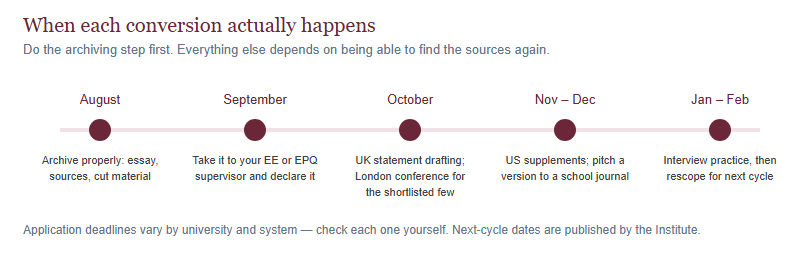
The August step is the one nobody does and the one everything else depends on. Archive in a way your future self can use: the submitted PDF, a plain-text list of every source with the specific claim you took from it, the paragraphs you cut in a separate file, and one page of notes on what you would do differently. That last page is worth writing while the memory of the deadline is still uncomfortable, because it will be honest.
For students who intend to enter again, the rescoping work belongs at the end of this sequence rather than the beginning. Choosing a new question in August, days after a result, tends to be an emotional decision wearing strategic clothing. By January you will have used the research in two other contexts, you will know which parts of it hold up under questioning, and you will be choosing from knowledge rather than from disappointment. If your interest sits in a field where evidence means state behaviour and institutional precedent, the expectations set out in our International Relations subject guide are a reasonable place to test whether the same reading can carry a second, sharper question.
A closing first-party note, offered as context rather than a promise. Across our 2026 John Locke cohort we recorded 86 shortlisted essays and 76 global awards — Hanlin's de-identified internal coaching record, not an official statistic and not a prediction for any individual entrant. What we see just as consistently, and what does not appear in any results table, is that the students who convert the work — into coursework, into a talk, into a sharper question next year — end the cycle further ahead than some of the students who were shortlisted and then stopped. The essay was never the point. The reading behind it was.
Frequently asked questions
Can I submit my John Locke essay as my IB Extended Essay?
Ask your coordinator first. Overlap rules are set by your school and exam board, and declaring it in advance is the only safe route.
Can I reuse the same research for next year's entry?
Reusing reading is normal. Reusing text is a rules question only the Institute can answer — check johnlockeinstitute.com.
Should I mention an unshortlisted entry on an application?
You can describe what you wrote and argued. Never imply a result you did not receive, and expect it to carry little weight alone.
Is it worth entering if I probably will not be shortlisted?
The research and the finished argument are the durable returns. Judge the entry on those, not on the outcome.
This is an independent guide operated by Hanlin Education for China-based international-school students. We are not affiliated with, endorsed by, or sponsored by the John Locke Institute. Resubmission and originality rules, shortlist and conference arrangements, eligibility ages and deadlines are set by the Institute and change between cycles, and coursework overlap rules are set by your school and exam board — always confirm current details on johnlockeinstitute.com and with your own school before acting on anything here. Factual errors reported to our editorial desk are corrected within 7 working days.