

The John Locke psychology category asks for an argument, not a survey. You are not running a study, applying for ethics approval, or reproducing the syllabus; you are defending one contestable claim about mind or behaviour in a very short essay, and answering the strongest objection to it. This guide covers what the category rewards, how to choose a claim your evidence can actually reach, and how to build the reading over months rather than weeks.
One caveat before anything else. Every procedural detail — the word ceiling, the deadline and its timezone, eligibility ages, the fee position, formatting rules and the interview arrangements — moves between cycles, and this site defers to the organiser on all of them. Confirm the current version on johnlockeinstitute.com before you plan around it. What follows is the part that does not move: how a short argumentative essay about psychology has to be built.
What the Psychology Category Actually Rewards
Psychology here sits inside an essay competition, not a science fair. That single fact reorganises everything. You have no data of your own, no lab, and no room for a methods section. Your materials are published research, conceptual analysis, and your own judgement about what that research can and cannot support. The essay is read by academic judges — the Institute publishes its current arrangements on its own site — and in our coaching experience an academic reader assessing a short argument is tracking three things in parallel, alongside the fuller criteria the Institute publishes:
- Is there a claim? Not a topic, not the question restated — a proposition that an informed person could deny.
- Does the evidence bear on that claim? Not on the general area, on that claim, at the level of specificity you have chosen.
- Has the writer met the best objection? Not a weak objection chosen because it is easy to knock down.
A useful private test: once you have written your thesis sentence, ask what a serious psychologist who disagrees would say first. If you cannot state that person's position in one sentence, you have not chosen a claim yet — you have chosen a subject. The same discipline applies across categories; our guide to how a winning John Locke essay is built works through the underlying structure in general terms, and everything below is the psychology-specific version of it.
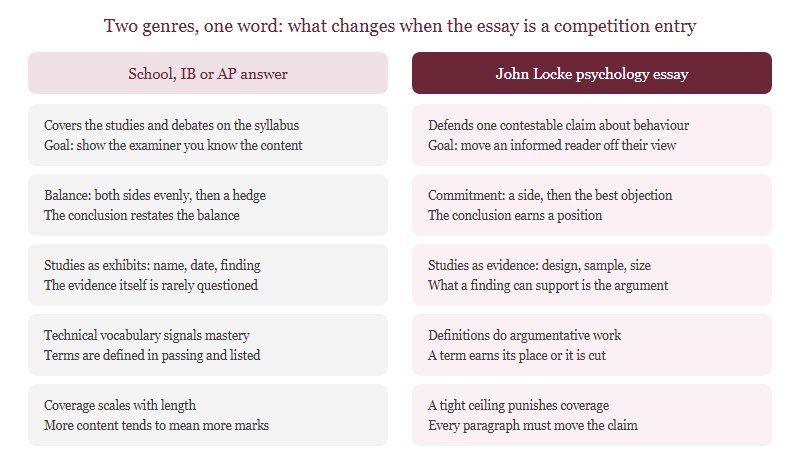
Three Ways Psychology Entries Go Wrong
Across the drafts our team reads each cycle, psychology entries fail in three recognisable ways. None of them is a knowledge problem. All three are genre problems.
The textbook recital. The essay walks through the standard treatment of a topic: definitions, key theories, two or three named studies, then an evaluation paragraph of the “strengths and limitations” kind. It is competent and completely inert. Nothing in it could have come out differently. A reader finishes knowing what the field says and nothing about what the writer thinks.
The study-dump. A chain of famous demonstrations — obedience, conformity, memory distortion — each summarised in three sentences and then abandoned. The essay reads as a museum tour. The tell is that each study is used once and never returns; a study that genuinely supports your argument should come back when you meet the objection.
The pop-psychology thesis. A self-help register creeps in: attention spans are collapsing, everybody should meditate, screens are rewiring the adolescent brain. These claims are not necessarily wrong, but they arrive without the evidence bridge that makes them arguable, and they are precisely the claims a psychologist has seen overstated most often. If your thesis could run as a magazine headline, tighten it until it could not.
The Claim Ladder: Choose a Thesis Your Evidence Can Reach
The single most useful move we teach psychology entrants is to place the intended claim on a ladder before writing a word. Each rung demands a different kind of evidence, and most weak essays are weak for one reason: the writer has promised a rung-four conclusion while holding rung-two evidence.
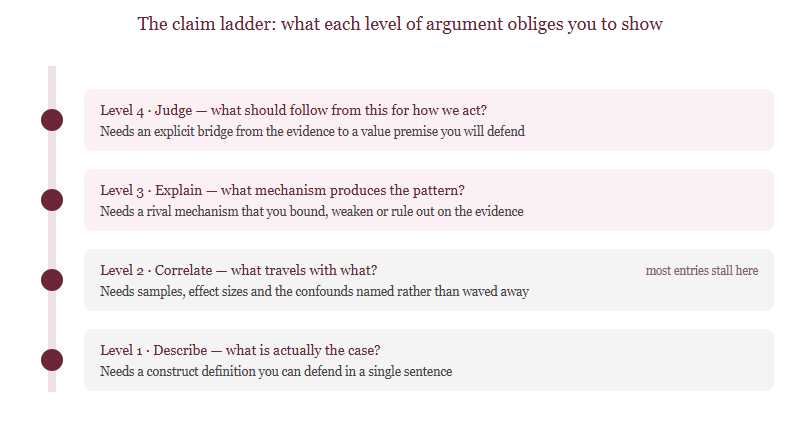
Two practical consequences follow. First, signal which rung you are on inside the first 150 words, so the reader knows what standard to hold you to. Second, if you cannot pay for rung four, do not promise it: an essay that establishes a mechanism rigorously and then states explicitly what further evidence would license the policy conclusion is stronger than one that leaps and hopes nobody notices.
Evidence Discipline After the Replication Crisis
Psychology is the category where an essay's handling of evidence is most visible to a specialist, because the field spent the last decade auditing itself in public. A candidate who cites a canonical demonstration as settled fact tells the reader something unintended. A candidate who cites the same demonstration, notes that its replication record is contested, and shows why the argument survives anyway, tells the reader something else entirely. The table below is the checklist we hand psychology entrants before they draft.
| The claim you want to make | What would actually settle it | What your essay must concede |
|---|---|---|
| “X causes Y in everyday life” | Randomised or well-identified evidence in a setting that resembles ordinary life | The lab-to-life gap: effects measured under controlled conditions routinely shrink outside them |
| “This effect is universal” | Replication across populations, not one convenience sample of university students | Sample composition, and that cross-cultural evidence is thinner than textbook treatments imply |
| “The effect is big enough to matter” | Effect sizes and base rates, read alongside the scale of the intervention proposed | Statistical significance is not practical significance — and small effects can still be real |
| “This classic study shows Z” | The original design plus what later re-analyses and replication attempts found | Several canonical demonstrations have contested records; an argument should not rest on one |
| “Therefore we should do W” | Evidence that the intervention transfers, plus a stated value premise | You are now making a normative claim, and it needs its own defence, not a borrowed one |
Notice what the third column is doing. Conceding is not weakness here; it is the move that buys authority. A reader who sees you name the limitation before they can raise it reads the rest of the essay more generously, because you have shown that you know what your evidence is worth. Students trained in exam systems find this counter-intuitive: at school, admitting a weakness usually costs marks.
A Reading Ladder Built Over Months, Not Weeks
Psychology punishes late starters more than most categories, because the evidence layer is where the marks are, and familiarity with a literature cannot be faked in a fortnight. The version we recommend to students beginning a new cycle spreads the reading across roughly four months of ordinary school terms — a few hours a week, not a summer sprint.
- Month one — vocabulary. One serious textbook chapter and two review articles in your area. You are buying the ability to use terms precisely, nothing more. Do not choose a thesis yet; you do not know enough to choose well.
- Month two — the empirical core. Three to five primary papers, read methods first: who was sampled, how many, what was manipulated, what was measured, how large the effect was. Reading only abstracts and discussion sections is the habit that produces study-dump essays.
- Month three — the opposition. Deliberately find the best published critique of the position you are drifting towards. If no such critique exists, either your claim is uncontroversial — and so not worth arguing — or you have not looked hard enough.
- Month four — draft, then cut. Draft long, then cut to the ceiling. Most of what disappears is background you were attached to because it took effort to learn.
Keep reading notes in four columns rather than as prose summaries: claim / evidence offered / limit of that evidence / how it bears on my thesis. The fourth column is what makes writing fast later, and it is the one nearly everybody omits. Students in IB and UK-curriculum schools in China often have workable access through school subscriptions and open-access repositories; test that access in month one, not in month four with a deadline in view.
What We See in Our Own Entrant Group
A first-party note, offered as evidence of coaching experience rather than as any kind of prediction. In the 2026 cycle, the entrants we worked with produced 86 shortlisted essays and 76 global awards across categories, according to Hanlin's internal records, reported here de-identified and in aggregate. Results vary enormously between students and between cycles, nothing here is a promise, and no competition result causes a university offer.
What the strongest drafts in that group had in common is duller than students expect. They stated their claim in the opening paragraph rather than building towards it; they spent more than half their length on a single mechanism instead of touring four; and they lost the least in editing, because they had never padded. The weakest drafts were not less knowledgeable. They were essays whose authors had read widely and then refused to choose.
Two closing pointers. If your idea keeps drifting towards states, institutions or conflict, it may belong in a different category altogether — our International Relations guide shows how the same placement problem plays out next door. And if you are in the younger age band, check the Junior Prize route before defaulting to a senior category, since eligibility and expectations differ; the current age rules are on the Institute's site.
Questions Students Ask
Do I need to run an experiment for the psychology category?
No. It is an argumentative essay; your evidence is published research and analysis. Confirm current rules on johnlockeinstitute.com.
Can a psychology idea be written in another category?
Often yes. A claim about mind and behaviour can sit in Philosophy or Public Policy — place it by the question you actually answer.
How many studies should I cite?
Fewer than you think. Three or four interrogated properly beat a dozen named in passing, because depth of use is visible to a judge.
Is IB or AP Psychology enough preparation?
It gives vocabulary, not the genre. School answers reward coverage and balance; a competition essay rewards one claim, defended.
This is an independent guide operated by Hanlin Education for China-based international-school students. We are not affiliated with, endorsed by, or sponsored by the John Locke Institute. Questions, categories, word limits, formatting rules, eligibility ages, fees and deadlines are set by the Institute and change between cycles — always confirm current details on johnlockeinstitute.com before acting on anything here. Factual errors reported to our editorial desk are corrected within 7 working days.