

Politics, Public Policy and Economics look like three doors into the same room. They are not. Each expects a different unit of analysis, a different kind of evidence, and a different sort of conclusion, and the commonest way a knowledgeable student loses marks is by writing an excellent essay of one type under a question of another. This guide gives you a placement test, and takes one topic through all three categories so the difference is visible.
A structural point first, because it changes how you should read everything below. You do not invent a title for a John Locke entry: each category comes with its own published set of questions, and you answer one as written. So “choosing a category” really means deciding which category's questions your interests and reading can serve. The current question lists, the rules on entering more than one category, and every deadline, age rule and fee detail are published by the Institute — check them on johnlockeinstitute.com before you build a season around any of this.
Why These Three Overlap — and Why Misplacement Is Expensive
All three categories deal with how a society organises itself, so the same real-world subject — housing, taxation, migration, technology regulation — shows up in all of them. What differs is the question being asked about that subject.
- Politics asks about power, authority and legitimacy: who may decide, on what basis, and what follows for how institutions should be arranged.
- Public Policy asks about instruments and outcomes: given a goal, which mechanism achieves it, at what cost, with what side effects, and how we would know whether it worked.
- Economics asks about behaviour under scarcity: what happens when people and firms respond to a change in prices, incentives or constraints, and who ends up better or worse off.
The cost of getting this wrong is that a reader who expects one kind of argument receives another, and the essay reads as though it has missed the point — even when everything in it is true. A Politics question answered with a cost-benefit analysis has quietly assumed away the question of who has the right to impose the costs. An Economics question answered with a moral case has skipped the part where you show what people actually do when the rule changes. Neither essay is wrong. Both are misaddressed.
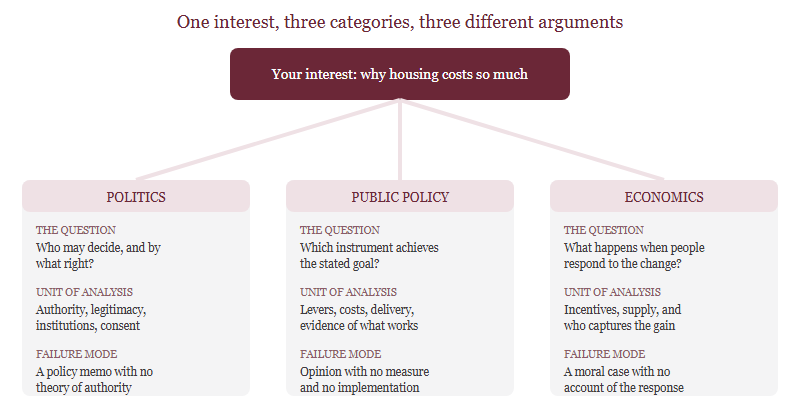
One Topic, Three Theses
Take a single situation: a large city where housing has become unaffordable, and the government is considering intervening. Here is what a strong essay looks like in each category. Every thesis below is illustrative — written by us to show the contrast, not drawn from any official question list.
| Category | An illustrative thesis | Evidence you must bring | What you may safely leave out |
|---|---|---|---|
| Politics | Land-use decisions should rest with the wider region rather than with existing residents, because the current arrangement gives a veto to those least affected by scarcity | An account of legitimate authority; who bears costs versus who votes; institutional design and its history | Fine-grained cost modelling — you need the shape of the trade-off, not the arithmetic |
| Public Policy | Of the available instruments, relaxing supply constraints outperforms demand-side subsidy, judged against a stated affordability measure over a decade | A named goal and metric; comparison of at least two instruments; implementation constraints; evaluation evidence | Deep political theory — legitimacy is assumed, and the argument is about what works |
| Economics | Where supply is constrained, a purchase subsidy is substantially captured by existing owners rather than by the buyers it targets | Incidence reasoning; elasticity of supply; expectations; distributional effects and the empirical record | Prescription — you may stop at what happens, without saying what should be done |
Read down the second column and the pattern is clear. The Politics essay could be right about legitimacy while being agnostic about which instrument works. The Public Policy essay could recommend the right instrument while ignoring who has the right to impose it. The Economics essay could be entirely correct about incidence and still decline to recommend anything at all. Each is complete as an answer to its own question, and each would look incomplete in the wrong category. That is the whole lesson.
The Placement Test
When a student arrives with an interest rather than a question, we run three diagnostics in this order. The order matters: it starts with the evidence you actually hold, not with the subject you find most interesting.
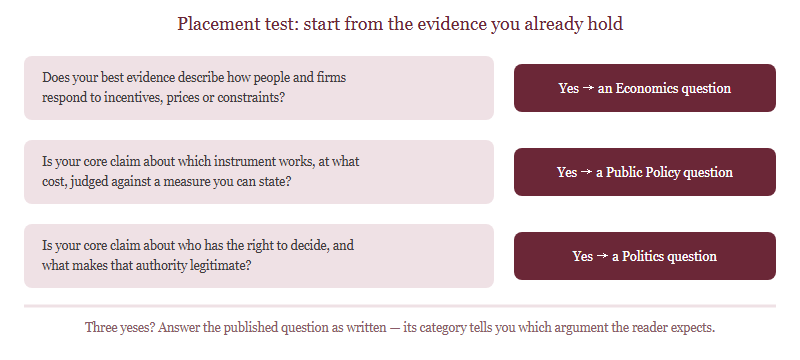
One refinement worth knowing. If your idea keeps pulling towards states, borders, war or treaties, you may be in a fourth room altogether: International Relations has its own logic, and our International Relations guide sets out what that category expects. The disambiguation habit is the same; only the boundary moves.
What Changes in Your Reading
Category choice is not only a writing decision — it determines what you should have been reading for months beforehand, which is why deciding late is expensive.
- Politics requires theory as a working tool, not decoration. You need to be able to use a concept — consent, representation, liberty, justice — precisely enough that a specialist recognises which tradition you are drawing on and why.
- Public Policy requires evaluation literature: attempts to measure whether a real intervention did what it promised. This is the category where you must be comfortable with the honest answer that the evidence is mixed, and say what would settle it.
- Economics requires the mechanism vocabulary — incidence, elasticity, general versus partial equilibrium, unintended response — and the discipline of following an effect past its first round. Formal modelling is not what this category is testing; clear reasoning about incentives is.
Whichever you choose, the underlying architecture is shared: a contestable claim, evidence that bears on it, and the best objection answered rather than dodged. We work through that spine in detail in our guide to how a winning entry is built, and it holds in all three categories — what changes is what counts as evidence.
Two Cautions Before You Commit
Do not pick by guessing where the field is thin. Students regularly ask which category is “easiest” on the assumption that a less popular one is a softer route. Entry patterns and question difficulty shift from cycle to cycle, and neither is something you can observe in advance from outside; and we have not found per-category odds published anywhere you could plan around. The reliable strategy is to enter where your evidence is strongest, because that is the only variable you control.
Do not let the category override the question. Occasionally a published question sits in Politics but sounds like policy, or sits in Economics but invites a normative judgement. Answer the question as written. Its placement is a signal about which kind of argument the reader expects to see doing the heavy lifting, not a licence to rewrite the prompt into the one you prepared for.
A first-party note, offered as evidence of coaching experience rather than as a prediction of any kind. In the 2026 cycle, the entrants we worked with produced 86 shortlisted essays and 76 global awards across categories, per Hanlin's internal records, reported de-identified and in aggregate. Results vary, nothing here is a promise, and no competition result causes a university offer. The pattern we would highlight from that group is narrow: category regret — the sense that the idea would have gone better next door — almost always appeared in students who chose a category in the final month, and almost never in those who chose while the reading was still being built. Younger writers deciding where to start should also read our Junior Prize guide before assuming a senior category is the right entry point.
Questions Students Ask
Can I enter more than one category?
The Institute publishes its own rules on multiple entries. Check johnlockeinstitute.com before planning a multi-category season.
Which of the three is easiest?
None reliably. Entry patterns and question difficulty shift each year, so choose where your evidence is strongest, not where competition looks thin.
Does the Economics category require mathematics?
Not formal modelling. It requires clear reasoning about incentives and trade-offs, with the empirical evidence handled honestly.
My question is in Politics but sounds like policy. What do I answer?
The question exactly as written. Its category tells you which kind of argument the reader expects to carry the essay.
This is an independent guide operated by Hanlin Education for China-based international-school students. We are not affiliated with, endorsed by, or sponsored by the John Locke Institute. Questions, categories, word limits, formatting rules, eligibility ages, fees and deadlines are set by the Institute and change between cycles — always confirm current details on johnlockeinstitute.com before acting on anything here. Factual errors reported to our editorial desk are corrected within 7 working days.