
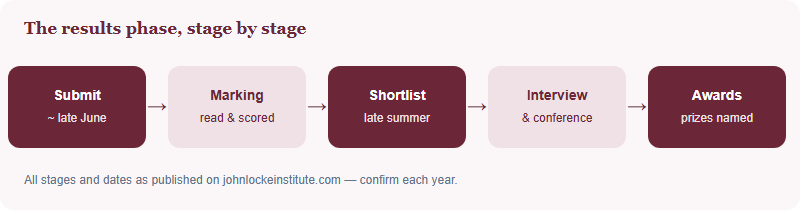
You have hit submit on your John Locke essay — so what now? After the late-June deadline, every entry is read and scored, a shortlist is released later in the summer, and shortlisted candidates move into an interview and awards stage centred on the Institute’s Oxford events, with prizes announced after that (all dates per johnlockeinstitute.com). This guide walks each stage and, more usefully, shows what you can still influence.
How your essay is read — and what markers reward
Before you refresh your inbox, it helps to know what your essay is now up against. John Locke essays are assessed on the quality of the argument, not the quantity of facts. Assessors tend to reward a clear, contestable thesis; reasoning that anticipates and answers the strongest objection; evidence used precisely rather than decoratively; and prose that stays disciplined across an analytical essay of around 2,000 words (confirm the exact word limit and rules on the official site).
Originality here comes from the shape of the argument, not from a gimmick or an exotic topic. Across a global field, the essays that travel are the ones that take a genuine intellectual risk and defend it well. If you want to reverse-engineer those qualities while you wait, our breakdown of what a winning essay’s structure tends to look like is a useful mirror to hold up to your own submission.
The shortlist: when it lands and how you’ll hear
After the late-June deadline, the marking window runs through the summer and a shortlist is released later in the season. Exact dates change each year and are posted on the official site, so treat any specific date you see on a forum as unconfirmed until you check the source. Notification comes through the Institute’s own channels and the email address you registered with — keep that inbox (and its spam folder) monitored, and do not assume silence is a verdict.
Two honest expectations help here. First, the field is global and very large, so a shortlist place is already a strong outcome — thousands write, far fewer are shortlisted. Second, no news during marking is not bad news; the process simply takes time. Refreshing rankings threads will only raise your blood pressure.
If you’re shortlisted: interview, conference and awards
Per the competition’s published process, shortlisted candidates progress into an interview and awards stage connected to the Institute’s academic conference in Oxford. The precise format, scheduling, and any attendance or travel details are set out on the official site and change year to year, so read those carefully rather than relying on last year’s account.
Whatever the exact format, the intellectual demand is predictable: you will be asked to stand behind your own essay. An interview at this level is not a memory test or a general-knowledge quiz — it is a conversation about the argument you chose to make. The most useful preparation is therefore to become the sharpest critic of your own work:
- Reread your essay slowly, as if you were marking a rival’s.
- Write down the three strongest objections a specialist could raise.
- Decide, honestly, what you would change if you could rewrite it now.
- Know your sources well enough to explain why you cited each one.
- Practise thinking out loud — clarity under mild pressure is a skill.
Prizes at the awards stage span subject-level and overall recognition, and the categories and any scholarship values are listed on the official site. Younger writers should note that the Junior Prize sits alongside the senior categories, so a strong early result is a real credential in its own right.
If you’re not shortlisted this year
Most entrants are not shortlisted — that is arithmetic, not a verdict on your ability. The healthiest frame is to treat this cycle as a data-gathering run. The essay you produced is now a reusable asset in three ways: it is a genuine writing sample, a super-curricular talking point you can discuss with conviction, and a scaffold you can rebuild into a sharper argument next time.
A quick, honest post-mortem is worth more than a fresh start. Which pitfall capped your score — a thesis that was too safe, a counterargument you dodged, or drift away from the exact question? Diagnosing that now is how a near-miss becomes a shortlist. If you are exploring where to aim next, subject-specific guides such as our International Relations breakdown show how the demands differ from one category to another.
Your calm-waiting checklist
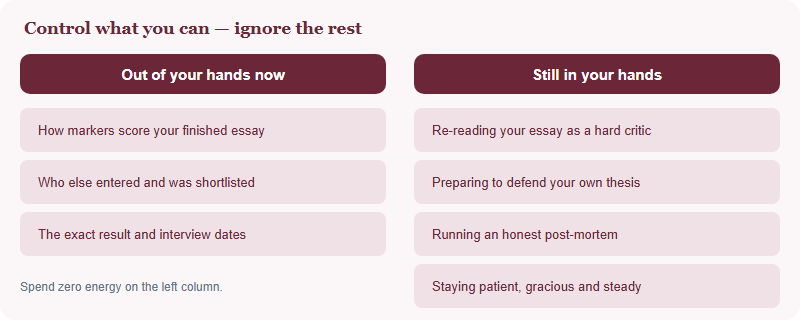
Anxiety in the waiting weeks usually comes from confusing what you can control with what you can’t. Sorting the two is the fastest way to feel — and act — sensibly.
| Stage | What happens | Timing (per official) | What you can influence |
|---|---|---|---|
| Marking | Essays read and scored on argument | Through summer | Nothing now — it is submitted |
| Shortlist | A subset is invited forward | Late summer | Monitor your registered email |
| Interview & conference | Shortlisted candidates engage in Oxford | Late summer / autumn | Prepare to defend your thesis |
| Awards | Subject and overall prizes announced | Per official site | Turn up prepared; stay gracious |
| Next cycle | New questions released | Following academic year | Run an honest post-mortem |
A first-party note on scale, offered honestly: in the 2026 cycle, students Hanlin coached recorded 86 shortlist places and 76 global awards (these are Hanlin’s own de-identified coaching figures, not official Institute statistics, and no result guarantees a university place). We share them only to make one point concrete — the shortlist-to-awards phase is a real, navigable process, and preparing for the interview conversation is time far better spent than refreshing a results page.
Frequently asked questions
When is the John Locke shortlist announced?
Marking runs through the summer and the shortlist is released later in the season; the exact dates are posted on johnlockeinstitute.com each year.
How will I know if I’m shortlisted?
Through the Institute’s official channels and the email you registered with, so watch your inbox and spam folder and confirm on the official site.
Does a shortlist place mean I have won?
No. A shortlist is an invitation into the interview and awards stage; subject and overall winners are decided after that.
What should I do while I wait for results?
Nothing about marking is in your hands now, so reread your essay, note what you would improve, and prepare to defend your argument.
This is an independent guide operated by Hanlin Education for China-based international-school students. It is not affiliated with, endorsed by, or sponsored by the John Locke Institute. Competition rules, dates, eligibility, prizes and process can change — always confirm current details on johnlockeinstitute.com. Spotted an error? We correct verified issues within 7 working days.