
In the 2026 cycle the John Locke shortlist rate was 17.5% (per Hanlin’s season report; confirm current figures on johnlockeinstitute.com). That number is usually misread as a lottery. It is closer to two separate gates: the shortlist rewards competence — on-question, inside 2,000 words, evidence handled properly — while the prizes reward an argument a senior academic had not already met. Different gates, different work.
What a 17.5% shortlist rate actually tells you
A headline rate is a property of the whole submission pool, not of your essay. And the pool is not uniform. Every year a large share of entries are started too late, drift away from the set question, run past the word limit, or read like a well-organised encyclopaedia entry with no claim in it. Those essays are removed quickly, and they are the reason the denominator is so large.
So the honest way to use the number is this: 17.5% is the base rate for an average entry. Your own probability is conditional on how many of the standard failure modes you have already eliminated before an examiner reads a sentence. Removing them is process work — planning, question analysis, drafting cycles, a real source base — and process is learnable and repeatable. That is why a prepared cohort’s shortlist count tends to be steadier year on year than its award count.
It also helps to be precise about what being shortlisted buys you. Per the organiser, shortlisted essayists are invited to the academic conference and awards dinner in London (2-4 October 2026 for the 2026 cycle) and receive certificates. That is a genuine credential and a genuine audience. It is not the same object as a prize, and treating the two as interchangeable is how students end up disappointed by a real achievement.
The published prize structure for 2026, per johnlockeinstitute.com: a Grand Prize for the best essay overall — an honorary Junior Fellowship together with a US$10,000 scholarship, and in each subject category first, second and third places worth US$5,000, US$2,000 and US$1,000 scholarships respectively, with senior and junior categories awarded separately. Values, eligibility and the award tiers can change between cycles — confirm on the official site before you quote them to anyone.
Two gates, two completely different questions
The organiser publishes what the judges assess: knowledge and understanding of the relevant material, competent use of evidence, quality of argumentation, originality, structure, writing style and persuasive force. Read that list twice and you will notice it contains two kinds of thing.
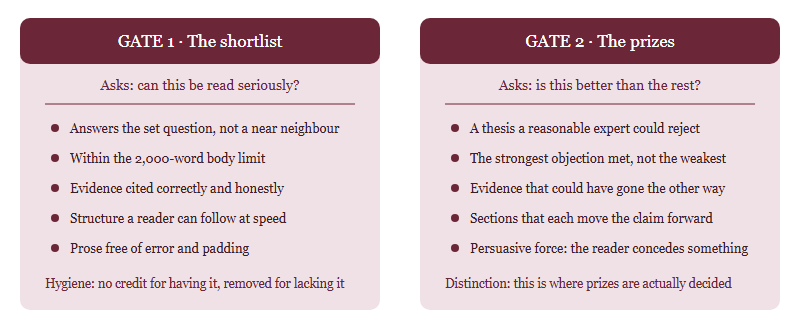
- Gate 1 — the shortlist. The question is “can this be read seriously?” It is an elimination gate, and it is mostly decided by knowledge, competent evidence handling, structure and clean prose. Almost everything here is a hygiene factor: you get no credit for having it, and you are removed for lacking it.
- Gate 2 — the prizes. The question is “is this better than the other essays that can also be read seriously?” This is a selection gate, and it turns on originality, quality of argumentation and persuasive force. Nobody wins on tidiness.
Most students prepare hard for Gate 1 and then assume that more of the same effort gets them through Gate 2. It does not. Past a certain point, extra polish has almost no marginal value, while a sharper thesis has an enormous one.
The same criterion, read twice
Here is the practical version of that split. Each published criterion has a shortlist-level interpretation and an award-level interpretation, and the second is not simply “more” of the first — it is often a different move altogether.
| Published criterion | What clears the shortlist | What reads like award-level work |
|---|---|---|
| Knowledge and understanding | You accurately describe the main positions in the debate. | You know where the debate is genuinely unsettled, and you write from inside that gap. |
| Competent use of evidence | Claims are supported; sources are real, relevant and correctly cited. | Evidence is selected because it was capable of refuting you, and you say what would have changed your mind. |
| Quality of argumentation | The reasoning is valid and the steps connect. | The load-bearing step is identified, defended, and tested against the best counter-case. |
| Originality | The framing is not copied from the first page of search results. | The essay makes a distinction, comparison or application the judge has not seen this year. |
| Structure | Intro, body, conclusion; signposted; nothing is lost. | The order of sections is the argument — reorder them and the case collapses. |
| Style and persuasive force | Clear, grammatical, unpadded. | Economical enough that the reader spends their attention on the idea, and ends up conceding a point. |
What our own cohort numbers do — and do not — show
We publish our record because it is the only thing on this page that is genuinely first-hand. All figures are de-identified, reported per Hanlin across Hanlin and its partner programme, and results vary; they are our cohort’s counts, not official competition statistics, and they are never tied to any university admission outcome.
| Cycle | Shortlisted (our cohort) | Went on to global awards | Note |
|---|---|---|---|
| 2022 | 45 | 12 | Including 10 High Commendations |
| 2023 | 108 | Not separately reported | Largest shortlist count in our record |
| 2024 | 95 | 45 | — |
| 2025 | 86 | 76 | — |
| 2026 | 57 | Awards phase ongoing at time of writing | Competition-wide shortlist rate reported as 17.5% — per Hanlin; confirm on johnlockeinstitute.com |
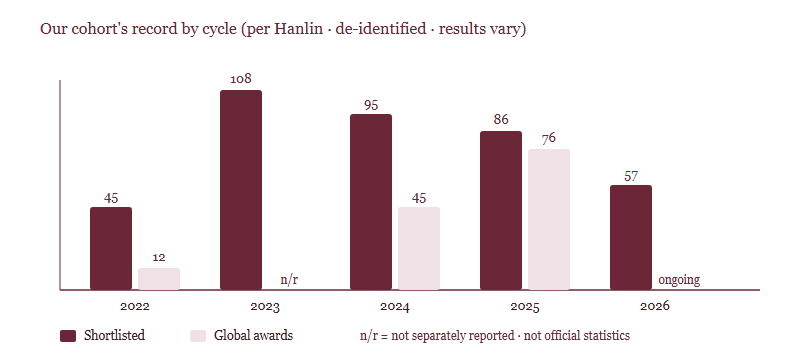
What the pattern is fair evidence for: shortlisting responds to preparation. It is the part of the funnel where teaching a process — question analysis, drafting discipline, source handling — visibly moves the number. What it is not evidence for: any promise about your own result. Awards are lumpier because they depend on whether one student had one genuinely interesting idea that year, and no programme can manufacture that on schedule. Anyone who tells you otherwise is selling certainty that does not exist.
Five upgrades that move an essay from “read again” to “worth a prize”
- Make the thesis costly. If a well-informed reader could not disagree with your central claim, you have written a summary. “Country X's policy had mixed effects” costs nothing. “The mechanism usually credited for the effect cannot have produced it, because the timing runs backwards” costs something — and can be wrong, which is the point.
- Steelman the strongest objection. Most essays answer the objection the writer finds easiest to beat. Award-level essays name the objection a specialist would actually raise, state it in its most persuasive form, and then either defeat it or concede a limited version of it. Conceding precisely is a sign of confidence, not weakness.
- Use evidence that could have gone the other way. Three studies that agree with you prove less than one careful case that might have refuted you and did not. Say explicitly what observation would have counted against your claim — that single sentence changes how the whole essay reads.
- Let the structure carry the argument. Sections should be named by claims, not topics. If your headings could be shuffled without loss, the essay is a folder, not a case. Our breakdown of how a winning John Locke essay is built — thesis, counter-argument and structure works through this in detail.
- Spend the word budget on reasoning. Per the organiser, the body is capped at 2,000 words; diagrams, tables, endnotes and the bibliography sit outside that count, while in-text citations count inside it. Footnotes are not permitted; endnotes and a bibliography are. That makes referencing style a word-budget decision as much as an academic one — every parenthetical citation is words you are not spending on the argument.
A pre-submission self-audit
Run this on your own draft before anyone else reads it. Any “no” is a Gate 1 or Gate 2 problem you can still fix.
- Can you state your thesis in one sentence, out loud, without reading it?
- Could a well-informed reader disagree with that sentence?
- Does every section name a claim rather than a topic?
- Is the strongest objection in the essay — and is it stated fairly?
- Can you say what evidence would have changed your mind?
- Have you read every source you cite, well enough to discuss it unprompted? Some candidates are invited to an online interview, so this is a practical requirement, not a moral one.
- Is the body inside the word limit with in-text citations counted?
- Is every word of the essay yours? Others may point out errors and weaknesses, but per the organiser no part of the essay may be written by anyone else, and the institute uses various means to detect plagiarism, contract cheating and undeclared AI use.
Two closing notes on scope. If you are fourteen or under, the same logic applies but the entry route differs — see our guide to the John Locke Junior Prize. And if you are choosing between subjects, the originality bar is easier to clear in categories where you can bring genuine regional or comparative knowledge; our International Relations subject guide shows what that looks like in one category. Registration windows, deadlines, fees and award values differ by cycle — confirm all of them on johnlockeinstitute.com before you plan around them.
FAQ
Is a 17.5% shortlist rate my personal chance of being shortlisted?
No. It is the base rate across the whole pool. Your rate depends on which common failure modes your essay has already removed.
Does being shortlisted count as an award?
They are different. Shortlisting brings a conference invitation and certificate; prizes are the published scholarship tiers. Confirm current details on johnlockeinstitute.com.
What is the single biggest difference between shortlisted and awarded essays?
A thesis a reasonable expert could reject, defended against the strongest objection — not more polish on a safe, descriptive claim.
Do citations count toward the 2,000 words?
Per the organiser, in-text citations count; diagrams, tables, endnotes and bibliography do not. Footnotes are not permitted. Verify on the official site.
This is an independent guide operated by Hanlin Education for China-based international-school students. We are not affiliated with, endorsed by, or sponsored by the John Locke Institute. Rules, dates, fees and award values change between cycles — confirm current details on johnlockeinstitute.com. Any factual error reported to us is corrected within 7 working days.