

A John Locke History essay is not a story about the past. It is an argument about causation, significance or judgement, assessed on exactly the same criteria as Philosophy or Economics: knowledge and understanding of the relevant material, competent use of evidence, quality of argumentation, originality, structure, writing style and persuasive force. The most common way strong history students lose is by writing beautifully — and narratively — when the question asked them to decide something.
What a history question is actually asking
History is one of the ten categories published by the organiser, alongside Economics, International Relations, Law, Philosophy, Politics, Psychology, Public Policy, Science & Technology and Theology. The set questions change every cycle and are published on johnlockeinstitute.com, so nothing here depends on a particular prompt. What does not change is that history questions come in a small number of shapes, and each shape demands a different kind of answer.
- Causal. “Why did X happen?” or “Was A the main cause of B?” The answer is a ranked claim about mechanisms, not a list of factors. If your conclusion is “a combination of factors”, you have described the question rather than answered it.
- Evaluative or significance. “How important was X?” or “Did X change anything?” Here you must supply a benchmark — important compared with what, measured over what period, by whose standard. Essays that skip the benchmark drift into praise or blame.
- Counterfactual. “Would B have happened without A?” This is the hardest shape and the most rewarding, because it forces you to specify a mechanism precisely enough to switch it off.
- Moral or interpretive. “Should we judge X by our standards or theirs?” These reward candidates who can hold two things at once: taking historical context seriously without collapsing into “everyone was a product of their time”.
Diagnose the shape before you research. It determines what counts as evidence, what your conclusion must contain, and which objection you are obliged to meet.
Narrative is the default failure mode
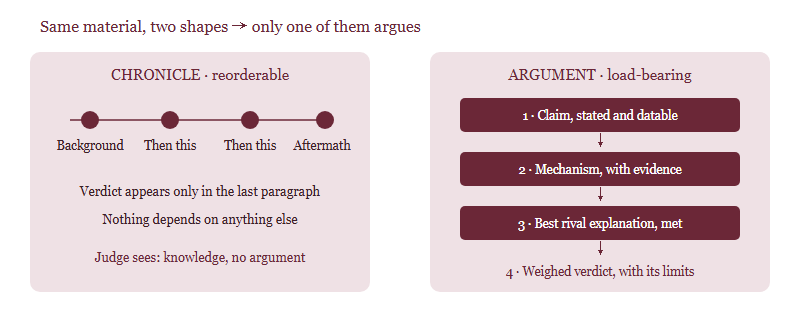
Chronology is comfortable. It gives you an order for the paragraphs, it feels like knowledge, and school history assessments often reward it. But a chronological essay makes an argument invisible: each paragraph reports what happened next rather than what follows from what. A judge reading for quality of argumentation has nothing to grip.
The test is simple. Take your section headings or topic sentences and shuffle them. If the essay still basically works, you have written a chronicle. In an argued essay, reordering breaks the case — because section three depends on section two having been established.
Three layers of evidence — and the one students skip
History has an evidence structure that other categories do not share, and handling all three layers is the clearest signal that a school-age writer has read like a historian.
| Layer | What it is | What it proves | Typical misuse |
|---|---|---|---|
| Primary | Documents, records, statistics, correspondence, speeches produced at the time | What was said, recorded or measured — and by whom, for whom | Quoted as neutral fact, with no account of who produced it or why |
| Secondary | Modern scholarship reconstructing and explaining events | The state of expert reconstruction, and where evidence is thin | Treated as a single settled voice: “historians agree that…” |
| Historiography | The record of how interpretations have changed, and why | That your reading is a position among positions, adopted for reasons | Omitted entirely — the layer most essays never reach |
Historiography is where originality is cheapest to obtain. You do not have to discover a new document to say something new; you can show that a long-standing interpretation rests on a source read in a particular way, and that a different reading is available. That move is fully within reach of a strong sixteen-year-old, and it demonstrates exactly the independence of thought the criteria reward.
One warning about the phrase “historians argue”. If you cannot name at least two historians who disagree with each other on your specific question, you are not describing a debate — you are describing a textbook. Naming the disagreement, and taking a side with reasons, is the difference.
Scoping a topic you can actually defend
Scope failure is the most expensive mistake in history writing, and it happens at the planning stage rather than the drafting stage. A set question is usually broad enough to invite a survey; answering it well almost always requires narrowing to a case you can evidence, then generalising carefully at the end.
The working rule we use with students is the one-case, one-mechanism test. Pick a single episode, institution, policy or text where the mechanism you care about is visible in the sources, and where at least two historians have taken different views. Then ask three questions before committing:
- Can I evidence it? Not “is there material about it”, but “can I reach the primary material and read it in the language it exists in, or in a named published translation?” If the answer is no, the case will collapse into secondary paraphrase.
- Is it contested? A case everyone agrees about leaves you nothing to argue. Contested cases hand you a ready-made counter-position — the thing the criteria reward you for meeting.
- Does the general claim survive the narrowing? If your case only supports a conclusion about one village in one decade, say so precisely and claim only that. A modest claim proved beats a grand claim gestured at, and examiners can tell the difference instantly.
Narrow scope also solves the word-limit problem before it appears. Students who choose a century need 400 words of context; students who choose a decade and a document need 150, and spend the difference on argument. When in doubt, take the smaller case and go deeper — depth is visible on the page in a way breadth never is.
Building a causal claim that survives
Most history essays make causal claims, and most make them one rung lower than they think. Each rung below asks more of your evidence and gives more back in credit.
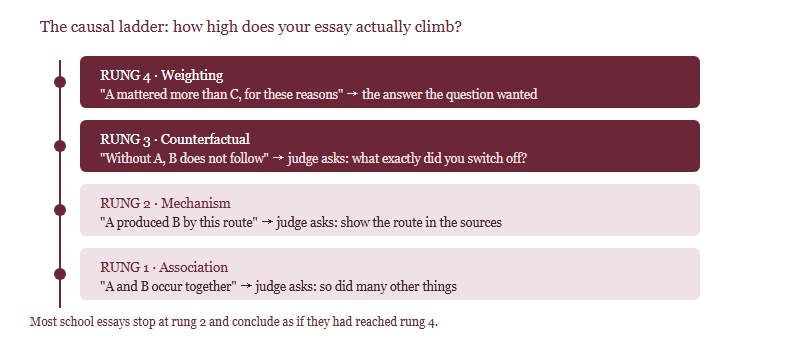
A practical rule for counterfactuals: keep them small and disciplined. “If the treaty clause had been drafted differently” is arguable, because you can trace the clause's effects through documented decisions. “If the war had never happened” is not an argument, it is a novel. The narrower the counterfactual, the more evidence can bear on it — and disciplined imagination is precisely what history examiners are looking for.
Four failure modes, and what a judge sees
| Failure mode | What it looks like on the page | What the judge concludes | Fix |
|---|---|---|---|
| The chronicle | Paragraphs organised by date; verdict only in the conclusion | Knows the material, has not answered the question | Rename every section as a claim; delete anything that does not defend one |
| Presentism | Judging actors solely by present-day standards, or excusing everything as “of its time” | Has not thought about the standard being applied | State the standard you are using and why it is the right one for this judgement |
| The single-school reading | One interpretive tradition presented as the consensus | Has read one book, or one summary of the field | Name a serious dissenting historian and answer them |
| Anecdote as proof | A vivid quotation carrying the weight of a general claim | Evidence is illustrative, not probative | Ask what the quotation is representative of, and show that it is |
A 2,000-word budget for a history essay
The body is capped at 2,000 words, with diagrams, tables, endnotes and the bibliography excluded and in-text citations included, per the organiser. That is tight for a subject where context feels obligatory — so decide the budget before drafting.
| Section | Words | Job |
|---|---|---|
| Opening | 150–200 | State the claim and the standard of judgement. No scene-setting, no “throughout history”. |
| Context | 200–250 | Only the facts a reader needs to test your claim. Everything else is decoration. |
| Mechanism | 500–600 | The route from cause to effect, evidenced from primary material. |
| Rival explanation | 350–450 | The strongest alternative, stated fairly, then weighed against yours. |
| Historiographical turn | 250–350 | Why the field has read this differently, and what your reading changes. |
| Verdict | 150–200 | The ranked answer, plus what would have changed your mind. |
Notice what has no budget line: a survey of everything you know. In history more than any other category, the discipline of exclusion is the skill being tested. The same structural logic — claim, mechanism, counter-case, weighted verdict — is set out in more general form in our guide to how a winning John Locke essay is built, and it transfers directly to neighbouring categories such as International Relations, where the evidence base differs but the argumentative demand does not. Younger writers entering the Junior Prize should apply the same shape at a smaller scale rather than reaching for a bigger topic.
Finally, the practical rules. Registration windows, submission deadlines, fees for late entry, eligibility by age, and the prize structure all vary by cycle and are published by the organiser — check them on johnlockeinstitute.com rather than relying on any guide, including this one. Footnotes are not permitted; endnotes and a bibliography are, which for a document-heavy history essay is a genuine advantage worth planning around.
FAQ
Do I need original archival research to do well in the History category?
No. Re-reading well-known sources against the standard interpretation is a realistic route to originality for a school-age writer.
Are counterfactual arguments acceptable in a history essay?
Yes, if they are narrow and evidenced. Switch off one specified mechanism and trace it; sweeping “what if” scenarios are not arguable.
How much background context should I include?
Only what a reader needs to test your claim. In a 2,000-word body, context beyond roughly 250 words usually crowds out argument.
What are the History category rules and deadlines?
History is one of ten categories; questions, dates, fees and prizes are published each cycle on johnlockeinstitute.com — confirm there before planning.
This is an independent guide operated by Hanlin Education for China-based international-school students. We are not affiliated with, endorsed by, or sponsored by the John Locke Institute. Set questions, categories, word limits, deadlines and prizes change between cycles — confirm current details on johnlockeinstitute.com. Any factual error reported to us is corrected within 7 working days.